
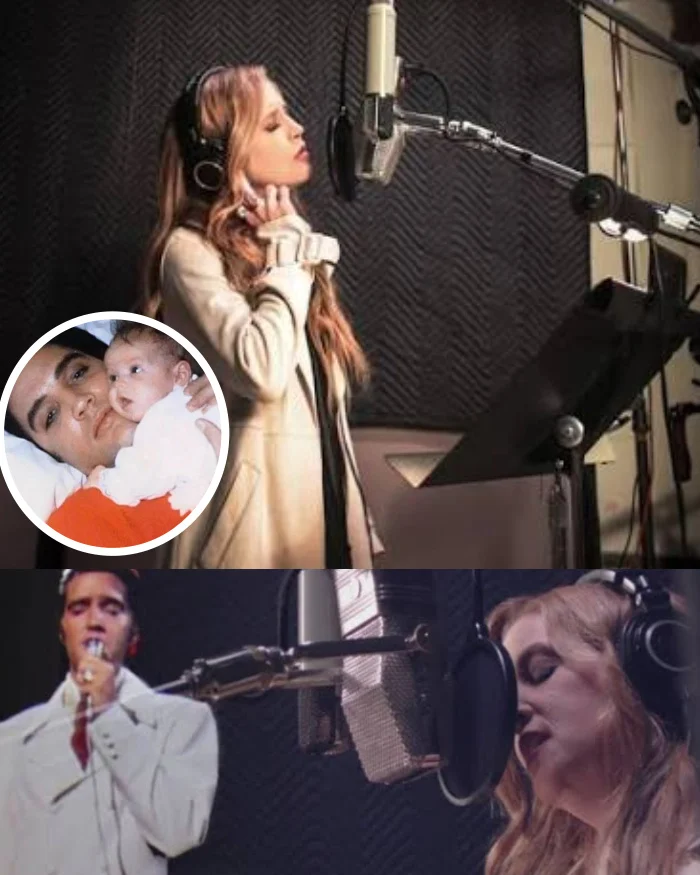
Fifty one years after Elvis Presley stepped into a Nashville studio to cut a devotional classic, his only child entered a vocal booth to answer him. Through a microphone and a pair of studio headphones, fifty one years of distance briefly vanished.
Lisa Marie did not replace the legacy of her father. She simply stood in the room and answered him.
The session took place in August 2018 during the production of Where No One Stands Alone, a fourteen track project celebrating the gospel repertoire that sustained Elvis throughout his life. Lisa Marie Presley co produced the collection. Rather than simply issuing remastered tapes, producers retrieved the master multi tracks from RCA Studio B in Nashville, recorded originally on May 25, 1966, and released in 1967.
Sound engineers carefully separated the original vocal channel of Elvis from the surrounding instrumentation, stripping away tape bleed and vintage room noise until his baritone stood entirely isolated in the studio monitors.
Lisa Marie Presley arrived at the studio to record her contribution, stepping up to the microphone to sing a direct harmony with that recovered vocal. She was nine years old when her father died in August 1977, leaving her with memories anchored in the quiet rooms of Graceland rather than concert halls.
For Elvis, sacred music had never been a career afterthought. Gospel was the music he turned to when the demands of fame wore him down. Even at the height of his touring fame in Las Vegas, he retreated to private hotel suites late into the night, sitting at upright pianos to sing hymns until daybreak. He also returned to that same spiritual sound at the Graceland piano late at night.
To recreate that specific sonic world, producers Andy Childs and Joel Weinshanker reassembled the surviving vocalists who had originally sung with him. Members of The Imperials, including Terry Blackwood, Armond Morales, and Jim Murray, alongside Bill Baize and Donnie Sumner of The Stamps Quartet, returned to stand behind the vocal mics.
For these veterans, standing at the recording console carried memories of grueling road schedules, backstage rehearsals, and the meticulous vocal phrasing Elvis demanded on religious arrangements. Decades earlier, they had matched their harmonies to his living voice. Now, they were tracking alongside his daughter as she answered his restored phrasing note for note.
Lisa Marie approached the recording during an intensely difficult personal period marked by health recovery and emotional rebuilding. She later described the experience not merely as a studio assignment, but as a direct channel to a father whose presence had long been mediated through public celebration and distant archives. The session became a moment of private reassurance.
Watching from the control room, the original backing vocalists saw a physical and musical resemblance that caught them off guard. Lisa Marie shared the instinctive pacing of her father, leaning into phrases with the same subtle and unforced weight that defined his quietest studio takes. Several of the elderly gospel singers wept quietly in the control booth as the combined vocals emerged through the speakers.
To accompany the track, the production team reviewed private 8mm and 16mm home reels preserved within the Graceland archives. The resulting video cut between contemporary black and white studio sessions and previously unseen color home movies of Elvis holding his infant daughter, carrying her across the Memphis lawn, and laughing away from public glare.
The visual contrast between the archival home movies and the modern studio monitors underlined what the recording achieved. It removed the overwhelming myth of an international icon and restored the central bond between a father and his child.
The preservation effort did not attempt to modernize the sound of Elvis with synthetic effects or trendy production choices. It relied on authentic analog separation, acoustic instrumentation, and the exact voices that had accompanied him on the stage decades before.