
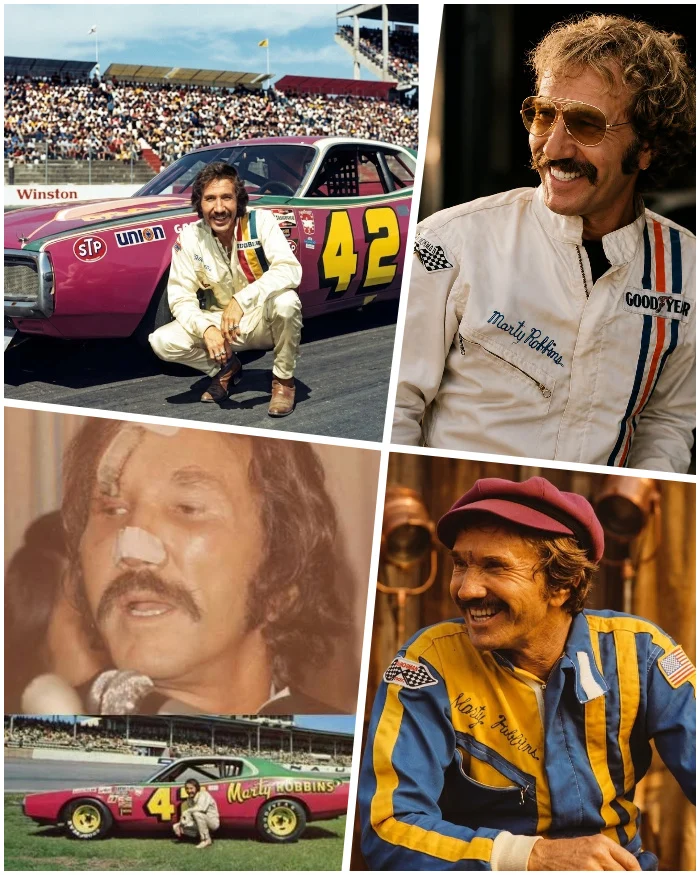
In a heart-stopping moment that redefined courage, country music icon Marty Robbins made a split-second decision that saved a life while sacrificing his own safety. On October 6, 1974, at Charlotte Motor Speedway, Robbins steered his pink and yellow #42 Dodge Charger into a concrete wall at 160 mph, not because of a mechanical failure, but to avoid striking Richard Childress, a young independent driver trapped sideways across the track.
It was the second lap of the National 500 when a multi-car pileup blocked the track ahead. Childress, whose driver’s side door was exposed to oncoming traffic, sat motionless in his stalled car. Robbins, approaching at full speed, had a split second to choose between hitting Childress’s car or the retaining wall. He chose the wall, knowing the impact would be brutal.
Witnesses recall the terrifying scene as the 49-year-old singer, already a veteran of the NASCAR garage, deliberately veered into the barrier. The collision destroyed the front end of his Dodge and sent him to the hospital with broken ribs, a fractured tailbone, chest injuries, and a deep gash between his eyes that required over 30 stitches. Yet, when asked about his facial scars, Robbins showed no concern for his stage career, only relief that no one had been killed.
“I looked down the track and saw Marty coming right at me,” Childress later recalled. “I knew if he hit me in the driver’s side I’d either be mangled badly or killed.”
Robbins’s selfless act was a testament to his character. Despite being a wealthy hobbyist in the eyes of some full-time independent drivers, he had already shown his commitment to the sport’s code. At the 1972 Winston 500 in Talladega, he disqualified himself for a minor infraction, proving he valued honesty over glory.
After the Charlotte wreck, no one ever teased Robbins about not working on his own cars again. “He could have killed himself moving into that wall that way,” Childress said. “In the split second that counted he chose to possibly give his life over hurting somebody else. I don’t think you can be much more of a man than that.”
Despite doctors advising him to give up racing to protect his health and voice, Robbins returned to the cockpit for the Daytona 500 in February 1975. He continued entering superspeedway races even after suffering heart trouble, logging 35 career starts and six top-ten finishes before making his final run in a Junior Johnson-built Buick Regal at Atlanta in November 1982, one month before he passed away at age 57.
Childress retired from driving in 1981 and built Richard Childress Racing into one of the most successful organizations in motorsport history, winning six Cup Series championships with driver Dale Earnhardt. In May 2021, nearly 47 years after the wreck at Charlotte, Childress entered his #8 Chevrolet in the Goodyear 400 at Darlington Raceway painted in the exact magenta and chartreuse colors of the #42 Dodge that Marty Robbins had steered into the wall.