
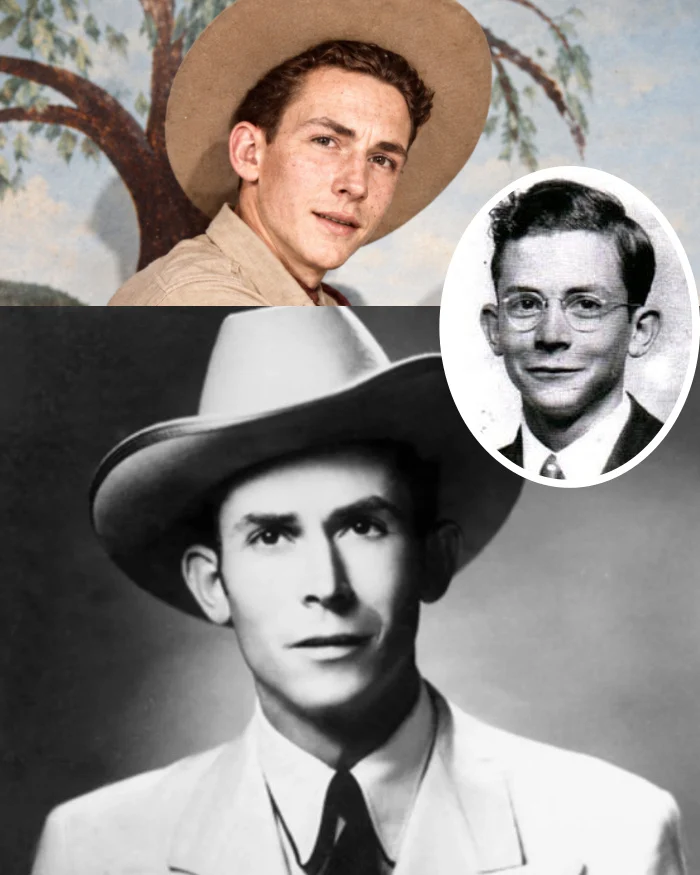
At New Year’s Day 1953, a frail body finally surrendered in the backseat of a pale blue Cadillac. The man inside was only 29. Yet the voice he left behind still carries the ache of a lifetime of pain.
Hank Williams appeared onstage as a tall archetype of southern masculinity. His cowboy suits and lanky frame hid a congenital spinal defect called spina bifida occulta. That hidden condition shaped his brief and brutal career.
He was born in September 1923 in Mount Olive, Alabama. His parents Lon and Lillie lived in deep poverty. His father suffered a brain aneurysm and later stayed in a Veterans Administration hospital. His strict mother raised him in a world of limited strength and constant suffering.
Pain in his back began when he was barely old enough to walk. It was never diagnosed or treated in the rural South. While other children ran and worked through the Depression, Hank was trapped inside an aching frame. The isolation carved a loneliness that would later pour into his songs.
After Lillie moved the family to Georgiana, Alabama, Hank found a cheap guitar. He sought out Rufus “Tee Tot” Payne, a Black street musician who saw the boy’s quiet intensity. Payne taught him blues chord structures and vocal timing. Music became the only doorway out of his physical prison.
By 1937 the family had moved to Montgomery. Hank played his guitar on sidewalks and earned a regular spot on WSFA radio. He formed the Drifting Cowboys and toured the region. A wartime job in a Mobile shipyard in 1943 worsened his back and introduced him to alcohol as temporary relief.
In 1946 Hank traveled to Nashville and met Fred Rose. The publisher recognized raw talent beneath an unpolished exterior. Rose edited his lyrics and helped secure a contract with MGM Records in 1947. Their partnership launched the modern era of country music.
Hits such as Move It On Over and Lovesick Blues emerged from grueling studio endurance. Standing before the microphone could become a battle. Williams often leaned against a stool while his damaged spine fought the simple act of staying upright.
A fall during a hunting trip in Tennessee in late 1951 turned chronic pain into acute crisis. He underwent spinal fusion surgery at Vanderbilt University Hospital. The procedure failed to restore the stability he desperately needed.
With touring demands and a body collapsing under pain, he turned to alcohol and prescription medication including chloral hydrate and morphine. That dependence was not celebrity recklessness. It was a lifelong attempt to silence the agony gripping his spine since infancy.
The self medication destroyed his marriage, his reliability, and his place on the Grand Ole Opry. His body gave out before another show in Ohio. He died on New Year’s Day 1953.
He gave the world an enduring musical legacy, yet never spent a single day inside a body that was completely healed.