
It was a scene of painful irony under the big top in Hendersonville, Tennessee. In late October 1994, four siblings sat among hundreds of strangers, bidding cards in hand, fighting to reclaim the pieces of their own childhood. Michael, Kathy, Joni, and Jimmy Twitty were not there to buy treasures; they were there to rescue the remnants of their father’s life from being scattered to the four winds.
Just a year earlier, Conway Twitty had died suddenly at 59 from a ruptured abdominal aortic aneurysm, following a performance in Branson, Missouri. The legendary country singer left behind a sprawling estate and a will that had been written a quarter-century earlier—before he married his fourth wife, Delores “Dee” Henry. That outdated document, signed in 1968, named only his four children as heirs, completely omitting his widow.
But Tennessee law had a provision for such an oversight. A surviving spouse could “dissent” from the will and claim a mandatory one-third of the net estate. Dee Henry, armed with this legal right, rejected the initial appraisals and demanded a public liquidation to maximize the estate’s cash value. That set the stage for a heartbreaking confrontation between the stepmother and the four children.
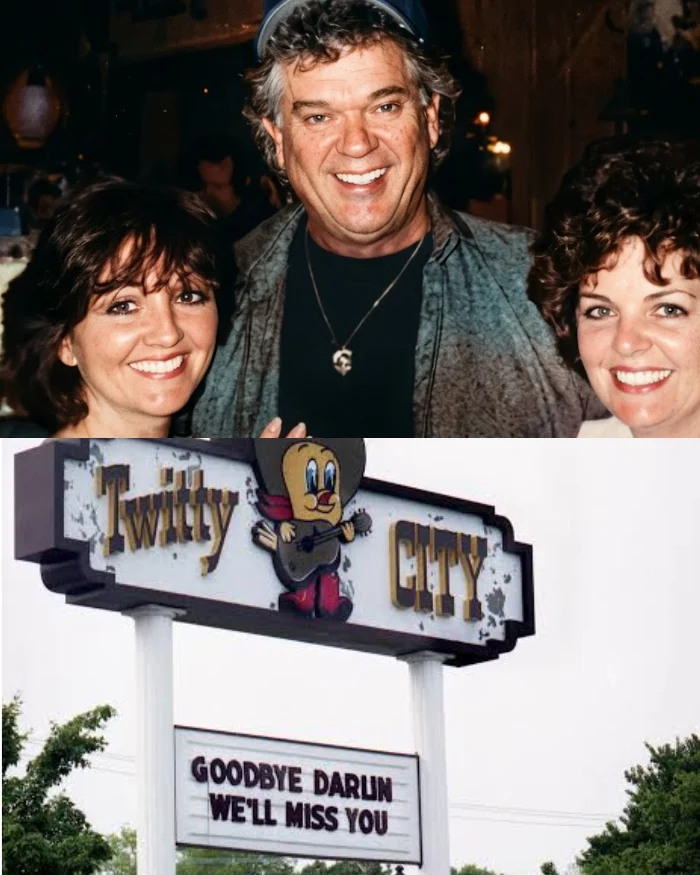
Twitty City was Conway’s dream, a nine-acre gated compound he built in 1982 for over $3.5 million. It was a haven where his mother and four children could live in separate homes within the same perimeter wall. But now, that dream was being dismantled piece by piece under the auctioneer’s gavel.
For three days, more than 2,000 lots went up for sale—gold records, stage suits, guitars, classic cars, tour buses, and personal items from Conway’s own bedroom and office. His reading glasses, house slippers, everyday shirts, handwritten letters, and notebooks were all tagged and sold.
“It was like watching strangers walk through your home, pricing the very chairs and tables where your father sat with you every day,”
Joni Ryles later recalled, her words capturing the raw grief of that event.
Fans wept as they bought small keepsakes for a few dozen dollars. Country music peers and family friends quietly bid on guitars and framed family photos, only to hand them back to the children outside the tent. The auction raised more than $1.2 million, but it couldn’t heal the loss of a sanctuary. The nine-acre property itself was sold to the Trinity Broadcasting Network for roughly $2.75 million, forcing the family to vacate the homes they had lived in.
The saga continued for decades. The network converted the grounds into Trinity Music City, using the auditorium for TV productions and gospel concerts)Skip. The mansion was eventually closed to the public in 2016 and later damaged by a tornado in 2023. When the network sought to demolish it, Joni Ryles stepped forward again, fighting to save the home her father had built. In January 2024, her plea was heard; the demolition plan was withdrawn, and the mansion was spared.
Conway Twitty spent decades on the road, gathering everything he earned into one Hendersonville sanctuary to keep his family together. In the end, it took his children—and a community—to keep that legacy alive.