
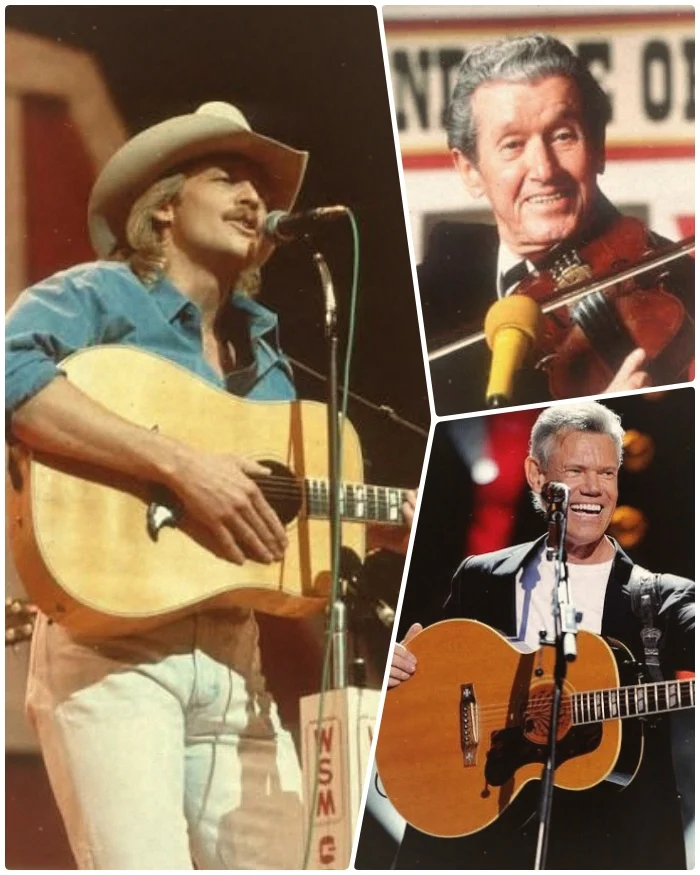
On a balmy June evening in 1991, the Grand Ole Opry stage witnessed a moment that would echo through country music history. An 87-year-old Roy Acuff, frail yet resolute, stood alongside Randy Travis to welcome a quiet Georgian into the institution’s sacred circle. That man? Alan Jackson, just six years removed from a forklift seat at a Kmart warehouse.
“I felt like I was standing on hallowed ground,” Jackson later recalled of his first step onto the six-foot oak circle, where heroes like George Jones and Hank Williams had once stood.
The journey to that circle began in Newnan, Georgia, where Jackson grew up in a modest home built around his grandfather’s old tool shed. Every Saturday night, he and his parents, Eugene and Ruth, huddled around the radio, listening to the Opry’s live broadcast—a ritual that planted a seed destined to bloom on that very stage.
In 1985, fate intervened at the Atlanta airport. Denise, Jackson’s wife and an Eastern Air Lines flight attendant, spotted Glen Campbell in the terminal. With nerves of steel, she approached the legend, shared her husband’s songwriting dreams, and walked away with a business card for Marty Gamblin, Campbell’s publishing manager. Gamblin’s simple advice? “Call me if you ever move to Tennessee.”
That October, the couple sold everything and drove to Nashville. Jackson took a job sorting mail in the TNN basement, just steps from the Opry House. By day, he pushed carts through hallways; by night, he scribbled lyrics in a cramped, dimly lit room, wrestling with the quiet fear that he might fail and have to crawl back home.
Everything shifted when Gamblin paired him with songwriter-producer Keith Stegall. Together, they crafted demos steeped in muscular honky-tonk—fiddle and steel guitar leading the charge—while Nashville’s labels chased pop-country crossover hits. Several majors passed, but in 1989, Tim DuBois, launching Arista Records’ Nashville division, took a gamble and signed Jackson as the label’s first flagship artist.
His debut album, Here in the Real World, dropped in February 1990, and its raw, traditional sound struck a chord. Just days later, on March 2, 1990, Cajun star Jimmy C. Newman introduced Jackson for his Opry debut. As he stepped onto that wooden circle—cut from the old Ryman Auditorium floor—Jackson felt overwhelmed, knowing his idols had stood on those very boards.
Fifteen months of meteoric success followed. The album went platinum, spawning four consecutive number-one singles. Opry brass noticed not just the chart-topping hits, but Jackson’s humility and his unwavering commitment to traditional instrumentation—a rare blend in an era of studio gloss.
Then came the night. On June 7, 1991, Randy Travis surprised Jackson onstage with a formal invitation to join the Opry cast. At the official induction, Travis stood beside Roy Acuff, the Opry’s founding pillar, then in the twilight of his life. Jackson, ever deferential, kept his words brief and pulled his white cowboy hat low, letting the moment speak for itself.
“My parents drove up from Georgia to watch from the wings,” Jackson once shared. “They valued this more than any trophy I could ever win.”
That induction became the anchor of Jackson’s career. For over three decades, he returned to the Opry stage, defending the fiddle and pedal steel sound on national broadcasts—including a memorable 1999 CMA duet with George Jones. In 2014, the Opry honored his 25th anniversary with a tribute concert, where peers credited him with keeping honky-tonk alive on nineties radio.
In 2021, Jackson revealed his diagnosis with Charcot-Marie-Tooth disease, a degenerative nerve condition affecting balance and mobility, slowing his touring. Yet the bond forged in 1991 remains unbroken. More than thirty years after sorting mail in the Opryland basement, the former forklift driver from Newnan still belongs to that wooden circle—where his name now sits beside the pioneers he once heard crackling through his parents’ radio.