
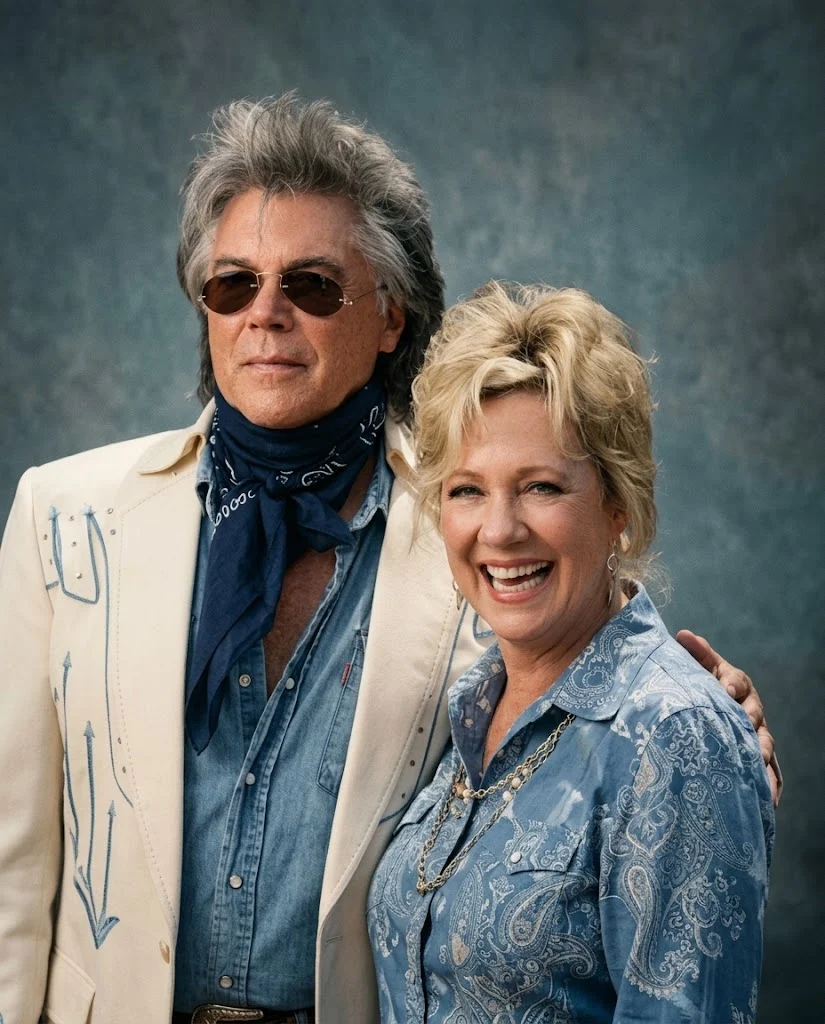
In the summer of 1970, an eleven-year-old boy in a bright yellow shirt stood in a crowd at the Choctaw Indian Fair in Mississippi, his heart racing as he watched Grand Ole Opry star Connie Smith perform. That boy was Marty Stuart, and he had begged his mother, Hilda, to buy him that shirt so the singer might notice him from the stage. After the show, he slipped backstage, had Connie sign his souvenir picture book, and stood proudly beside her as his mother captured the moment on film. On the drive home, he told his mother with absolute certainty that he would marry Connie Smith one day.
What sounded like a child’s wild imagination became the quiet compass of Marty’s life. He mastered the guitar and mandolin, joined Lester Flatt’s bluegrass band at thirteen, and spent six transformative years in Johnny Cash’s backing ensemble. Through grueling bus rides, late-night sessions, and rising solo success, he kept that faded photograph tucked among his personal belongings, studying traditional country arrangements and refining his skills as a producer—all with one goal in mind: to stand beside her as an equal partner.
By the mid-1990s, Connie had stepped back from touring to focus on raising her five children after three painful divorces. When she decided to return to the recording studio in 1994, she reached out to Marty to produce her comeback project. He approached the collaboration with unwavering patience, spending three years crafting traditional country and gospel arrangements with her, while also earning the trust of her children—Darren, Kerry, Jeanne, Jodi, and Michael—through steady support and respect.
Before asking for her hand, Marty placed that worn 1970 souvenir book into Connie’s hands. He pointed to the faded snapshot of the boy in the yellow shirt, revealing the promise he had carried for twenty-seven years. For a mother who had guarded her heart after years of personal heartache, that preserved keepsake offered undeniable proof of a devotion that asked for nothing in return. The defensive walls she had built came down, and she said yes through tears of quiet relief.
“The faded photograph in Connie’s hands proved that genuine devotion takes time to build.”
On July 8, 1997, the couple fulfilled that childhood vow on the Pine Ridge Indian Reservation in South Dakota, in a private ceremony officiated by Lakota medicine man Marvin Helper, blending sacred tribal blessings with their shared Christian faith. Returning to Tennessee, they forged a lasting musical and personal partnership—Marty produced her acclaimed 1998 self-titled album, and they became beloved fixtures at the Grand Ole Opry, her soaring vocals intertwined with his intricate mandolin playing.
To country music fans, Marty Stuart and Connie Smith are two of the genre’s most authentic traditionalists. But inside the home they built together, their greatest milestone was never a chart position or industry accolade—it was a childhood promise preserved in a faded photograph and fulfilled through a lifetime of quiet devotion, proving that some dreams are worth waiting for.