
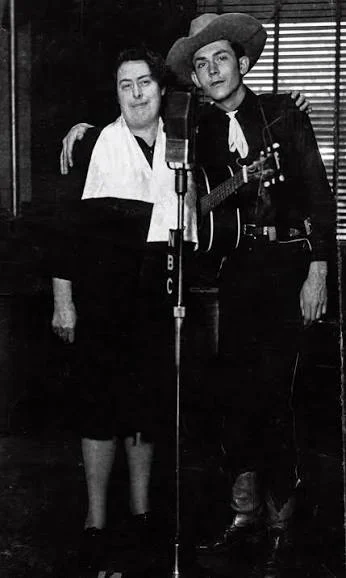
The cold concrete of a Montgomery sidewalk in 1937 became a stage for a fourteen-year-old boy whose family survival depended on the nickels he could pull from strangers. Hank Williams stood outside the Jefferson Davis Hotel with his guitar case open on the ground, shivering against the wind in a frayed shirt that stood in stark contrast to the tailored suits moving through the lobby. His mother, Jessie Lillie Williams, watched from a nearby doorway with a sharp and unrelenting gaze. She was not there to soften the moment. She was there to make sure pride never stopped him from singing.
That sidewalk was not simply a place to sing. It was a family’s last chance.
The family had left rural Georgiana in the grip of the Great Depression after Hank’s father was institutionalized in a regional Veterans Administration hospital. In Montgomery, Lillie opened a modest boardinghouse on South Perry Street. Rent was steep and groceries were not guaranteed, so the boy’s music became the fastest route to survival. The corner outside the Jefferson Davis Hotel was chosen with purpose. Upstairs sat the studios of WSFA, an influential NBC radio affiliate, and station managers and producers passed through the lobby every single day.
Hank’s sore fingers worked the strings for sparse nickels. The raw and aching phrasing he had learned while trailing the Black street musician Rufus Payne carried across the street. That unpolished cadence caught the attention of WSFA staff walking past. They halted on the pavement and invited the frail teenager upstairs for an audition.
The audition led WSFA to offer Hank a live fifteen-minute radio slot twice a week paying fifteen dollars weekly. For a kid who had been playing on the street for spare change, walking through those revolving doors marked the moment a desperate bid for family survival turned into the foundation of country music.
The steady broadcast check did more than steady the boardinghouse ledger. It shifted Hank’s world from informal street corners to the discipline of regular radio programming.
Adopting the moniker The Singing Kid, the young performer turned the WSFA microphone into his personal laboratory. Listeners across central Alabama responded to his plaintive vocal delivery and sent bundles of handwritten postcards to the station requesting gospel standards, cowboy laments, and traditional folk ballads. The surging regional attention convinced Hank to leave Sidney Lanier High School around age sixteen and pursue music full time.
He gathered local instrumentalists to establish his first formal backing unit, the Drifting Cowboys, creating a road-ready ensemble designed to monetize his radio popularity. Lillie stepped into the operation as the band’s de facto manager, bookkeeper, and driver. When Hank plugged upcoming appearances over the WSFA airwaves, she coordinated dates at schoolhouses, union halls, and rough-edged honky-tonks across Prattville, Wetumpka, and Greenville. At the end of every performance, she stood near the cashbox to ensure venue proprietors settled the door receipts in full.
Those late-1930s dance halls demanded sheer physical stamina. Unruly crowds and long night drives took a heavy toll on Hank’s fragile frame, which suffered from a congenital spinal defect, spina bifida occulta. To endure the continuous back strain and brutal traveling schedule, he turned to heavy drinking, initiating a volatile cycle that would shadow his professional life.
As World War II mobilized the country in the early 1940s, military service drafted several members of the Drifting Cowboys, leaving Hank to patch the band together with rotating substitutes. The escalating unreliability caused by his alcohol use strained his relationship with WSFA station managers, ultimately leading the station to drop his broadcast schedule in August 1942.
The loss of his primary platform forced Hank to seek industrial work, taking shifts as a shipyard welder in Mobile to support himself during the war years. Yet Montgomery remained his home base, and local demand never completely dried up. He gradually rebuilt his presence in area clubs, sharpened his songwriting notebooks, and returned to regional airwaves before heading north toward Nashville later in the decade.
The live microphone inside the Jefferson Davis Hotel gave a struggling Alabama teenager his first steady footing. That early broadcast chapter provided the working discipline and performance stamina that would soon carry Hank Williams from regional honky-tonks into the center of American music history.