
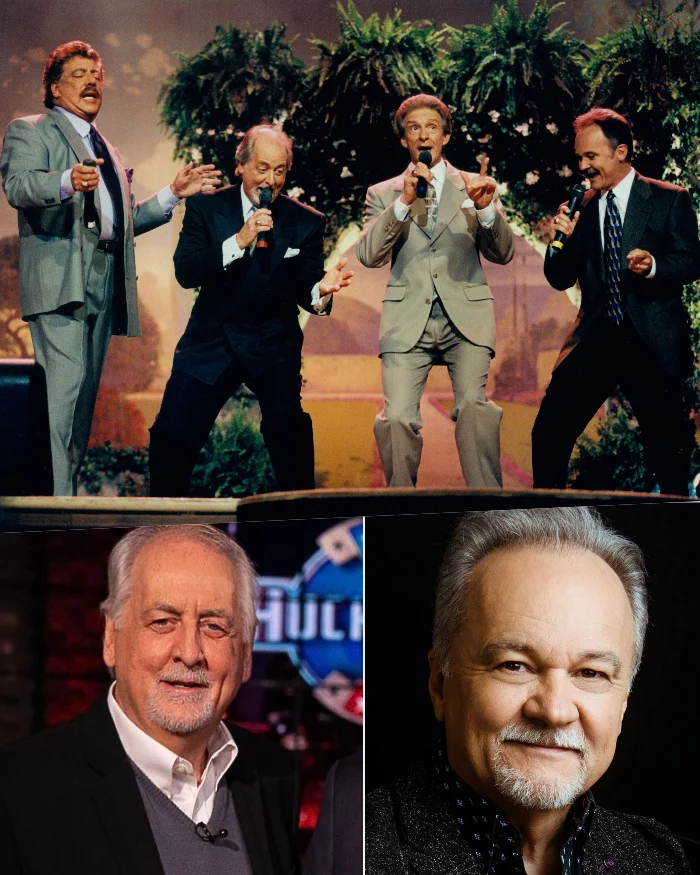
The most important forty minutes of The Statler Brothers’ career did not belong to them. They belonged to Johnny Cash.
In March 1965, four young men from the Shenandoah Valley of Virginia walked into Columbia Historic Recording Studio, often called Columbia Studio A, on 16th Avenue South in Nashville. Harold Reid, Don Reid, Phil Balsley, and Lew DeWitt called themselves The Statler Brothers, borrowing the name from a box of Statler facial tissues they found in a hotel room. They were working long dates on the road as the opening act and background vocalists for Johnny Cash, earning their road stripes while hoping for a signature hit of their own.
Lew DeWitt had penned an unusual song during a quiet break between grueling tour stops. Written inside an empty motel room, the verses captured a man unraveling in solitude after a romantic breakup, filling his empty hours by pacing the floor, counting cards, playing solitaire until dawn, and watching morning cartoon reruns. The brisk upbeat acoustic tempo disguised a portrait of quiet personal unraveling, creating a deliberate contrast between cheerfulness and sheer loneliness.
Columbia Records executives were openly skeptical of the track. Producer Don Law and Music Row decision makers found the song difficult to pigeonhole. The arrangement did not sound like traditional gospel quartet singing, nor did it match the sleek violin laden Nashville Sound that dominated country radio playlists in the mid 1960s. The label showed little interest in financing a session dedicated to an eccentric rapid fire tune sung by a relatively unproven road group, and it almost passed on releasing the song at all.
Johnny Cash intervened directly to break the deadlock. As Columbia’s premier artist, Cash commanded immense leverage in Nashville and possessed an unerring ear for raw honest storytelling. When Columbia executives balked at scheduling studio hours for the quartet, Cash put his own valuable recording session on the line. He voluntarily surrendered forty minutes of his allotted company studio time at Studio A and instructed the engineers and producer to let the four Virginians step up to the microphones.
Cash did not simply offer advice. He surrendered forty minutes of his own studio time so four young friends could prove the doubters wrong.
Working with veteran session players, the four men delivered a four part harmony arrangement driven by DeWitt’s lively acoustic guitar and Harold Reid’s resonant comic bass vocal notes. Cash leaned against the studio wall, nodding along as the vocal tracks snapped into place. Within those borrowed minutes, they committed Flowers on the Wall to master tape.
Released in the late summer of 1965, the single defied every institutional expectation. Flowers on the Wall caught fire across local radio stations and steadily climbed to No. 2 on the Billboard Hot Country Singles chart. The track soon broke through regional borders entirely, crossing over to reach No. 4 on the national Billboard Hot 100 pop chart, sharing space alongside The Beatles and The Rolling Stones.
The unexpected crossover transformed the quartet’s career overnight. At the 8th Annual Grammy Awards in 1966, The Statler Brothers walked away with two honors, Best Contemporary Rock and Roll Performance by a Group and Best New Country and Western Artist. The win validated DeWitt’s peculiar songwriting vision and proved that modern four part harmony could conquer both country and mainstream pop audiences.
Nearly three decades later, the recording experienced a massive cultural revival. In 1994, filmmaker Quentin Tarantino featured Flowers on the Wall prominently in his landmark motion picture Pulp Fiction, playing the upbeat recording over Bruce Willis’s car radio during a pivotal scene. The inclusion introduced the Virginia quartet to a global generation of listeners who had never tuned into a traditional country station.
The Statler Brothers went on to record scores of charting singles, host an acclaimed television variety program, and enter both the Country Music Hall of Fame and the Gospel Music Hall of Fame. Yet through decades of arena touring and industry accolades, the foundation traced back to a handful of borrowed minutes in Nashville, where a generous superstar stepped aside to let four young friends prove everyone wrong.