
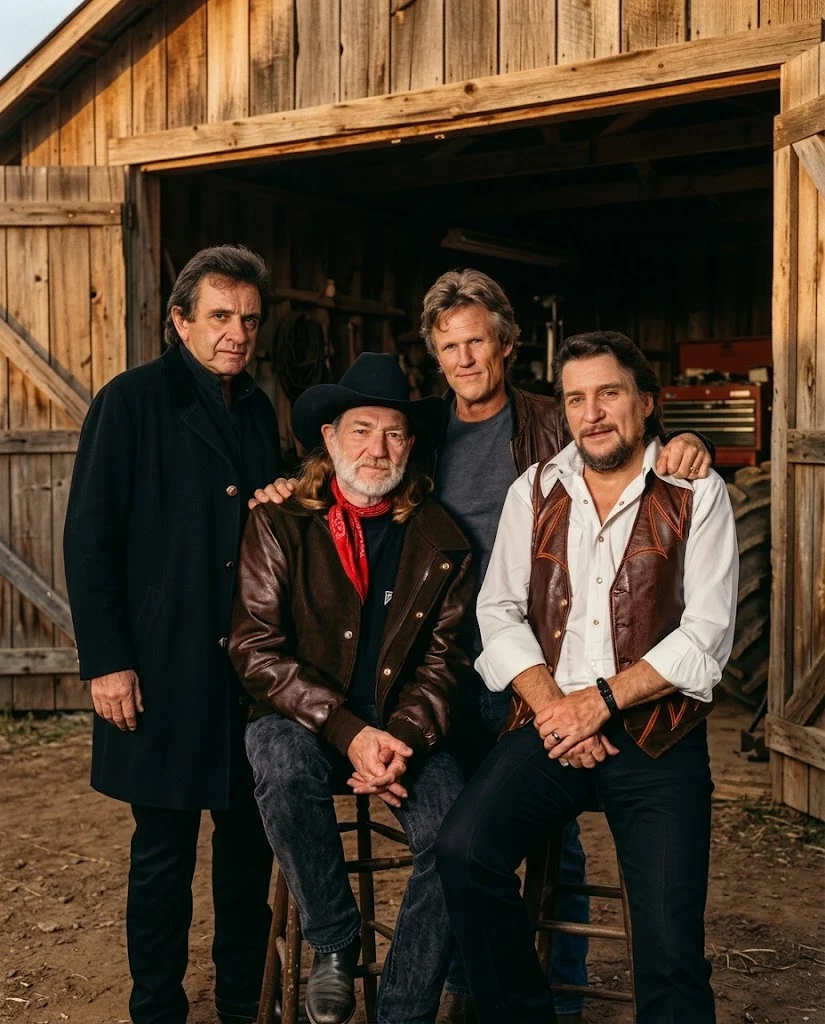
The studio seemed to lose gravity when Johnny Cash stepped forward as the starship captain. By then Willie Nelson, Kris Kristofferson and Waylon Jennings had already carried Jimmy Webb’s restless soul through a bandit’s raid, a sailor’s watery grave and a Hoover Dam builder’s fall. Cash’s deep baritone did more than close the song. It sent the story into orbit and turned a 1977 composition into a vow that outlasted the men who sang it.
That moment did not arrive by accident. In the mid-1980s country music was polishing itself for a pop-facing era. Four architects of the outlaw movement did not need to share a microphone. Yet when they entered the studio with producer Chips Moman to record “Highwayman,” they set aside four towering egos and served one sprawling narrative.
Webb had written the song years earlier after a vivid dream in a London hotel. The track had been recorded before, but it still seemed to be waiting for the collective weight that could anchor its lyrics. The four legends gave it that weight in 1985.
The verse split was not a boardroom decision. It was instinctive casting. Nelson, the free-spirited renegade, opened as the 18th-century bandit. His loose conversational phrasing gave the song a haunting timeless tone.
Kristofferson, the Rhodes Scholar and poetic soul, became the tragic 19th-century sailor lost at sea. His raspy quiet delivery carried the ache of a long weary journey.
Jennings brought working-class grit to the Hoover Dam builder. His unmistakable baritone held the dust, danger and defiance of a man falling into wet concrete. It sounded like the rugged American landscape he described and like his own unyielding career.
Then came Cash. His biblical gravity as the starship captain lifted the song off the earth. The final transition changed the room and changed the meaning of everything that had come before.
“I’ll be around and around”
Those words stopped being only a lyric. They became a defiant promise that their voices would outlast their physical years.
When Jimmy Webb heard the final playback, he was stunned. The casting felt so flawless that he said it seemed as though he had unknowingly written the song for these four men all along.
The public felt the magnitude immediately. In 1985 the track reached number one on the Billboard Hot Country Singles chart. In 1986 it won the Grammy Award for Best Country Song.
The recording also gave the supergroup its permanent identity. They became The Highwaymen, a collective force that proved country music’s older generation still held massive power in a changing industry.
For four men known for fierce independence and towering egos, the session was a masterclass in harmony and restraint. No one tried to outsing another. They passed the soul along, life after life and verse after verse, weaving a seamless tapestry of American music.
Today, with Cash, Jennings and Kristofferson having passed on, “Highwayman” stands far beyond a hit record. It is a poignant reflection on mortality and memory, sung by men who understood the twilight of their own legendary eras. For millions of listeners, the track remains a place where four pillars of country music still stand shoulder to shoulder.
Long after the stage lights fade, the promise remains. Their voices never truly leave the room.