
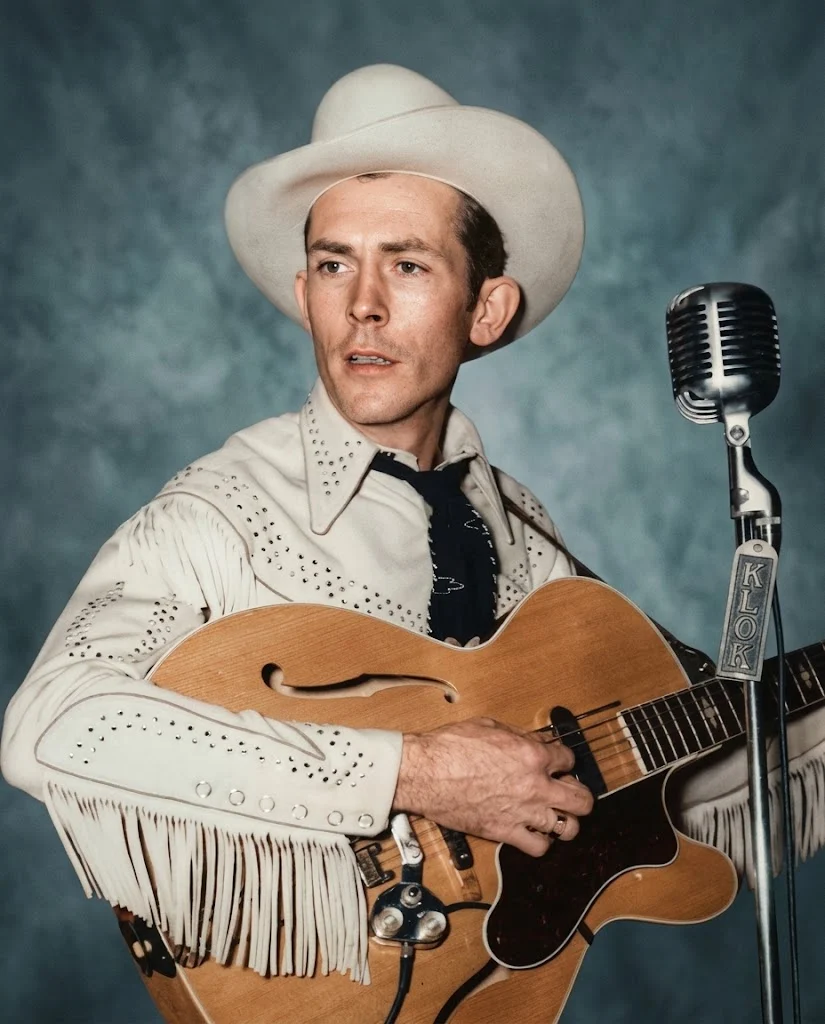
He entered a Nashville office hoping for grocery money and walked out with the partnership that would change American music forever. In under thirty minutes behind a closed door, Hank Williams proved his songs were his own and his talent was real.
In September 1946, a twenty three year old Hank Williams walked unannounced through the doors of Acuff-Rose Publications on Capitol Boulevard in Nashville, Tennessee. Accompanied by his wife Audrey, the gaunt Alabama singer carried a battered acoustic guitar and a handful of handwritten song drafts, hoping only to sell enough material to pay their traveling expenses and hotel bill and cover basic living costs.
Fred Rose, the veteran Tin Pan Alley songwriter who had co founded the firm alongside country pioneer Roy Acuff, listened attentively as Williams sang a few selections. The melodies were extraordinarily tight, and the emotional resonance felt unusually refined for an unknown performer who had spent his youth working street corners in Georgiana and rough dance halls around Montgomery.
Suspecting Williams might have purchased the songs from another writer, a common practice in that era, Rose decided to put the young man ability to an immediate and decisive test.
Rose handed him a title and a scenario, led him into an empty side office with a pencil and a legal pad, and shut the door to see if the talent was real.
The prompt centered on a wealthy woman living isolated in a hilltop mansion. Less than thirty minutes later, Williams opened the door and walked back into the main office. He sat down, strummed his guitar, and sang a finished composition drawn straight from the hardship of his early years, capturing heartbreak, longing, and social divide with striking simplicity and demonstrating the creative foundation for what soon became the classic ballad A Mansion on the Hill.
Rose recognized instantly that he was sitting across from a rare and untutored genius whose conversational storytelling required no fabrication. He offered Williams a songwriting contract on the spot, creating a creative partnership that would anchor modern country songwriting.
Rose moved quickly to get the young songwriter into a professional studio, arranging Williams first formal recording sessions with the independent Sterling Records in Nashville before the close of 1946. Those modest initial releases generated regional attention across the South, enabling Rose to negotiate a major recording contract for Williams with MGM Records in early 1947.
To capture the raw authority of Williams voice, Rose booked time at Castle Recording Studio, situated inside the historic Tulane Hotel in downtown Nashville. Inside Castle wood paneled room, Rose served as an indispensable editor, musical director, and balance wheel. He paired Williams with top tier session players, including steel guitarist Don Helms, while carefully polishing the arrangements so the acoustic warmth of the storytelling remained unvarnished.
Williams arrived at Acuff-Rose looking for a few dollars to survive another week on the road, for pocket money to get home. Instead, he found the one mentor who understood how to frame his rural poetry for a national audience and pair the raw singer with the steady producer who shaped his finest work.
That impromptu audition in a quiet Nashville office unlocked a catalog of American standards that would endure for generations. The partnership proved that when genuine talent meets absolute belief, thirty minutes behind a closed door can redefine a genre for decades to come.