
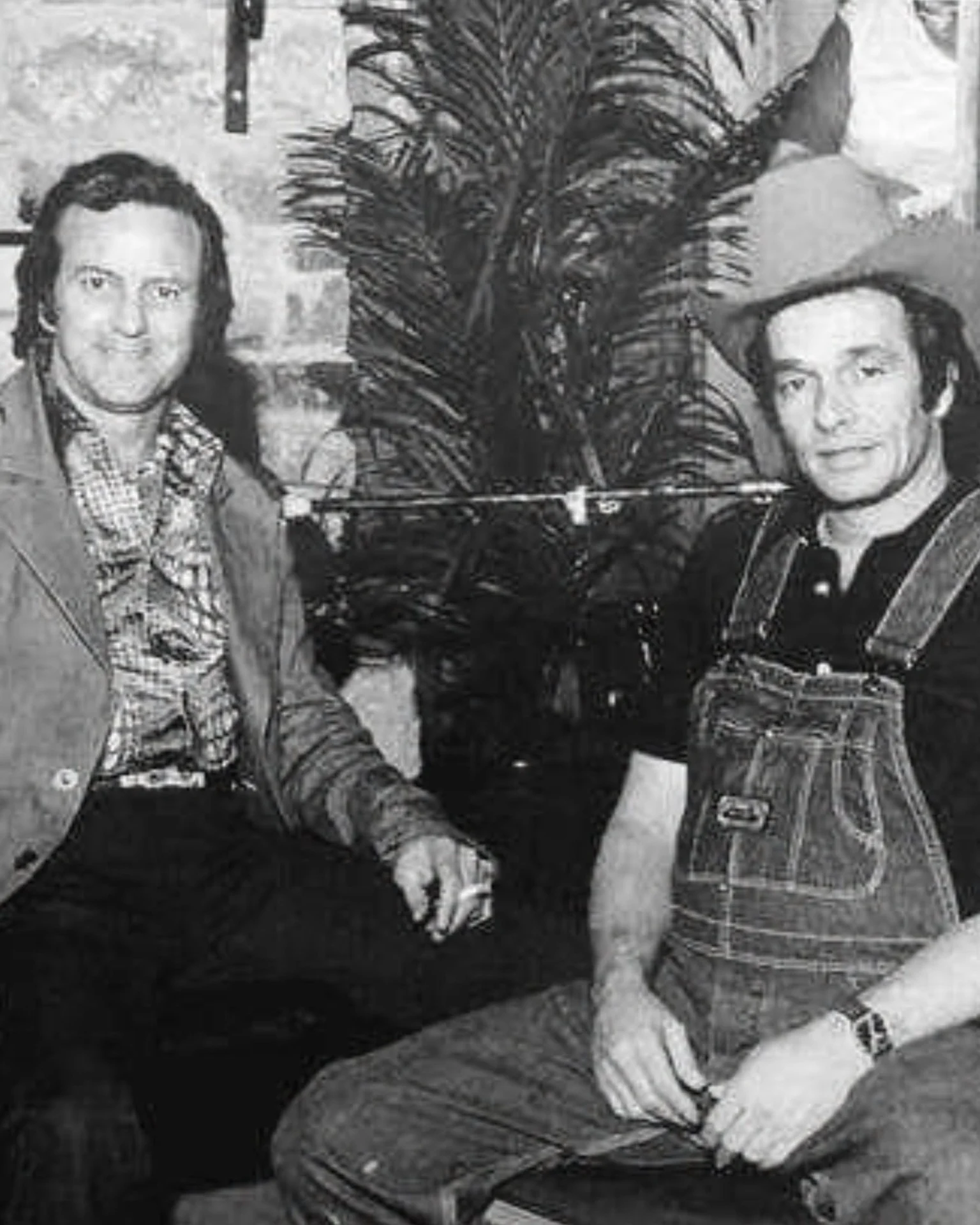
The song arrived in about twenty minutes on a moving tour bus, but Merle Haggard had been carrying the story behind it for years. When “Leonard” became a hit single in 1981, its subject was still alive to hear it, and that timing gave the tribute a warmth a posthumous salute could never have offered.
Merle told an interviewer in 1988 that he was driving the bus when “Leonard” came to him. Leona Williams, his wife at the time, sat near the front and took down the words as he spoke them. There was no story of weeks spent hunting for a hook and no claim that he had set out that morning to write a tribute. The writing was quick. The friendship underneath it was not.
The writing was quick, but the friendship behind it had taken years.
Listeners who met the record in 1981 heard only a first name. Understanding why Merle chose that name meant knowing the songwriter who had been working near him for much of his career.
Leonard Sipes Before Tommy Collins
Leonard Sipes grew up to make records as Tommy Collins. By the 1950s he was part of the California country scene that a younger Merle Haggard would soon enter. Buck Owens played lead guitar in Collins’s band, while Collins wrote and recorded his own songs and watched other singers begin carrying them into studios.
A stage name helped those records reach an audience, and the name on the label became the one most listeners learned. “Leonard” looked behind that label without treating Tommy Collins as a disguise. Both names belonged to the same working musician. Merle simply chose the one a close friend might use.
A Song Built On Years Of Exchange
Collins’s writing was already woven into Merle’s catalog. Haggard recorded “Sam Hill” in 1964, and Collins later wrote “Carolyn,” a No. 1 country record for Merle, and “The Roots of My Raising,” another No. 1.
That history makes “Leonard” far more than a famous singer saluting an early influence. Merle had carried Collins’s work into his own performances and into homes Collins might never visit. Audiences heard Merle’s voice, while the writing credit marked the part Tommy Collins had played in those records. Their bond was a continuing exchange of work.
The Years Outside The Spotlight
Collins had also spent time far from the career he helped build. After success as a performer, he entered a seminary and became a minister, quitting recording in 1960. He returned to the country charts later in that decade, but by the early 1970s, according to the Nashville Songwriters Hall of Fame, drugs and alcohol had become serious problems for him. His marriage ended and he suffered through depression.
Merle kept recording Collins’s songs during those difficult years. That does not make one man responsible for repairing another man’s life. It shows something quieter and plainly verifiable in the record. Collins could still hear work he had written travel under the name of a major artist, and when Merle finally wrote about him, it came after many years of singing from him.
Leona At The Front Of The Bus
The writing story holds a second person in a vital role. Leona Williams was sitting with Merle as he drove, close enough to catch each line before it slipped away. In Merle’s own account, she was not a decorative figure in a tale of sudden inspiration. Without someone writing the words down, he would have had to stop the bus or trust his memory to hold them.
Merle recalled the song coming together in roughly twenty minutes, and that speed can make the work sound effortless. What Leona captured was drawn from years of Merle knowing Collins, watching his career change and recording his songs. The bus ride was brief. The material was already there.
Hearing It In Time
“Leonard” appeared on Back to the Barrooms and became a hit single in 1981. Merle could sing the tribute while Collins could still hear how an old friend had chosen to tell his story.
The record did not close that story. Collins kept working afterward, and songs he had written kept finding new singers. George Strait’s 1988 recording of “If You Ain’t Lovin’ (You Ain’t Livin’)” carried a Collins composition back to No. 1 more than thirty years after Faron Young’s version, and Collins was inducted into the Nashville Songwriters Hall of Fame in 1999.
On a country record, a singer’s name is large enough to read from across a room, while a songwriter’s name usually asks a listener to turn the sleeve over. Merle knew the man on both sides of that arrangement, Tommy Collins on the records and Leonard Sipes in the life around them.
Leona wrote Merle’s words down as the bus rolled on. In the years that followed, Collins heard new recordings of his work, received his Hall of Fame honor and had time to hear what his friend had made for him.
Scroll down to the end of the article to listen to the music.
Video