
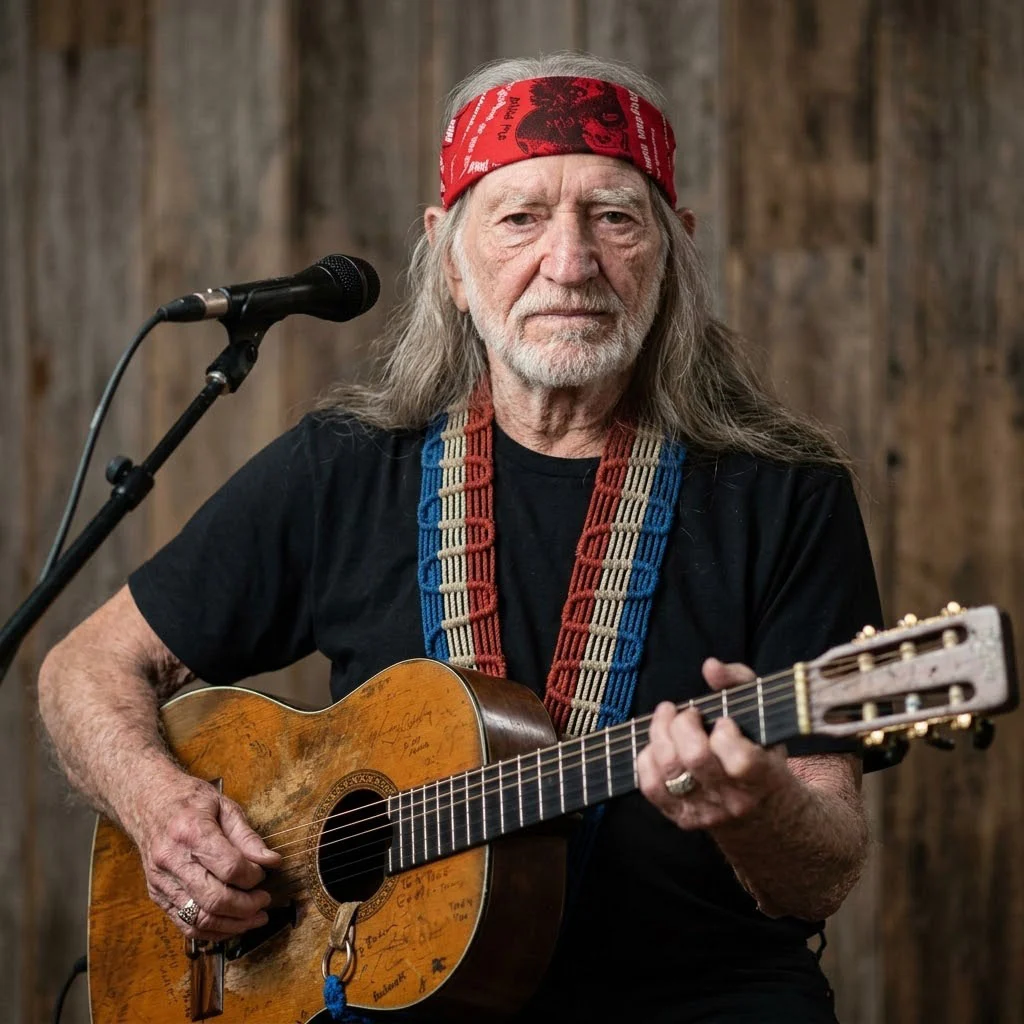
At ninety years old, Willie Nelson still walks slowly toward the microphone while a whole crowd holds its breath, and in that hush you can feel nine decades of rebellion, tenderness and stubborn freedom gathered in one battered guitar.
The voice is a little thinner now, yet the timing is perfect, a jazz kissed crawl through the very heart of country music, and it proves that the boy from Abbott never traded his soul for a chart topping hit.
He was born in the quiet dust and stifling heat of Abbott, Texas, in 1933, when the world felt grey and hungry but music still lived in church pews and on the radio, and he was writing songs long before the world learned his face.
Nashville loved his pen but did not know what to do with his voice. The city wanted him polished and packaged and tucked into a rhinestone suit, and while he handed over gems like Crazy, the paycheck never felt like home.
His soul belonged somewhere far from heavy drums and corporate offices, so he headed back to Austin and found a different kind of truth among the outlaws, and there he stopped following Nashville rules and started writing his own.
Look closely at the guitar in his hands. Trigger is not just an instrument. Its wood is scarred and hollowed by millions of strums, and it carries the signatures of friends who walked beside him like a living witness to a movement.
When Waylon Jennings passed, a piece of that movement went with him. When Johnny Cash left, the air in the room grew a little thinner. But Willie stayed, braids swinging and spirit unbroken, still standing tall in the Texas sun while others faded into nostalgia.
He stayed for the family farmers who were losing their land. He started Farm Aid not for cameras but because he saw the struggle in the eyes of the men he grew up with, a quiet rebellion against the disappearance of the American dream, and he stood on stages in pouring rain raising money and hope for people the world had forgotten.
He did not ask for permission from the industry. He just did it because it was simply the right thing to do.
The tour bus Honeysuckle Rose still rolls down long stretches of American highway, smelling of diesel and old leather and a life lived entirely on his own terms. He is no longer chasing charts. He is chasing the next sunset, the next town and the next song, the same restless promise that made On the Road Again an anthem for anyone who refuses to settle.
With his signature braids and his battered guitar, Willie Nelson remains the living pulse of the present and the face of the Outlaw movement, a laid back champion of the underdog who shows that as long as you stay true to your roots, the music never has to stop.
He is the living proof that staying true to your roots is the only way to never truly fade away.