
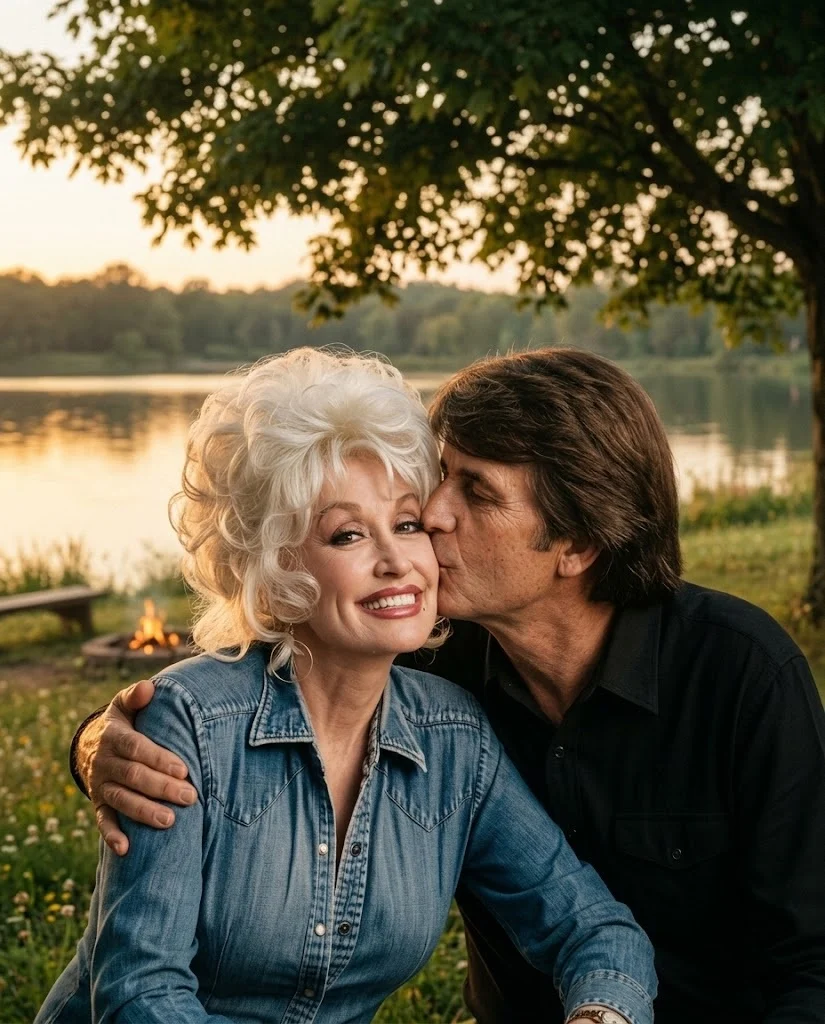
When the gates of their Brentwood home swung shut behind her, the roar of the arena faded, the towering wig came off, the heavy makeup was wiped away, and the woman the world called a global icon became simply a wife again.
That quiet transformation was not an accident. It was the carefully guarded rhythm of a marriage that had survived nearly six decades of fame, and it began long before the world knew her name.
In the summer of 1964, an eighteen-year-old Dolly Parton arrived in Nashville with a look she had built on purpose. Her hair stood tall, her makeup was bold, and her clothes were tight, all inspired by the woman known back in her Smoky Mountain hometown as the town tramp.
In a music business run almost entirely by men, that bold image often brought shallow judgment and open objectification. Label executives saw a product they could sell, while many men on Music Row saw only a novelty.
On her very first day in town, while she carried her clothes toward the Wishy Washy Laundromat, a twenty-one-year-old asphalt paving contractor named Carl Dean stopped his white Chevy pickup beside her. He had only meant to warn her about getting a sunburn, yet he treated her neither as a future star nor as a fragile decoration.
For their first date, Carl did not choose a glamorous downtown restaurant or pretend to know powerful people in the industry. He drove her to a local McDonald’s drive-thru, and inside his car, far from the noise of the city, they ate fast food and talked.
Where other men had offered flashy lines or stared at her figure, Carl looked straight into her eyes. He wanted to know who she was, where she came from, and what she truly wanted to do with her life.
That quiet, undivided attention became her first real safety net in a city that routinely discarded young artists.
Before anyone else recognized it, Carl saw the sharp mind and the prolific songwriter hiding beneath the exaggerated stage persona. His respect gave her a foundation strong enough to face a brutal business.
In 1966, even after Monument Records executives warned that marriage would ruin her image, the couple slipped away to Ringgold, Georgia, and exchanged vows with only her mother present as a witness.
As Dolly grew into a worldwide phenomenon, the couple understood that protecting their bond would require firm limits. They drew strict boundaries around their sprawling Willow Lake estate in Brentwood, Tennessee, and held them without exception.
After attending a single music industry event early in her career, Carl made a firm decision to step completely away from the Dolly Parton brand. Their home became a closed sanctuary. They did not host lavish Hollywood parties, and Carl refused to let reporters, photographers, or television crews inside.
The front gates stayed securely closed to the public eye. When Dolly returned from grueling international tours, the stage clothes were put away at the door, and the superstar stayed outside.
That rigid separation became the hidden mechanic of their survival. While she traveled across continents and sang to thousands in massive arenas, Carl stayed in Tennessee, quietly running his paving business and living a normal life.
When she was off the road, they skipped luxury celebrity resorts and chose instead to travel local backroads in a simple RV camper, where no one recognized the woman in the passenger seat as a global icon.
The entertainment industry is famous for breaking relationships under the crushing pressure of fame and the relentless demands of touring. Yet Dolly and Carl built a marriage that quietly endured, because he never needed a red carpet to prove his devotion, and she never asked him to give up his peace for her ambition.
Dolly Parton built a glittering empire by singing to the entire world, but her greatest achievement remains the quiet, heavily guarded home where the music stops and the man who once bought her a drive-thru burger is still waiting.