
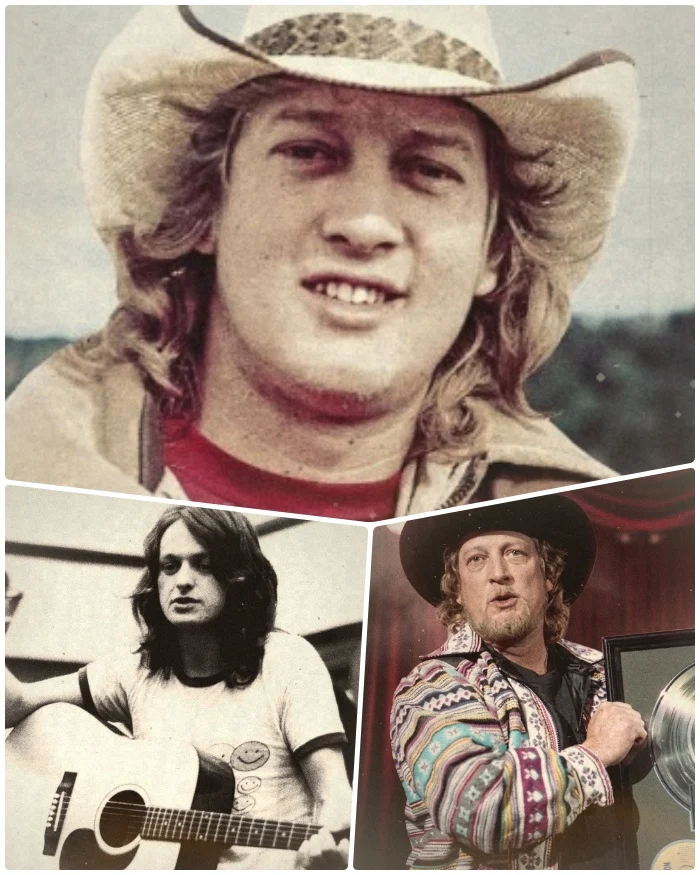
He did not arrive at the Grand Ole Opry House through the artist entrance. Long before the applause, John Anderson climbed above its unfinished frame with roofing shingles on his shoulder, cut hands stinging in the Tennessee heat, and a dream so distant it must have felt like it belonged to someone else.
In October 2024, fifty years after that roof went on, Anderson returned to a Nashville spotlight at the CMA Theater. Longtime mentor Bobby Braddock inducted the sixty-nine-year-old singer into the Country Music Hall of Fame, closing a circle that began when Anderson was a broke teenager looking down at an empty floor and imagining himself in the light.
Born in Apopka, Florida, he first played rock music in a teenage band called the Weed Seeds. Records by Merle Haggard and George Jones changed his direction and pulled him hard toward traditional country. After high school, he drove north to Tennessee and arrived unannounced at the home of his older sister Donna, carrying a guitar, almost no cash, and no contacts on Music Row.
Work paid the bills while the music waited. In the early 1970s, the nineteen-year-old took heavy labor jobs around Nashville, including roofing work on the historic Ryman Auditorium and on the massive new Opry venue rising east of downtown at Opryland USA. By day he hauled materials high above the new auditorium. By night he sang for tips in smoky clubs and honky-tonks, chasing songs in one world while building a roof in another.
The Grand Ole Opry House opened on March 16, 1974. During breaks in the months before that night, Anderson would pause on the framing and look down at the place where the six-foot oak circle from the Ryman stage was being installed. When the 4,400-seat hall finally glowed for opening night, Roy Acuff and Sonny James were inside with President Richard Nixon. Anderson had no ticket and no backstage pass. He was simply the young laborer who had helped cover the building and still stood outside looking in.
He pictured standing under those lights with a band behind him instead of a hammer in his hand
His first break came quietly. He cut What Did I Promise Her Last Night for the small independent label Ace of Hearts, and even though the label folded soon after, the record found publisher Al Gallico. Gallico heard something unmistakable in that raw bent-note phrasing and signed Anderson to a songwriting contract.
In 1977, after five years of construction shifts and tip-jar sets, Anderson signed with Warner Bros. Records. His first single I’ve Got a Feelin’ (Somebody’s Been Stealin’) reached the back end of the Billboard country chart. He climbed into the top forty in 1978 with The Girl at the End of the Bar before a turning point arrived through Roy Nichols, guitarist for Merle Haggard, who handed his boss a 45-rpm copy of Anderson’s 1979 single Your Lying Blue Eyes.
Haggard invited him onto the tour bus and then onto the road as an opening act in 1980, the same year Anderson earned his first top-ten hit with 1959. Soon after, he walked onto the Opry House stage as a recording artist for the first time, stepping beneath the vaulted ceiling his own crew had helped cover only a few years earlier.
By 1982 and 1983, Would You Catch a Falling Star and Wild and Blue had built his momentum, and Swingin’ became a multi-million-selling CMA Single of the Year. The former roofer was now one of the leading voices of the New Traditionalist movement, yet he never lost his private ritual. Every time his tours brought him back to the Opry across the next four decades, he would glance up toward the rafters on his way to the microphone.
The road was not always kind. His career endured a label drought in the late 1980s before roaring back in 1992 with the Double Platinum album Seminole Wind and number-one hits such as Straight Tequila Night and Money in the Bank. He later survived a severe health crisis in 2017 and 2018 that damaged his inner ear and his sense of pitch for a time, then returned again to the Opry stage to celebrate his catalog beside younger artists who had grown up studying his records.
On October 21, 2026, Anderson passed away at his home in Smithville, Tennessee, at age 71. He leaves behind far more than a string of beloved hits. His name remains tied forever to the very halls he once repaired and built from above, the dreamer on the roof who worked his way down to the circle and earned his place in the light.