
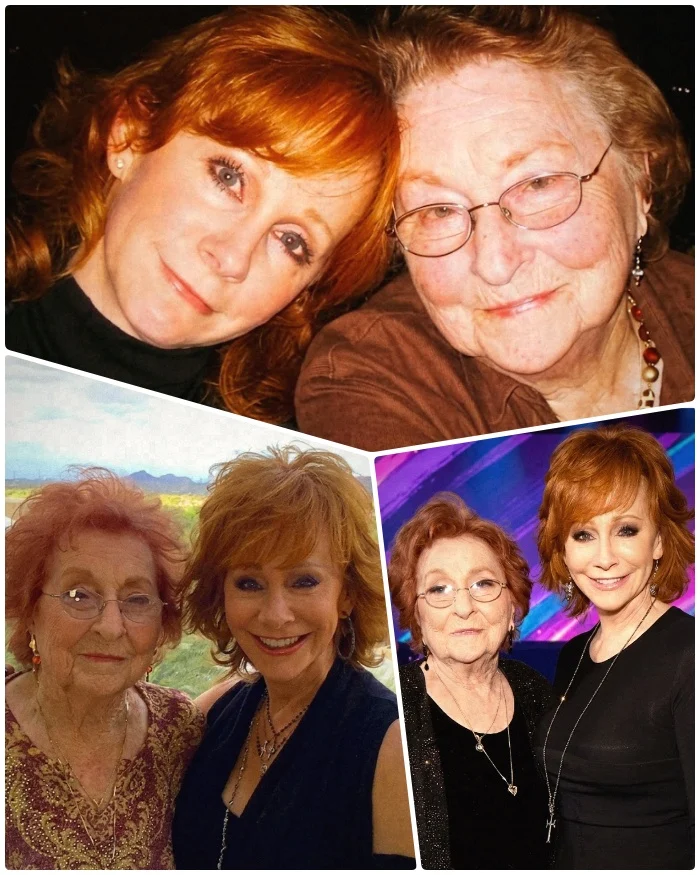
For decades Reba McEntire could fill an arena with one note yet in the spring of 2020 she sat on the floor of a quiet family home in Oklahoma and felt nothing when she thought of a microphone.
The woman she had sung for more than anyone else was gone and the silence that followed was louder than any crowd she had ever faced.
She had always sung for her mother first and without her the microphone felt pointless
Long before Nashville knew her name Jacqueline McEntire walked out of the ranch kitchen in Chockie, Oklahoma with a spatula still in her hand from frying potatoes to tell her children which voice had slipped off key.
Jacqueline had once dreamed of becoming a country singer herself. Instead she spent her working life as an Oklahoma schoolteacher and librarian and as a secretary for a high school superintendent while she poured her own musical hopes into her children during five-hour drives to watch her husband Clark compete at rodeos across the West.
On those long roads she taught them to blend in tight three-part harmony. By high school Pake played acoustic rhythm guitar and carried the melody while Reba soared on the high harmony and younger sister Susie anchored the low part as the Singing McEntires.
Jacqueline booked their shows at local rodeos and dance halls and VFW clubs and drove them to Oklahoma City to record a 45-rpm single called The Ballad of John McEntire for the small Boss label. Even while dinner cooked at the ranch her ear never left their rehearsals and she would stop them whenever Reba drifted onto Susie’s line and make them repeat the phrase until it locked into place.
In 1974 after Reba sang the national anthem at the National Finals Rodeo in Oklahoma City she sang an a cappella version of Dolly Parton’s Joshua at a hotel party for country artist Red Steagall. That night Jacqueline found Steagall and asked whether he could bring all three of her children to Nashville for a recording contract. When he called back in early 1975 with an offer for Reba alone her mother urged her to step through the open door.
For the next four and a half decades Reba treated her career as a dream shared by mother and daughter. Months before Jacqueline died she closed her 2019 album Stronger Than the Truth with You Never Gave Up on Me a tribute that moved her mother to tears when Reba played it for her.
Then on March 14, 2020 Jacqueline died at age 93 after a battle with cancer. Within days pandemic lockdowns closed much of the country and Reba returned to Oklahoma to help Susie clear out their parents’ house. Together the sisters sorted boxes of faded black-and-white photographs showing their mother beside old pickup trucks and pianos and in that empty house Reba admitted she no longer wanted to sing.
She wished she could trade everything for just seven minutes in heaven to sit across from her mother hold her weathered hands and talk the way they always had
The quiet began to lift when Reba returned to work and joined a lunch gathering at the home of Lisa Davis the widow of songwriter Mac Davis. There co-writer Matt Wynn played an unreleased ballad on acoustic guitar and Reba asked him to play it a second time right there in the room. Written by Wynn and Olivia Rudeen the song was called Seven Minutes In Heaven.
When she worked with producer Dave Cobb on her stripped-down October 2023 album Not That Fancy and its companion book she chose that song as the only brand-new track on the fourteen-track project. Cobb kept the arrangement spare so nothing crowded her voice and instead of the brassy power that had filled arenas for decades Reba sang softly and conversationally about walking past historic figures at the gates of heaven simply to spend seven quiet minutes catching up with her mother.
For the music video Reba sat alone in a quiet corner booth in a diner a familiar everyday place before rising to rest her hands on the shoulders of a woman portraying her mother. The camera stayed close on Reba’s face before closing with real family photographs of a young smiling Jacqueline surrounded by her children.
What began on the floor of a quiet Oklahoma house in 2020 has since given millions of listeners a way to remember the parents they still wish they could call one more time and the mother who once corrected harmonies with a spatula in her hand remains the voice that guided Reba back to music.