
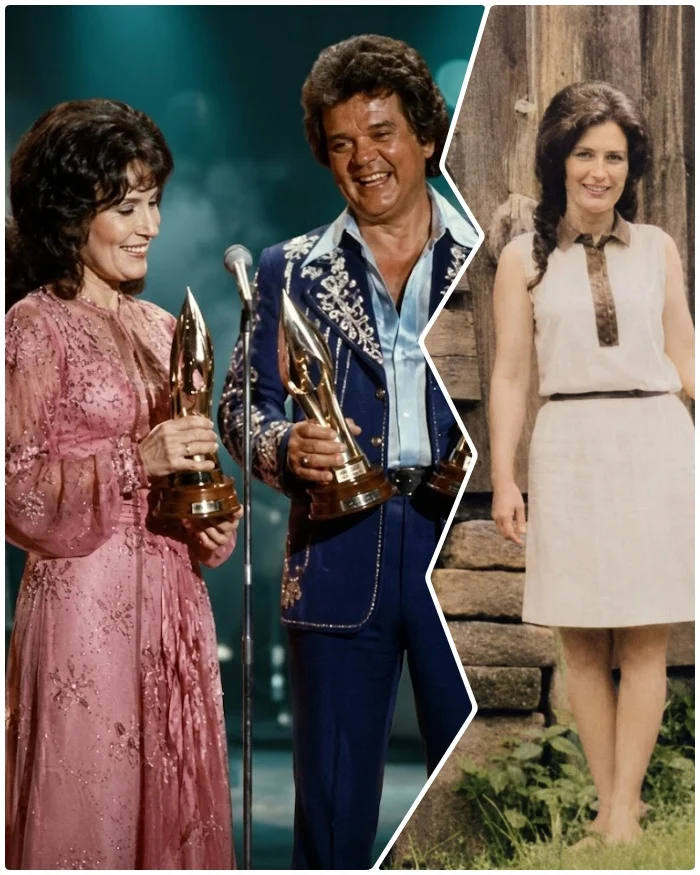
On a morning in June 1993, Loretta Lynn was torn between two bedsides that could not both be reached. Her husband Mooney lay critically ill in Tennessee while, far away in Missouri, the voice that had harmonized with hers for more than two decades had fallen silent forever. She could not fly to Missouri in time to say goodbye and learned of Conway Twitty’s death over the telephone, a final heartbreak for a partnership that had never needed a stage to feel real.
That partnership had not been invented in a record company boardroom. It had grown around the Lynn family kitchen table, where Mooney first heard Loretta and Conway blend their voices during an informal visit and urged them to carry that sound into a studio. It was a family suggestion, not a marketing plan, and it changed country music.
Management and booking teams on both sides first resisted joining two established solo headliners. Twitty and Lynn overruled their advisers and booked three days of sessions with producer Owen Bradley. On November 9, 1970, they stepped up to the microphones inside Bradley’s Barn on Bender’s Ferry Road in Mount Juliet, Tennessee, and recorded five duet tracks in a single day.
Between November 9 and November 11, 1970, backed by Nashville session players including Hargus Robbins, affectionately called Pig, on piano, Harold Bradley on bass, and Twitty’s steel guitarist John Hughey, they cut the tracks for their debut album We Only Make Believe. On that first evening they recorded After the Fire Is Gone by L. E. White. Two days later they laid down Lead Me On by Leon Copeland and held the second song back for their follow-up record.
Released on January 4, 1971, After the Fire Is Gone climbed straight to number one on the country charts and brought Twitty the only Grammy Award of his career. When Lead Me On followed in September 1971, it gave them a second consecutive chart-topper and established an annual recording rhythm at Bradley’s Barn that lasted through the decade.
Between 1971 and 1981, Twitty and Lynn released ten studio albums and sent twelve of their thirteen singles into the country Top 10. Among their five number-one hits were Louisiana Woman, Mississippi Man in 1973, As Soon as I Hang Up the Phone in 1974, and Feelins in 1975.
From 1972 through 1975, they won four straight Country Music Association Vocal Duo of the Year awards. That run ended the reign of Porter Wagoner and Dolly Parton while they outpolled married partners George Jones and Tammy Wynette, a remarkable feat for two singers who were not married to each other.
They stood inches apart, held hands, and never looked away from the first note to the last chord.
To manage the demand for live dates without surrendering their solo careers, the pair co-founded the United Talent booking agency with promoter Jimmy Jay and named their 1976 studio album United Talent after the company. Across eleven years of full-time joint touring, they structured each concert so every singer performed a full solo set with a personal band before meeting at center stage for a closing duet segment.
During those joint appearances, their stillness set them apart. While turbulent marital duets were popular in Nashville at the time, Twitty and Lynn sang with quiet closeness, eyes locked and hands joined. That intimacy fueled decades of public speculation about a romance behind the scenes, even though their bond remained strictly platonic.
Offstage, their relationship operated on strict family boundaries. Twitty guarded Lynn’s welfare and reputation on the road, joined her in the tour bus lounge to watch old movies between cities, and spent his off-duty hours fishing and talking with Mooney Lynn as a trusted family friend.
After wrapping up their regular studio albums in 1981, a year when fire destroyed the original Bradley’s Barn in Mount Juliet and Twitty survived a serious fall on his tour bus steps, the two continued to share concert bills across the country. By the spring of 1993, they were planning a new reunion album, a return that promised one more chapter for fans who had never stopped asking for it.
That chapter never came. On June 4, 1993, after performing at the Jim Stafford Theatre in Branson, Missouri, Twitty collapsed on his tour bus from an abdominal aortic aneurysm. He died the next morning, June 5, at age fifty-nine at Cox South Hospital in Springfield, while Mooney Lynn remained hospitalized in critical condition and Loretta faced an impossible choice between her husband and her singing partner.
Over the next twenty-nine years until her death in October 2022 at age ninety, Lynn never took another permanent duet partner and set aside a portion of every concert to sing Twitty’s songs. The harmony did not end with them. Years after the two singers first stood side by side at the microphones in Mount Juliet, their grandchildren Tre Twitty and Tayla Lynn walked onto stages across America as Twitty and Lynn, holding hands on the same songs their grandparents recorded fifty years earlier.