
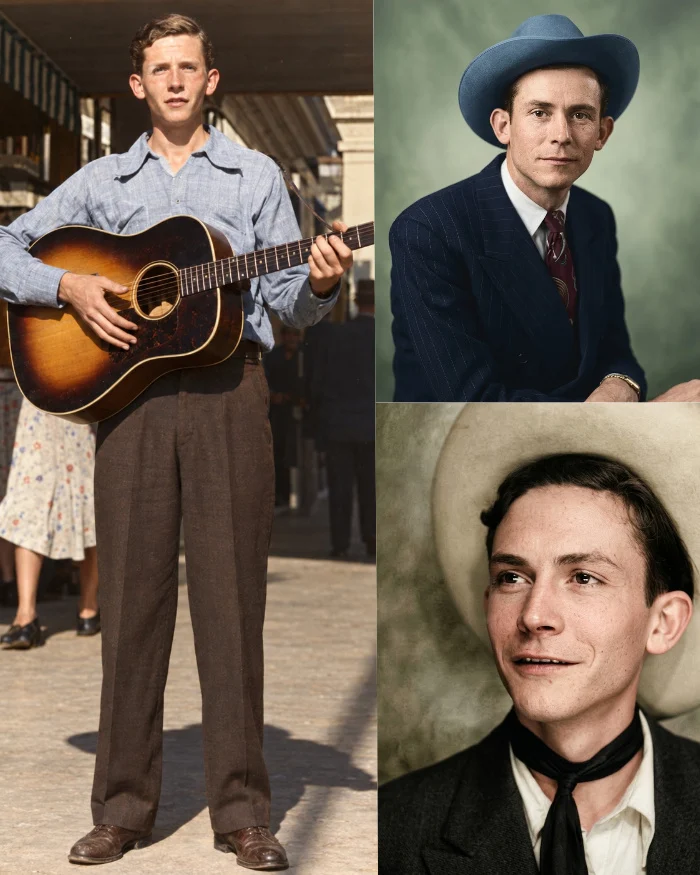
The first sip of moonshine did not feel like rebellion It felt like mercy. A thirteen-year-old boy in Butler County Alabama had spent years leaning against depot walls because his spine burned with pain. When the raw corn liquor hit his throat the grinding ache in his lower back loosened. For the first time he could remember his back felt light.
That moment in the Alabama pines became the hidden beginning of one of country music’s most enduring voices and one of its most painful dependencies.
Hiram “Hank” Williams was born in 1923 with an undiagnosed case of spina bifida occulta. His lower spine lacked complete structural closure and raw spinal nerves stayed vulnerable to irritation. With his father Lon long absent in Veterans Administration hospitals his mother Lillie carried the household. Specialized orthopedic care was out of reach.
By the mid-1930s the gaunt boy hauled freight crates in Georgiana sold newspapers before daybreak and shined shoes on dusty corners. Every crate and every hour bent over leather work pressed on an unstable lumbar spine. Sharp spasms fired down his legs and forced him to rest against depot walls just to breathe.
Around 1936 an afternoon in the rural pine woods outside town changed everything. Local timber cutters and turpentine workers buried jugs of corn moonshine beneath heavy pine needles and damp earth to dodge federal tax agents. Williams and neighborhood boys found a disguised wooden hatch and dug out the hidden jars as a daring prank.
For his friends the burning swallow was teenage rebellion. For Williams it was the first quiet his body had known.
Within minutes the stinging warmth entered his bloodstream and the constant physical pain eased. The temporary relief was so powerful it became survival. He began tucking moonshine jars beneath his worn jacket and treating the raw alcohol as home medicine for a broken spine.
When his mother moved the family to Montgomery in 1937 the habit collided with professional music. At fourteen he formed his first band the Drifting Cowboys and landed regular live broadcasts on radio station WSFA. Nightly sets in rowdy roadside beer joints blood-bucket taverns and dance halls across central Alabama demanded far more from a teenager who weighed barely one hundred and twenty pounds.
Behind the bandstands the moonshine deepened into an occupational necessity. Venue managers often provided whiskey as part of a band’s payment and Williams relied on continuous drinks to numb spasms during four-hour dance sets. When liquor caused missed radio slots and strained rehearsals his mother and bandmates stepped in to manage his schedules shielding a young performer whose endurance depended on an untreated injury.
The jar he carried out of those Alabama pines started a physical dependence that followed him through honky-tonk tours Grand Ole Opry stardom and the back seat of his Cadillac on New Year’s Day in 1953.
That early habit shaped his first road years in Montgomery and became a darker chapter of country music history that few early accounts explored. Hank Williams recorded thirty-five Top 10 country singles and established the foundational blueprint of American songwriting before passing away at the age of twenty-nine.
The haunting sorrow in his vocal phrasing was never a rehearsed mannerism. It was the sound of an artist who had learned his craft while leaning his injured spine against an unyielding world.