
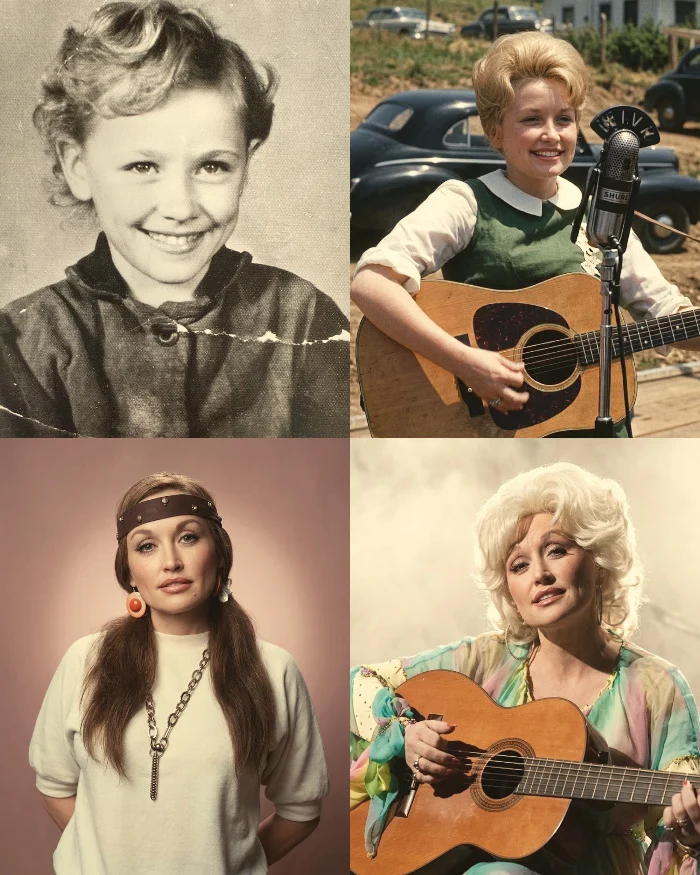
Nashville almost broke her before the world ever heard her name.
In the summer of 1964, the morning after she graduated from high school in Sevier County, Tennessee, an eighteen-year-old Dolly Parton left the Smoky Mountains for Nashville with a cardboard suitcase, a notebook of original songs, and a fierce belief that Music Row was waiting for her.
She found a city of closed doors instead. Rejections came fast. Her savings ran out. Soon she could not afford ordinary meals, yet she refused to go home and surrender the dream.
Her survival routine was quiet and humiliating. She went to local diners, gathered free ketchup and mustard packets, carried them back to her rented room, and mixed them with hot water to make a sharp watery broth that often served as her only sustenance for days.
She did not wait for Nashville to rescue her. She stayed hungry, tuned her guitar, and kept writing.
Her uncle Bill Owens had also moved to Nashville to help navigate the industry, and together they knocked on publishing doors until her songwriting strength opened the first real door. In 1965, she signed with Combine Publishing for a small steady income. Soon after, Fred Foster at Monument Records offered her a recording contract.
Label executives initially misunderstood her distinctive mountain soprano and tried to market her as a bubblegum pop artist. When those singles failed, Parton pushed back with conviction and insisted her voice and her songs belonged to country music. In 1967, Monument relented and released Dumb Blonde, which cracked the country charts.
That song drew the attention of Porter Wagoner, a powerful Nashville figure who needed a new female vocalist to replace Norma Jean on his weekly syndicated television show, a program that reached millions of viewers across the United States.
Wagoner hired Parton in 1967. The job pulled her out of financial instability and placed her before a national audience. Their duet recordings became hits, but the partnership came with strict boundaries. Wagoner controlled the show and its musical direction, while Parton carried a fiercely independent vision for her own career.
Television fame became a bridge, but creative control became the price of leaving.
After seven years of success and growing tension, Parton knew she had to break away to survive as a solo artist. In 1974, she walked into the office of Porter Wagoner and played I Will Always Love You to explain her departure.
The split allowed her to take absolute ownership of her trajectory. She protected her publishing rights, a rare and difficult move for a female artist at that time, and expanded into mainstream pop and film.
By the mid-1980s, the woman who had once starved at the edges of Nashville returned to Sevier County and opened Dollywood. The theme park was not merely branding. It was a deliberate economic engine designed to bring thousands of jobs to the rural mountain community she had left behind.
Decades later, she launched the Imagination Library, a literacy program that has mailed hundreds of millions of free books to children worldwide.
The global country music empire did not begin with a lucky break. It began in lonely rooms and diner tables, with hot water, free packets, and an unbreakable refusal to quit.
Before the stages, the royalties, and the philanthropy, Dolly Parton survived on hope and ketchup packets.