
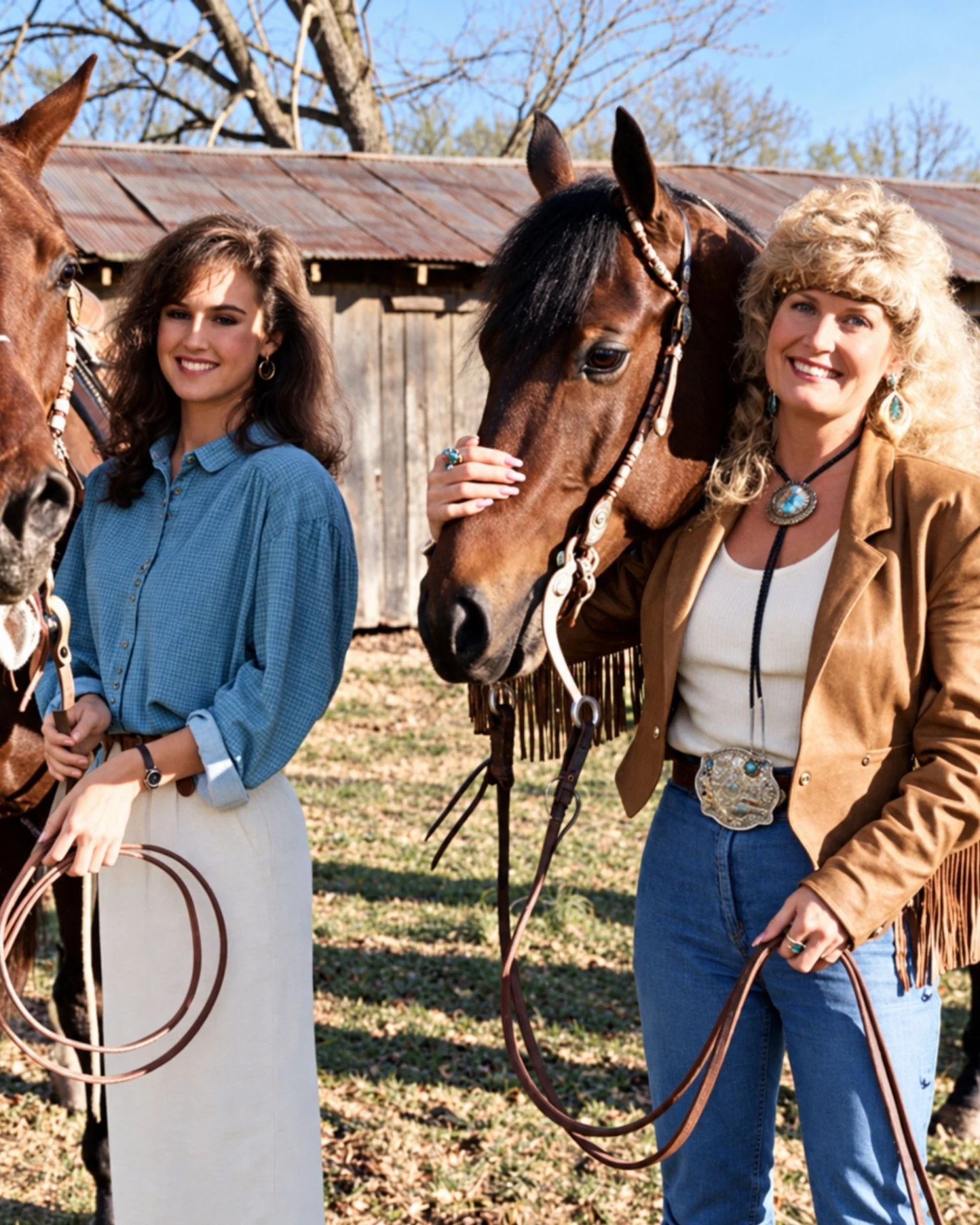
The story began in dust, not in a recording studio.
Lynn Anderson’s world before television lights smelled of leather and horses. She competed across California while her mother, Liz Anderson, sat in the stands with a notebook. Long classes gave Liz time. She used that time to write songs that would help carry the family into country music.
Years later, Lynn laughed and said her mother wrote because horse shows were boring. The comment was simple, but it revealed a strange and powerful arrangement. Waiting became work. Work became hits.
“One mother’s waiting time became a daughter’s catalog.”
Liz Anderson had grown up poor in northern Minnesota. Music lived in her early years through singing and mandolin, but marriage, labor and motherhood came before any professional stage. Her husband, Casey, served in the Navy while Lynn was very young, leaving Liz to raise their daughter alone for a time in Grand Forks, North Dakota. The family later moved west and settled in California.
Horses became Lynn’s center. She rode young and turned into a serious competitor. Ranch space, travel, tack and show schedules shaped the household.
From the bleachers, Liz kept listening with a songwriter’s mind. Her songs were not pretty pictures of riders. They spoke about fugitives, troubled marriages, pride and people trying to part without losing themselves.
The arena gave her hours. She made them useful.
Her compositions started traveling. Del Reeves recorded her material. Conway Twitty found his first country-chart success with “Guess My Eyes Were Bigger Than My Heart.” Merle Haggard recorded “(All My Friends Are Gonna Be) Strangers,” a song that gave his band its name. He later took “The Fugitive” to number one.
RCA signed Liz as an artist. Lynn, still known for riding and beauty-pageant work, sang harmony during some of her mother’s sessions. That closeness put her voice in front of industry ears. Chart Records executive Slim Williamson heard her and offered a contract in 1966.
The order mattered. Liz did not step aside to build a daughter’s career. She built her own first. Her writing and recording opened a door, and Lynn walked through it while Liz kept walking too.
Liz wrote “Ride, Ride, Ride,” a song that sounded made for Lynn’s early image. It became one of her first hits. Liz also wrote “If I Kiss You (Will You Go Away),” “Promises, Promises” and “Big Girls Don’t Cry.” Five of Lynn’s early hits came from her mother.
Those songs gave Lynn a sharper voice than her polished television look suggested. She was blond, poised and telegenic. Liz gave her characters who were doubtful, impatient and unwilling to settle for whatever a man offered.
Mother and daughter wrote and recorded “Mother May I” together in 1968. A Mother’s Day appearance on The Lawrence Welk Show brought their relationship to a national audience.
The duet sounded traditional. Their lives were not. Two women were learning the same business at almost the same time.
Lynn eventually needed more than the family catalog. Television appearances brought country music into homes that rarely heard it. She formed her own band when many female singers were still attached to male-led road shows.
After moving to Columbia Records, she recorded Joe South’s “(I Never Promised You a) Rose Garden.” Her producer and then-husband, Glenn Sutton, doubted whether a male-written song suited her. Lynn kept asking for it.
The record crossed country, pop and international markets. Overnight, it made her famous beyond Nashville and placed a song written outside the family at the center of her identity.
That success did not cancel Liz’s contribution. It showed that Lynn could leave her mother’s catalog without leaving her mother’s story.
Horses stayed important after buses, awards and network lights arrived. Lynn bred and showed quarter horses and cutting horses. She rode native breeds abroad. Lady Phase, a mare tied to her program, became influential enough that Breyer produced a model based on her. Skipster’s Chief served as a poster horse for the North American Riding for the Handicapped Association.
Cutting horses demanded a different kind of trust. The animal had to understand which cow it was working. Then the rider loosened the reins and let the horse do its job. Lynn described herself then as a passenger.
That image balanced her music life, where a woman leading her own band had to grip reins the industry expected a man to hold.
Her therapeutic-riding work began with one small birthday gathering. During a party for her daughter, a six-year-old child with spina bifida was lifted onto one of Lynn’s horses. Lynn watched height, balance and motion change the child’s experience.
A child who approached in a wheelchair could suddenly sit above the adults nearby. The horse did not erase the disability. It changed the child’s place in the room for the length of the ride.
Lynn joined the North American Riding for the Handicapped Association. She helped start Nashville’s Saddle Up program with Dixie Paul. Later, she directed proceeds from projects involving country artists and horses toward the organization.
The work reunited parts of her life that fame often split. The girl from the horse shows and the woman on television were never separate.
Near the end of her career, Lynn returned deliberately to Liz’s songs. It was not a way to recreate the Chart Records years. “Rose Garden” had followed her for decades, and her own catalog, television work and live performances already stood on their own.
Revisiting her mother’s material let her hear familiar words with a fuller life behind them. Marriages, children, setbacks and aging had changed the voice carrying songs that once passed through a family home.
Liz died in 2011. Lynn died four years later. Their daughter Lisa Sutton later helped care for Lynn’s archive and recorded legacy. The family work became another kind of labor. It meant finding, restoring and keeping what two earlier generations had made.
The Anderson story is not a tale of a mother giving everything for a daughter, or a daughter escaping a mother. Liz wrote while Lynn rode. Liz reached Nashville first. Lynn carried several of her mother’s songs onto the charts, then found the record that made her internationally famous elsewhere. Each success made room for the other.
The most lasting inheritance may not be a song. A child was lifted onto a horse at a birthday party. Lynn saw what that ride could give. She turned one afternoon into continuing service for other children.
Liz turned hours in the stands into pages. Lynn turned one driveway afternoon into help.
“The family gift was not only music. It was noticing that empty space could become useful.”