
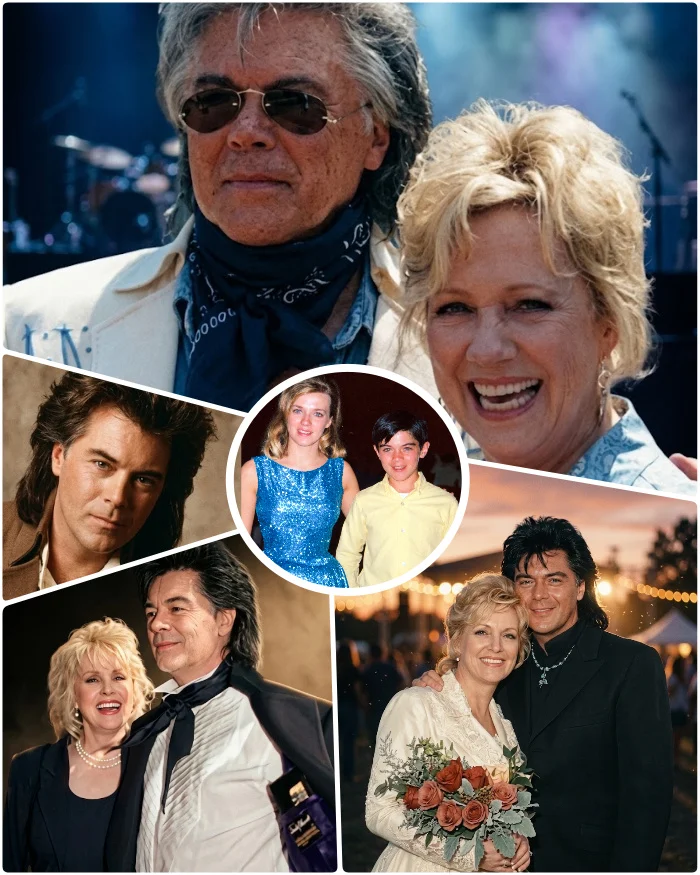
In 1970, an eleven-year-old Marty Stuart made a bold declaration that would echo through the decades. Standing beside his mother at the Choctaw Indian Fair in Mississippi, he pointed at the stage and vowed to marry the woman performing. That woman was Connie Smith, a rising country star who had just released her hit “Once a Day.” She was twenty-eight, he was eleven, and the age gap seemed insurmountable—but Marty’s heart had already made its choice.
Years passed, and their paths diverged. Marty joined Lester Flatt’s band, toured with Johnny Cash, and even married Cash’s daughter. Connie stepped away from the grueling tour circuit to raise her five children and focus on her faith. After three failed marriages, she swore she would never wed again.
But fate had other plans. In the mid-1990s, when Warner Bros. Records executive Jim Ed Norman approached Connie about a comeback album, he brought Marty in as producer. Before entering the studio, Marty suggested they write songs together. Their first writing session began with a simple question: “What kind of song do you want to write?” Marty’s answer was direct—”a love song.”
Over the next few years, the two co-wrote eight tracks for Connie’s 1998 self-titled comeback album, including “Hearts Like Ours” and “You Can’t Stop Love.” Their collaboration, filled with steel guitars and twin fiddles, slowly transformed into a courtship. Despite the seventeen-year age difference, something undeniable was growing.
Marty, who had spent decades photographing life on the Pine Ridge Indian Reservation in South Dakota and was even adopted into the Oglala Lakota tribe, brought Connie along to the place that held deep meaning for him. On July 8, 1997—twenty-seven years after that fateful night in Mississippi—they exchanged vows in a private, traditional Lakota ceremony on the South Dakota prairie, surrounded by the community that had welcomed them.
While the spiritual setting was the heart of their union, Marty later confessed a practical reason for choosing South Dakota. At the time, many states required couples to undergo a blood test before issuing a marriage license. South Dakota did not. Marty, who fainted at the sight of needles, admitted with a laugh:
“I passed out cold every time a nurse tried to draw a sample. South Dakota let me skip the clinic and stay safely on my feet for the ceremony.”
After the vows, the newlyweds drove into the Badlands, played Buck Owens’s “Your Tender Loving Care” on the car stereo, and danced on a cliff above the plains. What began with a boy pointing at a stage ended with a man standing upright, without a single needle in sight—launching one of country music’s most enduring love stories.