
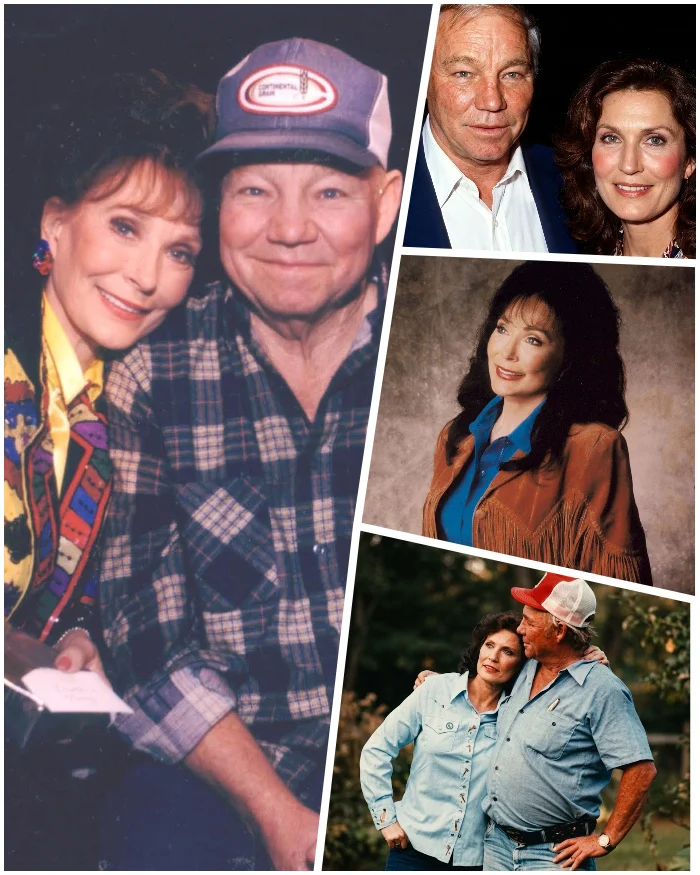
In the quiet of a Tennessee hospital room in August 1996, a legendary voice trembled with love and loss. Loretta Lynn, then 69, sat beside her dying husband, Oliver “Doolittle” Lynn, and sang him a song she had avoided for years—a plea for sobriety and tenderness that had once cut too close to home. Five days before his 70th birthday, she turned that haunting ballad into a goodbye.
Their story began on January 10, 1948, in Kentucky, when Loretta Webb was just 15 and Doolittle was 21. They married a month after meeting, and within a year, they moved to Custer, Washington, seeking steady work outside the coal fields. There, Loretta was seven months pregnant with their first child, beginning a 48-year journey that would shape country music forever.
Those early years painted a portrait of contradictions. Doolittle drank heavily and was unfaithful—once leaving Loretta alone while she was in labor—yet he was also her fiercest champion. When he heard her singing to their children, he insisted she had a talent that rivaled anyone on the radio. In 1953, he bought her a $17 Harmony guitar for her 21st birthday, a gift that would change everything.
Loretta taught herself chords at the kitchen table while raising four kids, and Doolittle refused to let her voice stay hidden. He booked her into local venues like the Delta Grange Hall and Bill’s Tavern, helping form her first band, Loretta and the Trailblazers. When her 1960 debut single, “I’m a Honky Tonk Girl,” was recorded in Hollywood, Doolittle mailed copies to radio stations and drove her across the South—sleeping in the front seat of their car between stops—until the record climbed the charts and brought her to the Grand Ole Opry.
As her fame soared in the 1960s and 1970s, Loretta turned the pain of their marriage into hits like “Don’t Come Home A-Drinkin’ (With Lovin’ on Your Mind)” and “Fist City.” But it was her 1985 ballad, “Wouldn’t It Be Great?,” that captured a deeper ache—a quiet wish for a husband who could speak with a clear, sober mind. For years, she rarely performed it in front of Doolittle, saying it cut too close to their daily life.
“I loved that song,” she later said, “but singing it in front of Doo was just too hard.”
By the early 1990s, Doolittle’s health deteriorated. Diabetes complications cost him both legs, and congestive heart failure left him needing constant care. Loretta stepped back from touring, staying at their ranch in Hurricane Mills, Tennessee, to nurse him into her sixties. In his final days, after prolonged medical treatment, Doolittle was completely sober—and Loretta sang him that song one more time, turning a plea from their hardest years into a quiet farewell.
He passed away on August 22, 1996, at age 69. Loretta barely recorded for years afterward, but she never forgot the man who believed in her. In her 2002 memoir, *Still Woman Enough*, she wrote that she was explaining, not excusing, his behavior—calling him a hard worker and her safety net who always told her she was special. When she died on October 4, 2022, at age 90, she was buried beside him on the ranch.
Without that $17 guitar and Doolittle’s early belief, Loretta Lynn once said, the world would never have known her name. Their love was messy, flawed, and enduring—and it gave country music some of its most honest songs.