
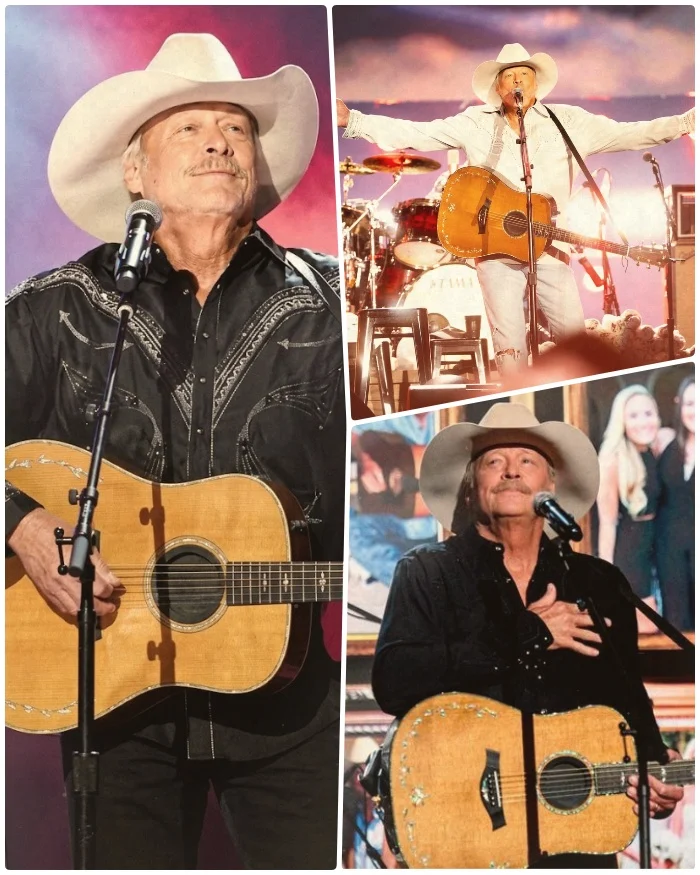
He did not want tears to define the night. When Alan Jackson finally walked out beneath his white cowboy hat at Nashville’s Nissan Stadium on June 27, 2026, he opened his twenty five song set with Gone Country and made clear that the farewell would be a celebration. More than 50,000 fans had gathered for the final concert of his touring career, and the 67 year old singer greeted them with humor rather than sorrow.
He was still very much alive and he did not want the night weighed down by sad farewell talk
The sold out stadium date closed his Last Call One More for the Road tour and celebrated more than three decades of traditional country music. Jackson also refused to let the evening serve only as a retirement party. One dollar from every ticket went to the CMT Research Foundation to support research into Charcot-Marie-Tooth disease, while anonymous donors matched another two dollars for every seat in the venue.
By then Jackson had lived with the degenerative genetic nerve disorder for fifteen years. Diagnosed in 2011, he inherited the condition connected to his father Eugene Jackson and had also watched it affect his grandmother and older sister. For ten years he kept the diagnosis private while continuing to record and tour, finally discussing it during a September 2021 appearance on the Today show. Nerve damage in his lower legs was making him stumble, and he did not want fans to think he was drunk on stage.
A Decade Of Quiet Adjustments
Keeping his touring promise from 2022 through 2026 required constant adaptation as the illness progressed. Jackson admitted that he sometimes forgot how to play certain parts of his older songs on guitar, and he gradually surrendered his old habit of roaming from one end of the stage to the other. During the final arena runs he relied on a tall stool at center stage or stood in one place with one hand resting firmly on the microphone stand to hold his balance.
Even as the disease reduced the dexterity in his hands and fingers, he protected his closing ritual. At the end of each night he still took a marker, signed cowboy hats and tossed them toward fans near the front row. The body that had carried him across stages in the nineties had changed, but his determination to finish on his own terms had not.
Seventeen Tributes Before The Final Set
Before Jackson took the microphone, summer weather briefly forced a stadium evacuation and delayed the schedule until after nine in the evening. A lineup of younger artists then honored his catalog with seventeen tribute performances. Luke Combs sang Hard Hat and a Hammer, Carrie Underwood delivered his 1997 hit Everything I Love, and Miranda Lambert performed Dallas. Eric Church offered Someday, Cody Johnson covered Job Description, Jon Pardi took on She’s Got the Rhythm, and Lee Ann Womack performed Between the Devil and Me before the guest roster joined together for Pop a Top. Keith Urban and Luke Bryan were also among the major artists who joined the Nashville farewell.
Halfway through Jackson’s own set, he welcomed longtime friend George Strait for Designated Drinker, performed together for the first time since 2017. They followed it immediately with their classic duet Murder on Music Row, creating one of the evening’s most powerful meetings between two defining voices of traditional country.
The most personal passage arrived when Jackson recognized his family inside the stadium. He spoke about his wife Denise and their nearly five decades together, saying they were happier than ever and preparing to welcome their fifth grandchild. He then sang Remember When for the final time on tour, turning a beloved song about a shared lifetime into a farewell grounded in the family waiting beyond the road.
Jackson closed his main set with Chattahoochee and returned for an encore of Mercury Blues and Where I Come From. Afterward he stepped away from touring to spend his days in Tennessee with Denise and their growing family. The nerve condition had taken the easy movement of his younger years, yet he remained at the microphone long enough to close thirty five years on the road before a stadium full of listeners, surrounded by friends, family and songs that had become part of their lives as well as his own.