
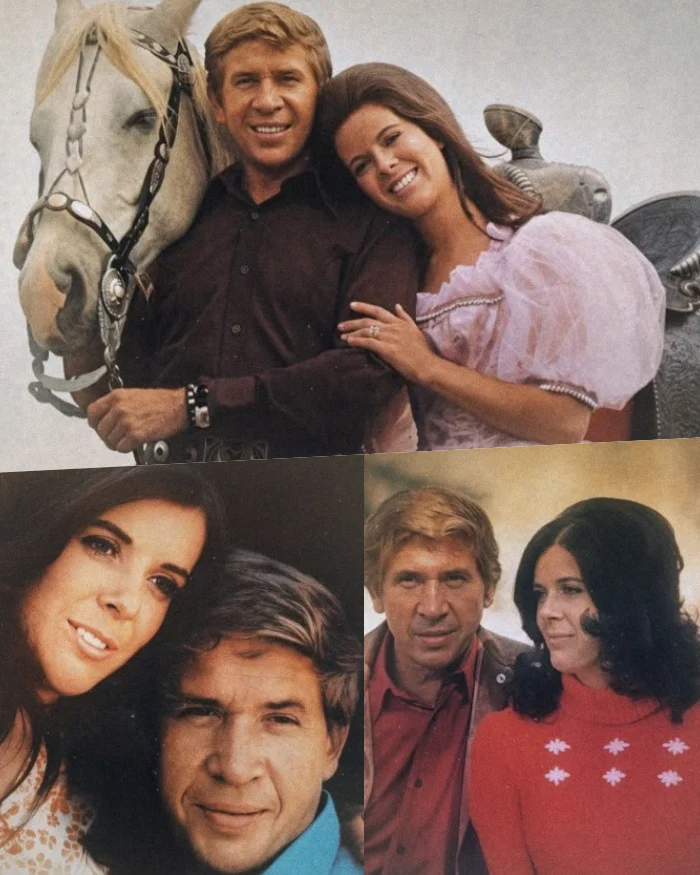
The most moving moment in Buck Owens’ autumn 1970 studio date was not a soaring lead line but the space he left behind it. He had built his name with a bright Fender Telecaster twang and a hard driving Bakersfield pulse. Yet when he entered Capitol Records Studio B in Hollywood in October 1970, he chose a gentler path and placed a rising singer named Susan Raye at the center.
For nearly a decade, Owens had leaned into the microphone over Don Rich’s crisp Telecaster leads while rhythm tracks pushed the song forward. On the sessions for ‘The Great White Horse’, he pulled the tempo back completely. Raye, an Oregon native who had joined his touring organization only two years earlier, needed room to be heard, and the material asked for restraint instead of honky-tonk volume.
The title song came from a writing session between Owens and Leanne Scott, who was then married to Rich, the longtime guitarist and musical anchor of the Buckaroos. Instead of barroom heartbreak or betrayal, the lyric offered a fable about romantic hope. It set childhood dreams of knights and storybook rescues against the quieter choice of building a shared life. Arranged as an acoustic waltz with soft strings, the track let Raye’s bright soprano stand in front while Owens supported from below with a low harmony.
Capitol released the single in late summer 1970, and programmers were surprised by the absence of the usual Bakersfield drive. Within weeks the record climbed to number eight on the Billboard Hot Country Singles chart and crossed into the Easy Listening surveys. The full album, produced by Owens himself, reached the country top twenty before the year ended.
The partnership was not a casual studio favor. Owens used his established standing to help Raye grow into a solo artist rather than a background voice inside his revue. Born in Eugene, Oregon, she had sung on local radio and performed at military clubs before auditioning with Jack McFadden, Owens’ longtime manager. McFadden brought her to Bakersfield, where Owens signed her to an artist management deal and placed her on his syndicated television program, ‘The Buck Owens Ranch Show’.
By 1970, Owens had one of the largest media footprints in American entertainment. He co-hosted the nationally syndicated variety show ‘Hee Haw’ with Roy Clark and brought his ensemble into thirty million homes every week. Rather than keeping that spotlight for himself, he carved out regular feature segments for Raye, giving the twenty-six-year-old singer prime-time exposure that many country artists spent decades trying to secure.
Their working relationship was practical and demanding. In the studio, Owens insisted on clean vocal articulation and straight-ahead melodies that working-class listeners could catch on the first pass. Raye adapted to his quick tracking schedule and often recorded full master takes in two or three passes beside the core Buckaroos rhythm section of bassist Doyle Holly and drummer Jerry Wiggins.
The balance they found on ‘The Great White Horse’ sparked a five-year recording partnership. During the first half of the 1970s, Owens and Raye released five joint studio albums for Capitol and scored additional charting duets including ‘Togetherness’, ‘Love Is Strange’, and ‘We’re Gonna Get Together’.
That shared visibility gave Raye the foundation she needed to launch her own catalog. With Owens in the producer’s chair, she cut solo hits such as ‘Willy Jones’ and her signature 1971 crossover single ‘L.A. International Airport’. The song earned international sales honors and made her a headliner in her own right.
For Owens, stepping into a supporting role at the peak of his commercial power revealed an artistry that loud amplifiers rarely showed. He softened his public sound so a younger voice could rise beside him, and that choice left a mark beyond chart placement.
‘True leadership in country music often meant opening the door for someone else to step through beside you.’