
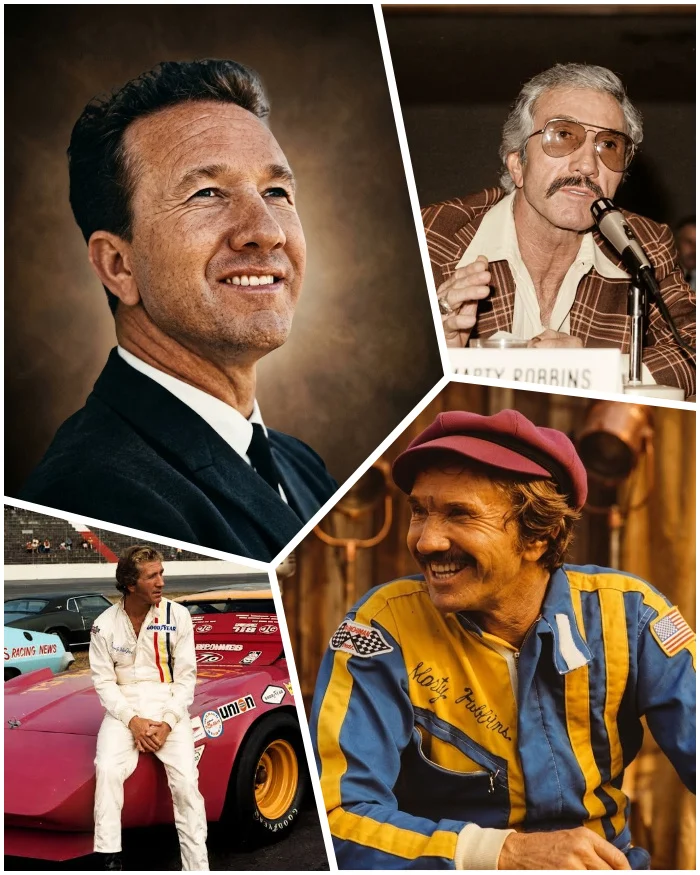
In the sweltering heat of a May afternoon in 1972, a country music legend pulled off one of the most audacious stunts in stock car racing history—then gave it all back with a smile. Marty Robbins, the 46-year-old Grand Ole Opry star, had just crossed the finish line at Talladega Superspeedway after running nearly 190 miles per hour in his purple-and-gold No. 42 Dodge Charger, leaving Richard Petty and Bobby Isaac in his rearview mirror. But instead of collecting the Rookie of the Race trophy and a $1,300 check, Robbins walked straight to NASCAR’s chief inspector and confessed: he had knocked the restrictor plates out of his carburetor.
Robbins had qualified at roughly 172 miles per hour, enough for ninth on the 50-car grid. But the night before the Winston 500, he took the mandatory airflow restrictor device back to his hotel room and modified it so his engine could breathe without the safety limit. When the green flag dropped, his Dodge surged 15 mph faster than his qualifying pace, blowing past seasoned factory teams and leaving legends like Petty, Isaac, and Cale Yarborough staring as the No. 42 car roared by on the straightaways.
His goal was simple, as he later told the stunned inspectors:
“I just wanted to know what it felt like once in my life to run flat out at top speed and see legends like Petty and Isaac in my rearview mirror.”
Robbins had no interest in stealing a win or taking money that didn’t belong to him. After completing 179 of 188 laps, he voluntarily pulled into the pits, ensuring he wouldn’t take finishing positions or prize money away from full-time racers. Then, with a grin, he handed over the modified carburetor to technical inspector Bill Gazaway, who disqualified the car and dropped Robbins to last place.
Instead of facing a heavy fine or suspension, NASCAR officials simply confiscated the part—turning Robbins’s honest confession into one of the sport’s most beloved stories. The locker room of full-time drivers respected him even more for pulling off the track and turning himself in. Over the next decade, Robbins returned to Talladega nine more times as an accepted regular, scoring two Top 10 finishes before his final Cup start in November 1982, just a month before his passing at age 57.