
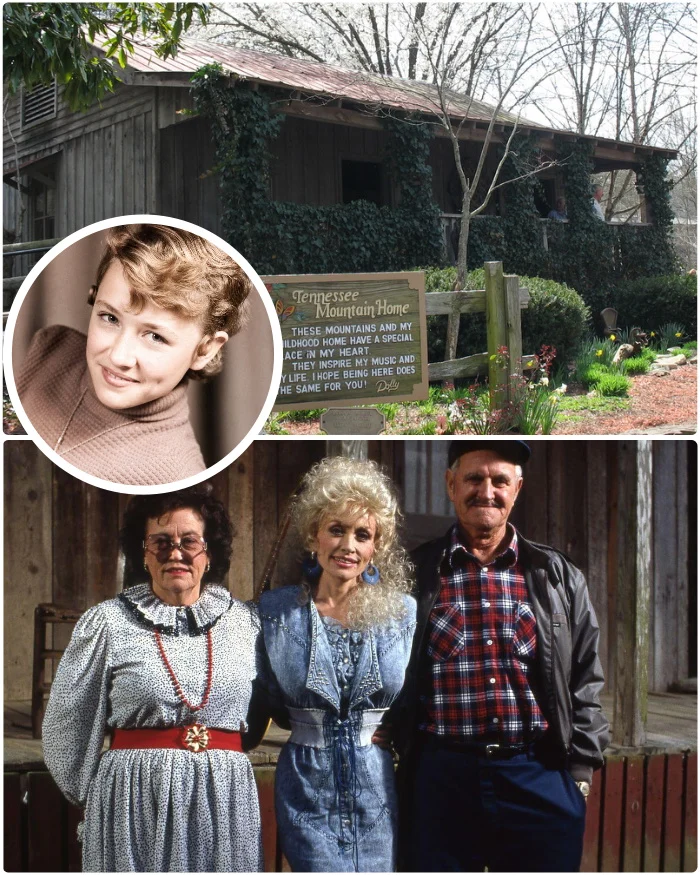
The most famous woman in country music once spent a fortune to make a two-room cabin look poor again. That is the paradox at the heart of Dolly Parton’s private sanctuary on Locust Ridge in the Great Smoky Mountains. The world knows her as a rhinestone-covered global empire. Yet the place she fought hardest to reclaim is a rusted tin roof and newspaper-lined walls that held twelve children in the hills of Sevier County, Tennessee.
In the late 1980s, the original Locust Ridge property slipped into the hands of outside owners. This was the same ground where Robert Lee and Avie Lee Parton raised twelve children in a space barely large enough to hold them. Parton did not negotiate for long. She bought the land back immediately.
She did not clear the plot for a secluded mansion. Instead, the country music icon chose to rebuild the original two-room cabin of her childhood with exacting care. She wanted the rusted tin roof, the rough-hewn wood, and the same floor plan where her family once crowded around a single wood stove. The original structure had no electricity and no indoor plumbing. Parton wanted the restoration to honor that uncompromising reality.
This was never a simple decorating project. Parton brought in her brother Bobby, a skilled builder, to handle the structural framing. She and her mother took charge of the interior. Parton tracked down extended relatives and bought back original family belongings, paying a premium to return them to the mountain. For items that had been lost or destroyed, mother and daughter scoured local antique stores. They refused anything less than exact era-accurate matches for the washbasins, beds, and chairs the family once used.
The detail went beyond furniture. Parton insisted that old newspaper pages be pasted directly onto the wooden walls. It was not a rustic design choice. It was a precise copy of the method Avie Lee used to seal cracks and keep the bitter Appalachian winter wind from reaching her children as they slept.
Those same two rooms gave birth to stories behind some of the most enduring songs in country music. The cabin was the physical birthplace of the songwriting well Parton would draw from for the next sixty years. Restoring it was not only about preserving a building. It was about protecting the origin point of her entire catalog.
Millions of tourists walk through a replica of the home at Dollywood every year. The replica lets fans step inside the humble beginnings of a global superstar. The actual restored cabin on the mountain remains entirely private. There are no tour buses, no ticket booths, and no cameras allowed on the Locust Ridge property. It stands as a closed sanctuary where the surviving Parton siblings can gather away from the public eye, sit on the porch, and remember a time before the world knew their last name.
Parton has often joked in interviews that it cost her a lot of money to look that poor.
It cost her a lot of money to look that poor.
The legendary punchline hides a deep and quiet reverence for her parents. Keeping the harsh reality of her upbringing intact was her way of honoring the people who carried the family through it with dignity and faith.
She made sure the cabin stood exactly as it did when the family had nothing but each other. The woman who became synonymous with glamour and wealth never truly walked away from the mountains. She built an empire large enough to protect them, ensuring that the true foundation of her legacy would always belong to her family.
The longer story of how she located and recovered the specific artifacts that fill those two rooms remains a much deeper chapter of the Locust Ridge story.