
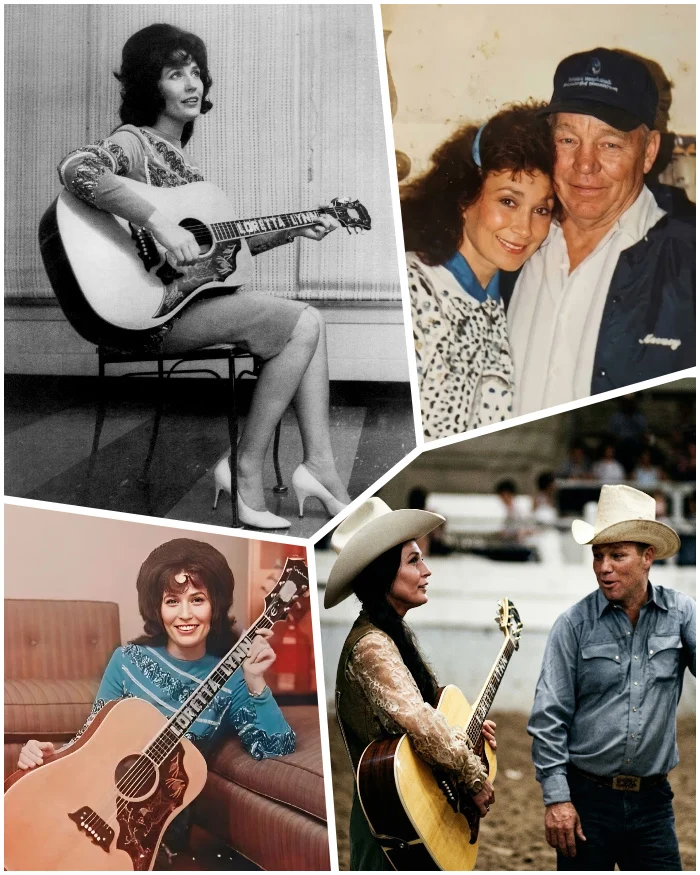
In the late spring of 1960, a 1955 Ford Fairlane pulled into Nashville with two exhausted passengers and a trunk full of dreams. Loretta Lynn and her husband Doolittle had driven three months from Washington state, leaving their four children behind, to hand-deliver records to radio stations across the South. They slept in parking lots, ate bologna and crackers, and faced every obstacle a young singer could imagine. Yet by the time they reached Music City, Loretta’s debut single was climbing the charts—and her life was about to change forever.
Seven years earlier, in Custer, Washington, Doolittle had spent $17 at Sears, Roebuck & Co. on a Harmony guitar for Loretta’s twenty-first birthday. He had noticed that her lullabies to their babies were better than anything on the radio. That humble gift sparked a passion that would take her from a coal miner’s daughter in Butcher Hollow to the Grand Ole Opry stage.
In February 1960, Canadian lumber businessman Norm Burley heard Loretta on a local Tacoma television show. He founded the small label Zero Records and backed her first session with producer Don Grashey at United Western Recorders in Hollywood, where she recorded her self-written song, “I’m a Honky Tonk Girl.” With no marketing budget, the couple stayed up late at their kitchen table, addressing and packing more than 3,500 records and promo photos for radio stations before hitting the road.
The journey was grueling. Loretta, who had never left her children before, cried almost every night in the passenger seat. To save gas money on an 80,000-mile push, they skipped motels and restaurants, sleeping curled up on car seats in station parking lots and surviving on crackers, cheap bologna, and packaged cheese. Raised in poverty, Loretta was so shy that Doolittle had to walk into stations first to introduce her. She often stared down at her worn shoes while talking—until she sang unaccompanied and stunned the DJs in the room.
When their old Ford finally rolled into Nashville, “I’m a Honky Tonk Girl” was climbing toward Number 14 on the Billboard country chart without a major label behind it. The Wilburn Brothers took notice, leading to her Grand Ole Opry debut on October 15, 1960, a record seventeen-week run on the Opry stage, mentorship from Patsy Cline, and a contract with Decca Records.
“I was so shy I couldn’t talk to people, but when I sang, I could say anything.” — Loretta Lynn
At Decca’s Quonset Hut studio on Music Row, producer Owen Bradley paired her mountain vocal phrasing with the Nashville A-Team session musicians. In 1962, her single “Success” gave her a Number 6 country hit and prompted the Grand Ole Opry to induct her as an official member on September 25, 1962. Later in the decade, she began recording bold, autobiographical compositions that defined her career—starting with “You Ain’t Woman Enough (To Take My Man)” in 1966 and her first Number 1 single, “Don’t Come Home A-Drinkin’ (With Lovin’ on Your Mind),” in early 1967.
By October 1972, twelve years after she and Doolittle had slept in their 1955 Ford outside the Ryman Auditorium while peddling records out of the trunk, Loretta stood on the Nashville stage as the first woman ever named Entertainer of the Year by the Country Music Association. From a $17 Sears guitar to the pinnacle of country music, her journey was a testament to grit, talent, and the power of a dream—and a husband who believed in it.