
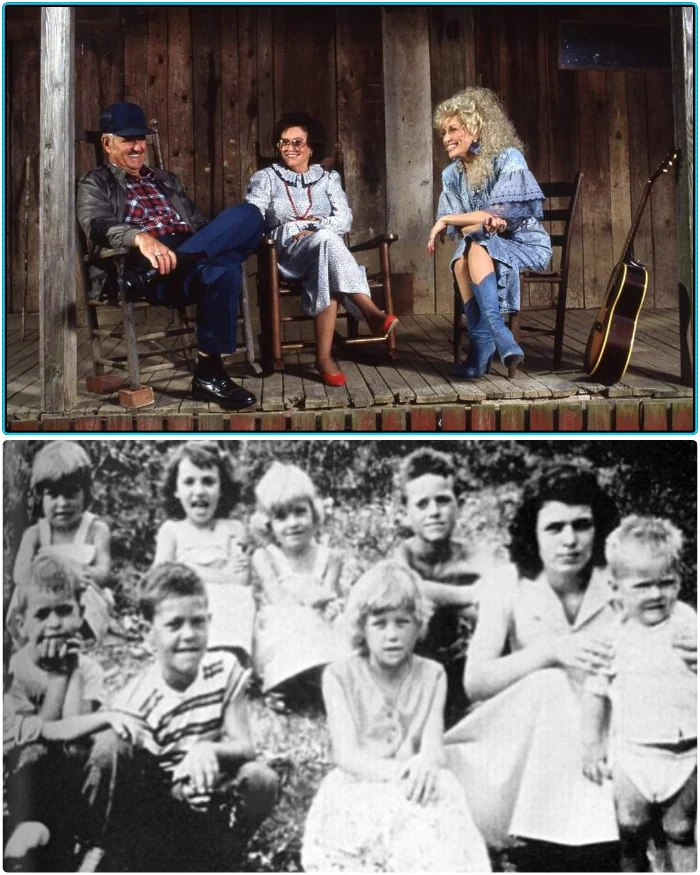
For the father who could not read, his daughter’s love became hundreds of millions of free books. That daughter was Dolly Parton, and the story of how she turned a childhood of extreme poverty into a lifelong mission to lift others begins in a one-room cabin in Locust Ridge, Tennessee, in the Smoky Mountains.
Dolly was the fourth of twelve children. The doctor who delivered her in that Locust Ridge cabin accepted a sack of cornmeal as payment. The family home had no electricity and no running water, and the Appalachian winters demanded a quiet, relentless endurance.
When winter came, her mother sewed clothes from scrap fabric. One year those discarded rags became a small patchwork coat. Classmates laughed at the garment, but the young girl wore it with immense pride. Poverty did not harden her. It shaped a specific kind of ambition.
Music became her way out. By age ten she was singing on local radio and television. At thirteen she stepped onto the Grand Ole Opry stage for the first time. The morning after her high school graduation she packed her clothes into a crumpled paper bag and boarded a Greyhound bus to Nashville.
Nashville was famous for chewing up young talent, but she learned the industry quickly. During her first recording sessions she watched where the real money went. She saw that songwriting and publishing were the true currency of the town. Before she became a household name she co-founded her own publishing company to keep control of her catalog. That sharp business sense led to one of her most famous financial choices. She refused to sign over half of her publishing rights to the biggest rock star in the world for a cover of her most famous ballad.
Global fame and hit records made her one of the most recognizable women on earth, but she did not abandon the mountains that raised her. She returned to Sevier County with a masterclass in economic development. She opened a major theme park in her home region because she knew tourism could transform the landscape. The venture directly created thousands of steady jobs and helped revitalize the community that had known the same poverty she survived.
Yet her most personal work was built for her father. He was a deeply intelligent and hardworking man who provided for twelve children, but he lived his entire life unable to read or write. She saw how illiteracy could quietly limit a brilliant mind. To make sure no child faced the same barrier, she launched the Imagination Library. The program began by mailing high-quality books to children in her home county from birth until kindergarten.
As her empire grew, so did the program. It expanded around the world and mailed hundreds of millions of free books to children. For the girl who grew up without electricity, every book given away was a quiet thank you to the man who raised her.
A patchwork coat and a paper bag of clothes were the foundations of a relentless drive to lift up the people around her.
She conquered the music business not just to see her name in lights but to guarantee that the mountains she called home would never be left in the dark. How a teenager navigated her first recording sessions and built the business acumen to change her hometown remains a masterclass in country music history.