
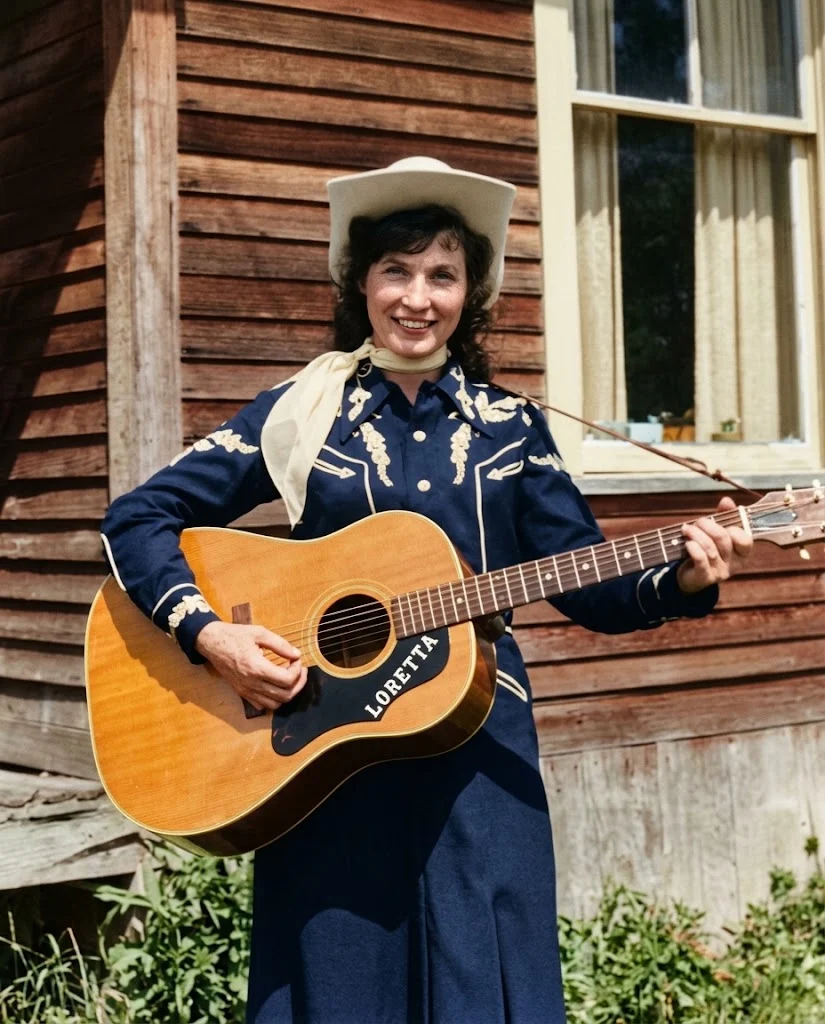
In the misty, rain-soaked fields of Washington, a young mother with calloused hands and a heart full of Appalachian longing was about to change the face of American music forever.
Loretta Lynn, just twenty years old and already raising four children, found herself thousands of miles from the rolling hills of Butcher Holler, Kentucky. Her days were a relentless grind of picking strawberries until her fingers ached and cooking meals for thirty-six hungry loggers in a remote logging camp.
But it was the quiet moments that nearly broke her. Homesickness clung to her like the damp fog, and she would sing old mountain melodies while washing clothes, pouring her isolation into the soapy water. It was in one of those moments of raw vulnerability that her husband, Doolittle, heard something extraordinary in her voice.
Believing in her before she believed in herself, he spent a hard-earned seventeen dollars on a Harmony guitar straight from the Sears Roebuck catalog. That cheap instrument was unforgiving, its stiff, high steel strings cutting deeply into her unconditioned fingers as she tried to form her first chords. Her hands, already weathered from scrubbing floors and working the wet fields, bled as she forced them to learn the instrument.
Soon, her husband pushed his painfully shy, timid wife onto the tiny stage at Bill’s Tavern in nearby Blaine, Washington. Standing before a noisy crowd of drinkers, loggers, and local workers, she was terrified, initially keeping her eyes fixed firmly on the floor.
But as she played, that seventeen-dollar guitar quickly became more than wood and wire. It became a key to a different life, allowing her to reclaim her identity as a woman with her own unvarnished truth to tell.
When a small label named Zero Records finally funded her first single, “I’m a Honky Tonk Girl,” the couple knew the established industry would not simply open its doors to an unknown mother of four. Instead of waiting for permission, they took control of their own fate.
They loaded their children into a 1955 Ford and spent three grueling months driving coast to coast, living entirely on bologna and cheese sandwiches. They walked directly into local radio stations in nearly every town they passed, introducing themselves to disc jockeys and hand-delivering the record.
It was a relentless, street-level hustle that completely bypassed Nashville’s powerful gatekeepers, forcing the industry to pay attention on her terms. By the time they finally pulled into Tennessee, the song was already climbing the national charts, effectively rewriting the rules of how a country artist could break through.
That same independent grit defined the rest of her legendary career at Decca Records. She refused to sing sanitized songs about perfect romances. Instead, she began writing about the harsh realities of marriage, the exhaustion of motherhood, and the daily fight for respect, saying out loud what other women were only allowed to whisper in private.
She never lost the toughness forged in those Washington logging camps. The authenticity that made her a global icon was never a carefully crafted marketing strategy; it was the direct, unfiltered result of a life lived on the sheer edge of survival.
She gave a permanent, unapologetic voice to working-class women who had always felt invisible. The bleeding fingers that fought those cheap steel strings eventually built a catalog that fundamentally changed American music.