
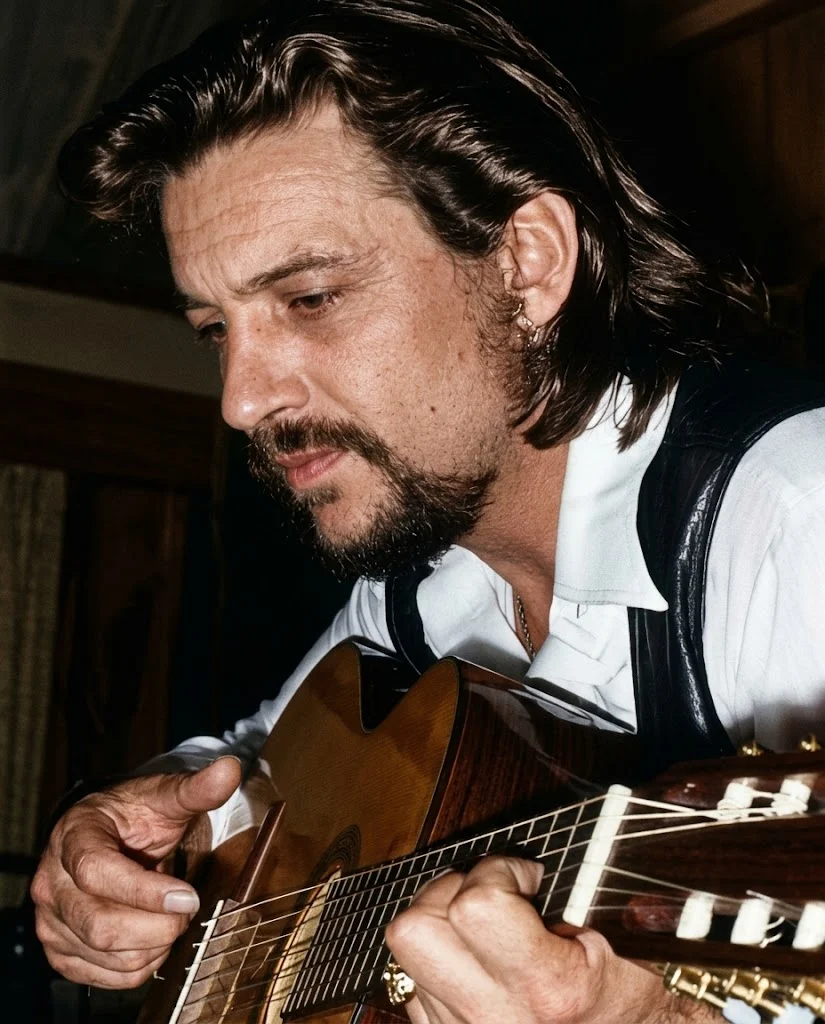
When Waylon Jennings collapsed from acute hepatitis in the early 1970s, he wasn’t just fighting a medical battle—he was fighting for his artistic soul. The man who would become the architect of the Outlaw movement lay in a hospital bed, forced to confront a truth more painful than any physical ailment. The system that had promised him stardom had instead left him exhausted, indebted, and creatively bankrupt.
Jennings had been living on the edge, performing roughly 300 shows a year to keep the Nashville music machine running. The traditional studio system was an assembly line of manufactured hits, where producers chose the songs, hired the session musicians, and dictated the sound. Artists were expected to show up, sing, and move on—no questions asked.
To survive the grueling pace, Jennings relied on amphetamines, pushing his body to its breaking point. The inevitable collapse came when he was hospitalized, and in that quiet hospital room, the silence spoke volumes. He realized he was deeply in debt, his health deteriorating, and his career controlled by a system that didn’t care if he lived or died.
The rebellion that followed wasn’t just about artistic freedom—it was about survival. Jennings fired his old management and hired Neil Reshen, a tough, no-nonsense negotiator who had no patience for Music Row’s polite traditions. Together, they turned Jennings’ lowest point into a powerful weapon, forcing RCA Records to the negotiating table.
In a landmark 1972 renegotiation, Jennings won unprecedented creative control. He secured the right to bring his own band, The Waylors, into the studio, choose his own material, and design his own album covers. That victory paved the way for ‘Honky Tonk Heroes’ in 1973, a stripped-down masterpiece that became the foundation of the Outlaw movement.
The scarred, defiant voice that would define a generation was forged in the harsh reality of that collapse. The Nashville machine nearly broke him, but in the end, it was Waylon Jennings who changed the machine—proving that sometimes, the greatest victories come from the most unexpected places.