
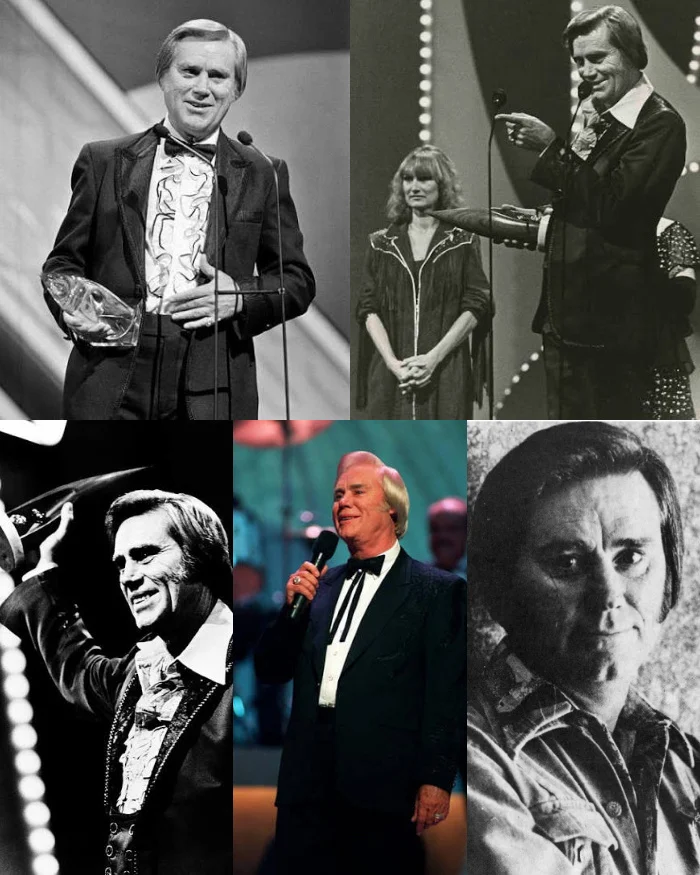
The moment George Jones stepped onto the stage at the Grand Ole Opry House on October 13, 1980, the room erupted. The Country Music Association had just named him Male Vocalist of the Year, and the standing ovation that followed was not merely polite applause—it was a roar of redemption from an industry that had nearly lost him forever.
Earlier that evening, his haunting ballad He Stopped Loving Her Today had taken Single of the Year, while songwriters Bobby Braddock and Curly Putman collected Song of the Year honors. For Nashville, the night was a collective embrace of an artist many had already written off.
Just months prior, Jones was at rock bottom. Bankrupt, homeless, and battling severe substance abuse, he had become notorious for missing concert dates—earning the painful nickname “No Show Jones.” His career seemed not just stalled, but finished.
The turning point happened behind the soundproofed walls of CBS Studio B, where veteran producer Billy Sherrill was determined to capture a masterpiece. Sherrill had worked with Jones since 1971, but by 1979 the partnership was fraying. He believed the Braddock and Putman ballad about unyielding devotion that only ended in the graveyard was the perfect vehicle for Jones’s voice.
Jones disagreed. He told Sherrill that no one would buy something so morbid and sad. But Sherrill persisted.
“Getting the performance onto tape turned into an exhaustive test of stamina.”
Between 1978 and early 1980, Sherrill booked multiple recording dates, but Jones often arrived physically depleted or unable to focus on the melody. In several takes, Jones unconsciously drifted into the melody of his earlier hit Help Me Make It Through the Night, forcing Sherrill to halt the tape machine and reteach the progression phrase by phrase.
Instead of demanding a single live master take, Sherrill patiently constructed the track piece by piece. He kept the tracking band relaxed, brought Jones back to the microphone during brief windows of sobriety, and recorded individual vocal lines whenever Jones felt strong enough to sing.
The spoken recitation near the end of the song presented its own hurdle. Jones struggled to deliver the passage with steady diction, prompting Sherrill to punch in the lines syllable by syllable across separate afternoons.
Once the lead vocal was finally captured, Sherrill applied his trademark orchestral approach to complete the atmosphere. He enlisted steel guitarist Hargus “Pig” Robbins on piano, brought in weeping pedal steel accents, and layered sweeping string arrangements alongside soprano backing vocals from Millie Kirkham. The lush backdrop did not cushion Jones’s pain; it gave his weathered, cracked baritone an echo chamber that made every lyric feel earned.
When Epic Records released the single in April 1980, it shattered Jones’s commercial drought, rapidly climbing to number one on the Billboard country chart and remaining there for four weeks.
The single revived his stalled touring business and offered Jones the first solid ground he had walked on in years. When he climbed the steps to accept his awards six months later, his hands trembled under the studio lights. The victory was a direct product of the quiet patience shown inside a dark control room, where a determined producer refused to give up on an ailing friend until the truth was captured on tape.