
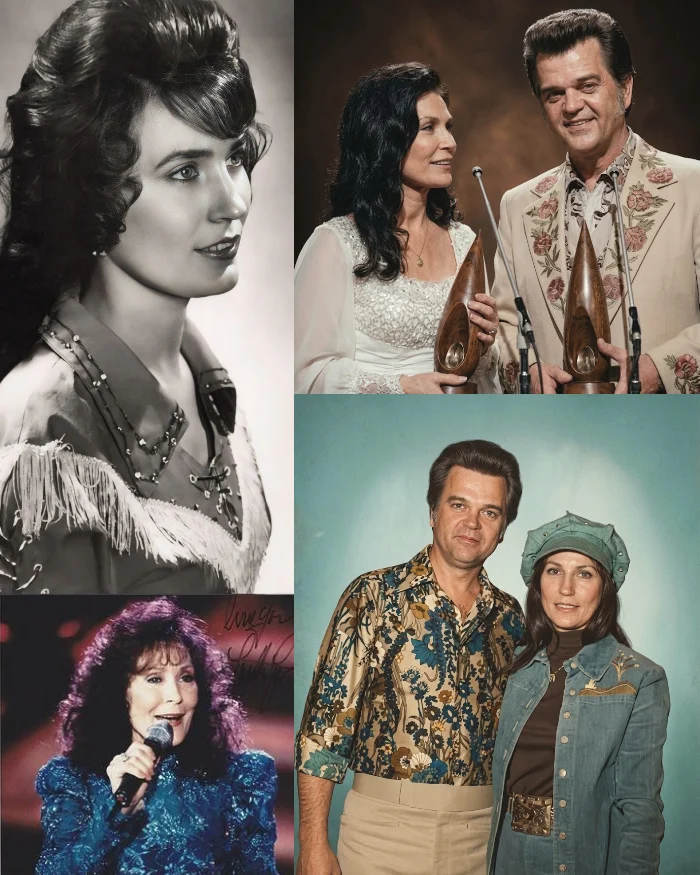
The night of June 4, 1993, was supposed to be a routine post-concert evening for Conway Twitty. But as his tour bus rolled away from Branson, Missouri, the legendary singer collapsed, clutching his abdomen in agony. Paramedics rushed him toward Cox South Hospital in Springfield, unaware that the woman who had shared his greatest musical triumphs was already inside those same walls—waiting for a different miracle.
Loretta Lynn had been living in the hospital’s shadows for days. Her husband, Oliver “Doolittle” Lynn, lay in the intensive care unit, recovering from emergency open-heart surgery. When Twitty was wheeled through the emergency doors with a ruptured abdominal aortic aneurysm, Lynn found herself torn between two rooms—one holding the man who gave her a home and family, the other sheltering the artist who had harmonized with her through decades of rural radio waves and packed arenas.
In the surgical waiting area, Lynn clutched the hands of Twitty’s wife, Dee Henry, as doctors fought through the early morning hours to stem the internal bleeding. But by dawn on June 5, every measure had been exhausted. Conway Twitty died at age 59, silencing one of country music’s most beloved voices.
“It was like the music just stopped,” one witness recalled. “You could feel the silence in the building.”
Doolittle Lynn eventually survived his recovery, but Loretta left Springfield carrying a grief that no stage could soothe. The partnership that had defined a genre was gone, severed not by a fading chart position but by a hospital corridor’s cold emptiness.
Their alliance had never been accidental. By 1970, both were solo stars under Decca Records, produced by Owen Bradley, who saw the magic in pairing Lynn’s raw Appalachian edge with Twitty’s polished Mississippi baritone. When they cut “After the Fire Is Gone” at Bradley’s Barn in Mount Juliet, Tennessee, the chemistry was undeniable—a number-one hit in 1971 and a Grammy that cemented their place in history.
For the next decade, they released a studio album every single year, stacking five consecutive chart-toppers and twelve Top 10 singles. The Country Music Association named them Vocal Duo of the Year four years running, from 1972 to 1975—an unprecedented streak. But their influence didn’t stop at vinyl. They toured relentlessly, filling arenas and state fairs with a show that felt less like a performance and more like a conversation between friends.
Behind the scenes, the logistics demanded absolute trust. Twitty, a meticulous businessman, anchored the operation while Lynn battled exhaustion and migraines on the road. Fans speculated about romance, but the truth was simpler and deeper: they were confidants, allies who understood the weight of superstardom without losing their rural Southern roots.
That bond was what held Lynn upright in that waiting room, as doctors delivered the news that would end an era. Doolittle lived three more years, but when Loretta walked out of Cox South Hospital that June, she left behind the friend who had shared thousands of miles and countless harmonies. The quiet halls of Springfield had witnessed the final, sudden parting of country music’s golden duet—and the silence that followed was deafening.