
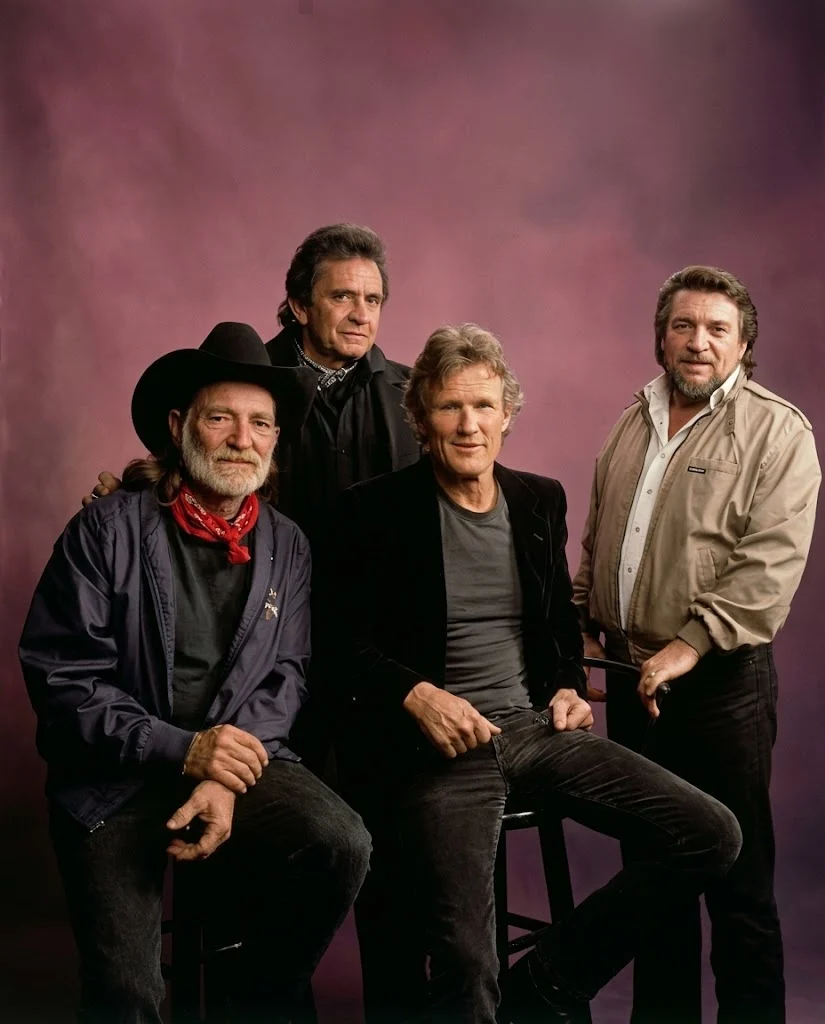
In the early 1980s, Music Row executives had quietly turned the page on the outlaw movement. Nashville was transitioning, embracing a polished, pop-leaning sound that left its rough-hewn storytellers searching for relevance. Waylon Jennings, Johnny Cash, Willie Nelson, and Kris Kristofferson were dismissed by label heads as historical icons whose best days belonged to the past—until they closed ranks and proved everyone wrong.
“They were told their best recording days were over. Instead of fading away, they changed the definition of survival.”
In 1985, these four legends formed The Highwaymen—not as a corporate strategy, but as a natural convergence of survivors. Each carried heavy scars: public divorces, crippling IRS battles, and near-fatal addictions. They knew the cost of fame intimately, and they knew how easily that title could become an isolating burden.
For Jennings, the alliance was a lifeline. He was rebuilding his life after a severe cocaine dependency that nearly destroyed him. Stepping onto the stage alongside Cash, Nelson, and Kristofferson offered something rare: a true sanctuary. He no longer bore the weight of a tour alone. He was flanked by men who understood the grueling toll of the road, the loneliness of hotel rooms, and the quiet danger of rock bottom. They never judged the lines on his face—they wore the same miles.
Recording at Chips Moman’s Nashville studio, four notoriously stubborn alpha males could have clashed. Instead, they treated the sessions like a conversation around a kitchen table. When they cut their signature track, they didn’t fight for the mic—they divided the narrative by character. Nelson took the outlaw, Kristofferson the sailor, Jennings the dam builder, and Cash the starship captain. Moman recorded them together, letting their contrasting baritones trade spaces, and the friction of gravel, vibrato, and deep resonance became the record’s enduring power.
The result was a Platinum-selling debut that hit number one on the country charts—proof that unfiltered, lived-in voices still commanded authority. For the next decade, The Highwaymen recorded three albums and toured globally as the Mount Rushmore of country music. Audiences saw genuine smiles, shared glances, and profound respect that couldn’t be faked. When one forgot a lyric, another stepped in. When one struggled, the others carried the show. They gave each other permission to age with dignity in an industry that discards its pioneers.
They were more than a supergroup—they were a support system in plain sight. The industry expected them to bow out quietly. Instead, they stood shoulder to shoulder, proving that survival isn’t just about making it through the fire—it’s about who you choose to walk with on the other side.