
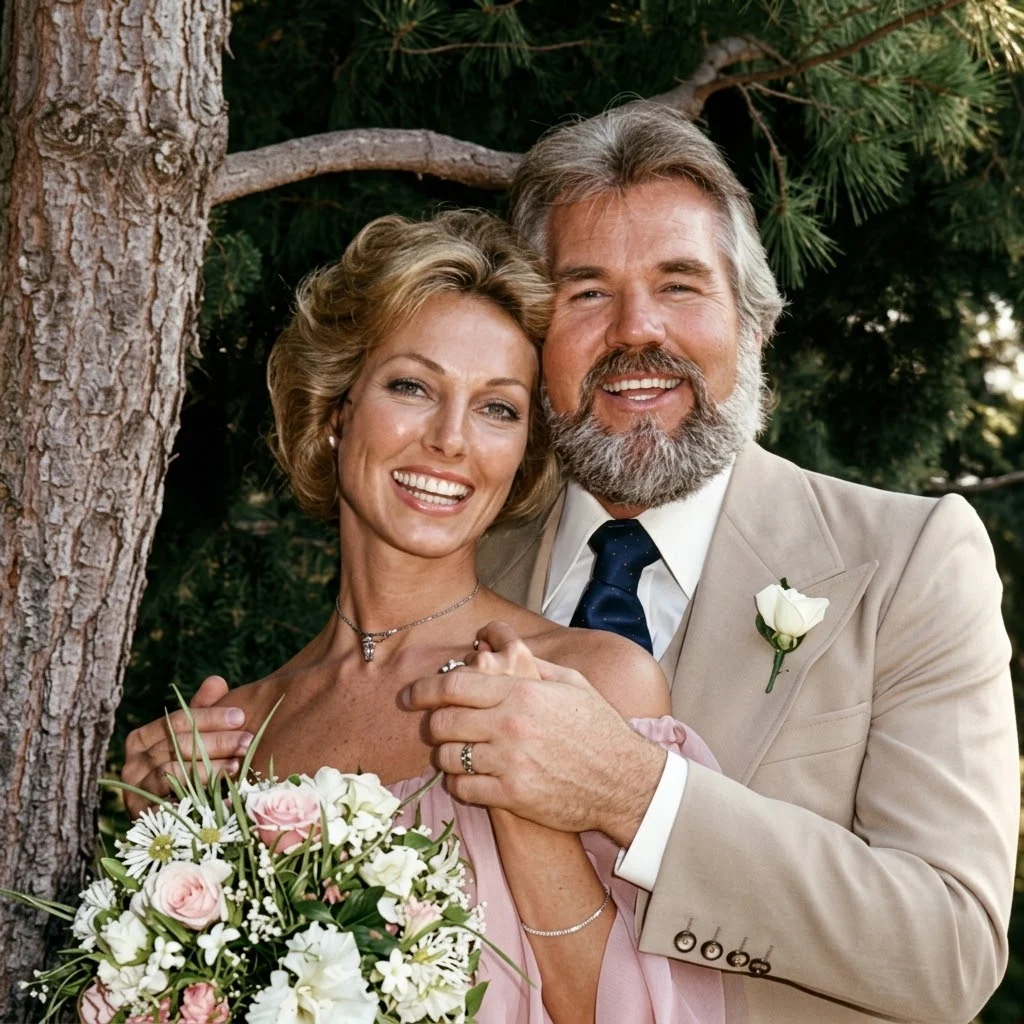
The most important turning point in Kenny Rogers’ career did not happen under a spotlight. It happened at an altar on October 1, 1977, when he married actress Marianne Gordon while his finances were still bruised and his future was anything but certain.
Rogers was thirty-nine and stepping into his fourth marriage. Just one year earlier, The First Edition had broken apart in a painful collapse marked by lawsuits, canceled television deals, and heavy financial losses. He was staring at roughly sixty thousand dollars in debt, and many industry insiders treated him as an aging artist with little left to offer.
Marianne was already a familiar face in American living rooms as a regular on the hit variety show Hee Haw. They had met during a guest taping in the mid-1970s, when Rogers was not a celebrated headliner but an uncertain musician trying to restart his life from scratch.
Her faith became the steady ground beneath a comeback that much of Nashville had not seen coming.
Long before arena crowds called his name again, Marianne absorbed the strain behind closed doors. She offered encouragement while Kenny played small clubs to make payroll and clear his obligations. She rearranged her own television schedule and traveled with him on exhausting commercial flights, giving him a calm refuge when industry doors kept closing.
The breakthrough arrived in early 1977 with Lucille. Written by Roger Bowling and Hal Bynum, the narrative ballad rose to Number 1 on the Billboard Country Singles chart, reached the top five on the pop charts, and earned a Grammy Award for Best Male Country Vocal Performance. By the time Kenny and Marianne exchanged vows that October, his unmistakable raspy voice was already pouring from car radios across the country.
That wedding day became the hinge where his luck turned. With Marianne anchoring their home life, Rogers entered the most commercially dominant era of his career. He signed lucrative deals with United Artists and worked with producer Larry Butler to build a remarkable run of crossover hits. Over the next five years, The Gambler, Coward of the County, She Believes in Me, and Lady turned him into a global cultural phenomenon.
The couple eventually settled on a sprawling estate outside Athens, Georgia, creating a private world far from the predatory pressures of the entertainment industry. In 1982, their son Christopher Cody Rogers arrived, and Marianne stepped away from active television work to raise him in a grounded environment.
Their sixteen-year union ended with a high-profile divorce in 1993, yet Rogers never hid his gratitude for the woman who stood beside him during his darkest chapter. In later reflections, he credited Marianne with giving him the inner peace he needed to rebuild his self-worth when almost nobody else was betting on him.
For an artist who spent decades under blinding stage lights, the foundation of his greatest triumph was forged in the quiet belief of a partner who stayed when his pockets were empty and the music had gone silent.