
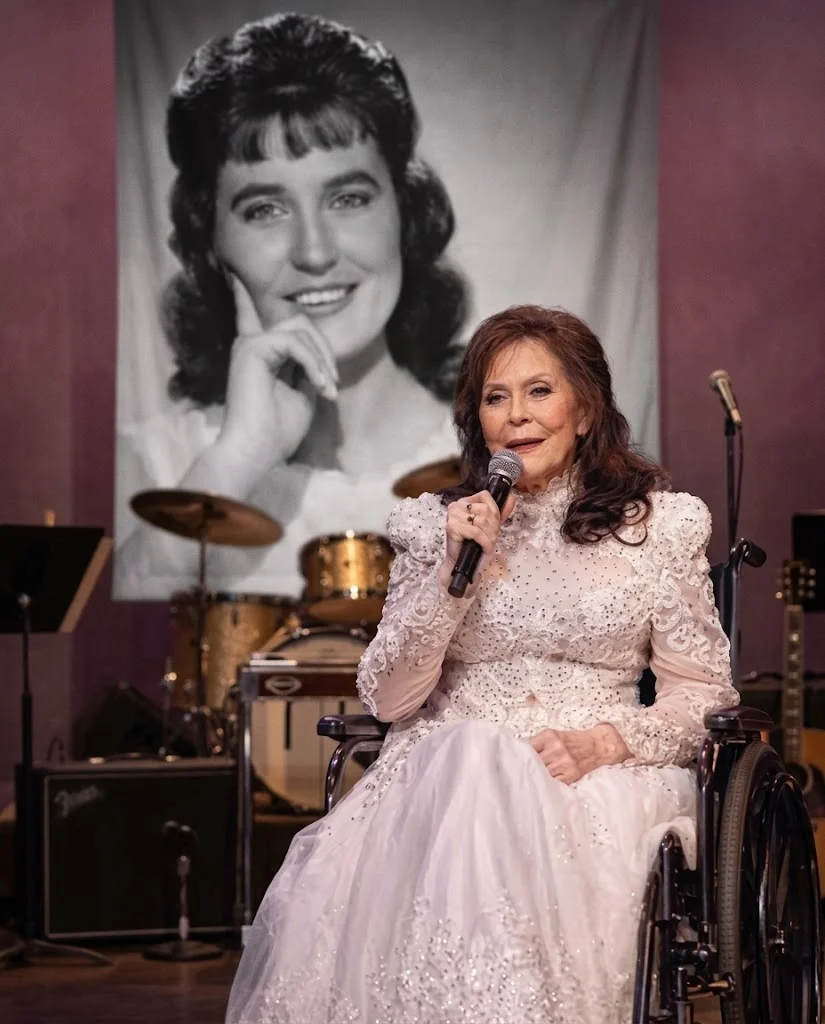
In May 2017, a sudden stroke forced Loretta Lynn to halt her decades-long highway journey. The 85-year-old country music legend was at her Hurricane Mills ranch when the medical emergency struck, sending her to a Nashville hospital and putting the brakes on a career that had been in constant motion since the 1960s.
Lynn’s demanding concert schedule was instantly cleared, and her forty-first studio album, Wouldn’t It Be Great, was shelved indefinitely. The project, co-produced by her daughter Patsy Lynn Russell and John Carter Cash at the Cash Cabin Studio in Hendersonville, Tennessee, would have to wait while she focused on rehabilitation.
For an artist defined by constant work, the quiet at Hurricane Mills was a profound shift.
Months of speech and physical therapy followed, all happening out of public view. Letters and prayers poured in from fans around the world, but the physical work of recovery was a private battle. Lynn’s voice and mobility were challenged, yet her commitment to the country music community never wavered.
That determination became visible just five months later, in October 2017. Lynn made an unannounced public return at the Country Music Hall of Fame Medallion Ceremony in Nashville. Seated in a wheelchair, she made her way into the CMA Theater to personally induct her longtime friend Alan Jackson. When she placed the medallion around Jackson’s neck, the entire room rose to its feet.
But the road to releasing her postponed music took another turn just a few months later. On New Year’s Day 2018, Lynn suffered a fractured hip in a fall at home. The secondary injury added another rigorous cycle of physical therapy, testing her patience but never shifting her focus away from the unreleased tracks sitting in Hendersonville.
Instead of abandoning the recordings, Lynn used the forced downtime to refine the project. She worked alongside Patsy to ensure the arrangements captured the acoustic weight she wanted. The collection spanned fresh interpretations of standards like “Coal Miner’s Daughter” and “Don’t Come Home A-Drinkin’,” alongside deeply personal new compositions such as “Ruby’s Stool” and the title track, which she had originally written decades earlier about her husband, Oliver “Doolittle” Lynn.
In September 2018, sixteen months after the stroke, Wouldn’t It Be Great finally arrived in stores. Released on Sony Music’s Legacy Recordings, the album proved that her vocal phrasing remained remarkably sharp, marked by the direct honesty that had defined her catalog since “I’m a Honky Tonk Girl.”
The delayed release served as tangible proof of what those secluded months in rural Tennessee had yielded. While the physical demands of long-distance touring had ended, the creative discipline that built her career remained fully intact.
Loretta Lynn never measured her life by the quiet periods between stages. Back home in Hurricane Mills, she simply treated recovery the same way she had always handled adversity: she went back to work, took her time, and let the music speak when she was ready.