
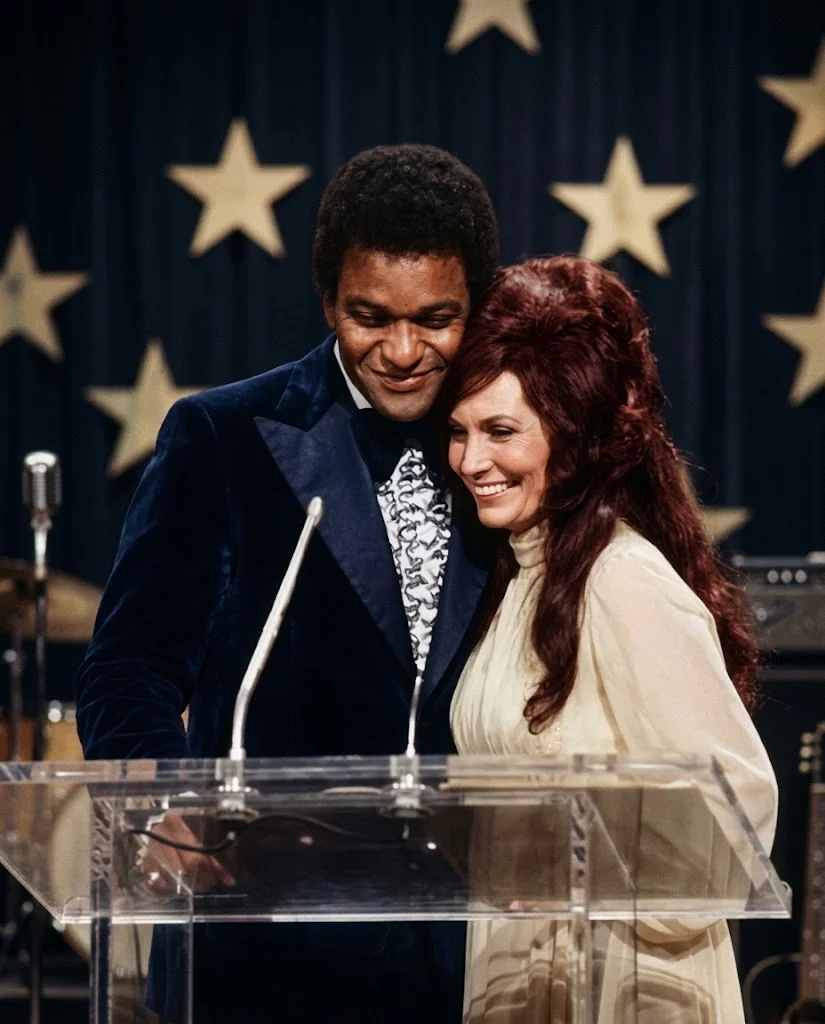
The most important gift Charley Pride received in Nashville was not a trophy or a record deal. It was Loretta Lynn’s willingness to stand beside him in plain sight.
When Charley Pride arrived in Nashville in the mid-1960s, the country music establishment was rigidly divided. Record executives hesitated to put a Black man on stage, fearing the reaction of a deeply traditional and often unpredictable fan base. RCA Records released his early singles without sending his photograph to country radio stations, hoping disc jockeys would judge his soaring, effortless baritone before they judged the color of his skin. During his earliest days performing live and walking the halls of the Grand Ole Opry, Pride navigated quiet hostility, skeptical stares, and closed doors. But Loretta Lynn, who was rapidly solidifying her own status as country royalty, refused to let him navigate that environment alone.
Lynn did not simply offer private encouragement in the dressing room. She understood the weight of her influence and deliberately used her popularity to force the industry’s hand. When promoters, peers, or venue owners hesitated to embrace Pride, Lynn publicly pulled him into her orbit. She shared the Opry stage with him and stood physically shoulder to shoulder under the Ryman Auditorium lights in front of thousands of listeners who revered her as the undisputed voice of the working class.
If the Coal Miner’s Daughter embraced him without a second thought, the audience implicitly understood that they were expected to do the same. She introduced him, stood by him in plain view, and silently challenged anyone in the building to question his rightful place in country music.
Their connection was not forged out of industry politics or public relations. It was rooted directly in the dirt of their beginnings. She had fought her way out of poverty in Butcher Holler, Kentucky, carrying the raw honesty of Appalachia in her voice. He was born to a sharecropping family in Sledge, Mississippi, and he picked cotton and played baseball before he ever stepped up to a Nashville microphone to sing the traditional western music he loved. They were both outsiders who had to fight for every inch of ground they gained in a notoriously insular town.
To Lynn, Pride was never a symbol, a trailblazer, or a racial pioneer to be paraded around. He was simply a fellow traditionalist.
I never looked at him by his color
That quote was not a passing comment in an interview. It served as a permanent, public shield against the era’s harsh prejudices. She fiercely protected him because she believed his smooth, soothing delivery made him one of the greatest vocalists the genre had ever recorded.
Behind the curtains of countless award shows and grueling package tours, away from glaring camera flashes and nervous executives, the two artists built a quiet sanctuary. Archival black-and-white photographs from those early decades capture them leaning in, laughing freely, and trading stories backstage. In those unscripted, untelevised moments, there were no invisible racial lines or historic burdens for Pride to carry. There was only a mutual, working-class respect that would sustain an unbreakable friendship spanning more than 50 years.
Charley Pride eventually shattered every barrier placed in front of him. He amassed dozens of number-one hits, earned the Entertainer of the Year trophy, and claimed his rightful spot in the Country Music Hall of Fame. His legacy as a pioneer is permanently secured in the history books.
But long before the Nashville establishment finally decided to hand him their highest honors, Loretta Lynn handed him her stage. The industry ultimately gave him a crown, but she gave him a sanctuary when the doors were still locked.