
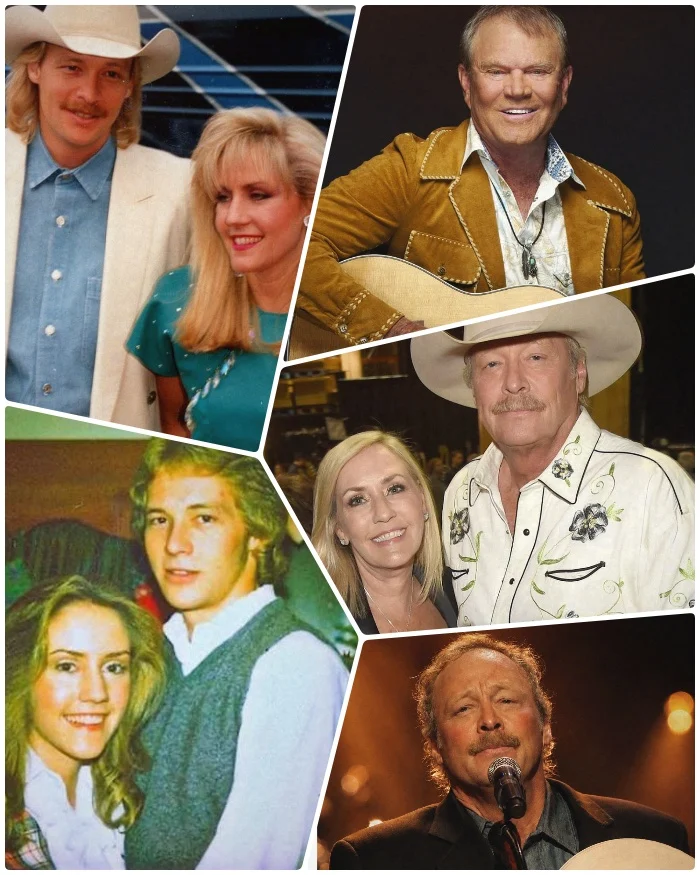
In June 1985, Alan Jackson and his wife Denise packed up their life in Newnan, Georgia, and drove to Nashville armed with a single address: the office of Glen Campbell’s publishing company. It was a leap of faith that would change country music history.
Months earlier, Denise, an Eastern Airlines flight attendant, spotted Campbell at Hartsfield Atlanta International Airport. Despite company rules discouraging flight attendants from approaching celebrities, she walked up to him and told him about her husband, a tireless musician who had spent six years since their 1979 wedding driving a Kmart forklift, doing carpentry, selling shoes, and trading used cars — all while honing his craft in local Georgia clubs at night.
“I just had to try,” Denise later recalled. “He was our shot.”
Campbell listened, handed her the business card of his manager Marty Gamblin, and told her to have Alan send a demo tape. When Alan visited Nashville to play his songs in person, Gamblin offered honest advice: his songwriting needed refinement, and he should move to town to learn the craft. Gamblin promised to help with day work if the couple made the leap.
So they did. Denise kept flying out of Atlanta to support them while Alan took an entry-level job in the mailroom of The Nashville Network at Opryland USA. For nine months, he sorted fan mail, pushed delivery carts through studio corridors, and watched established country artists walk the halls — all while writing songs at night, studying the classic structures of Hank Williams, Merle Haggard, and George Jones.
By 1986, Gamblin believed Jackson was ready. He signed him to Seventh Son Music at $125 a week, and Jackson formed the Strayhorns, playing small clubs across the Southeast for fifty dollars a night. Yet every major label on Music Row passed on him. Executives in the mid-1980s said traditional country hat acts were out of style and Jackson, nearing thirty, was too old to launch.
Then came the turning point: Clive Davis, the legendary pop and rock executive, decided to open a Nashville division of Arista Records and hired producer Tim DuBois to run it. Looking for a flagship artist, DuBois consulted Keith Stegall, who had been working with Jackson on demos. Stegall and Gamblin invited DuBois to watch Jackson perform live. Impressed by his tall frame, plainspoken delivery, and original material, DuBois made Jackson the very first artist signed to Arista Nashville in June 1989.
Paired with Stegall as producer, Jackson recorded his debut single “Blue Blooded Woman” that summer, followed by his full-length debut album Here in the Real World in early 1990. The album produced four consecutive top-five country hits, including his first number-one single, “I’d Love You All Over Again,” written for Denise on their tenth wedding anniversary.
Over the next three decades, Jackson sold more than sixty million records and earned three CMA Entertainer of the Year trophies while staying true to that same traditional sound.
When he was inducted into the Country Music Hall of Fame in October 2017, Jackson stood at the medallion ceremony podium looking out at Denise in the front row. He thanked the high school sweetheart who walked up to Glen Campbell in an Atlanta airport terminal thirty-two years earlier — before anyone knew his name.