
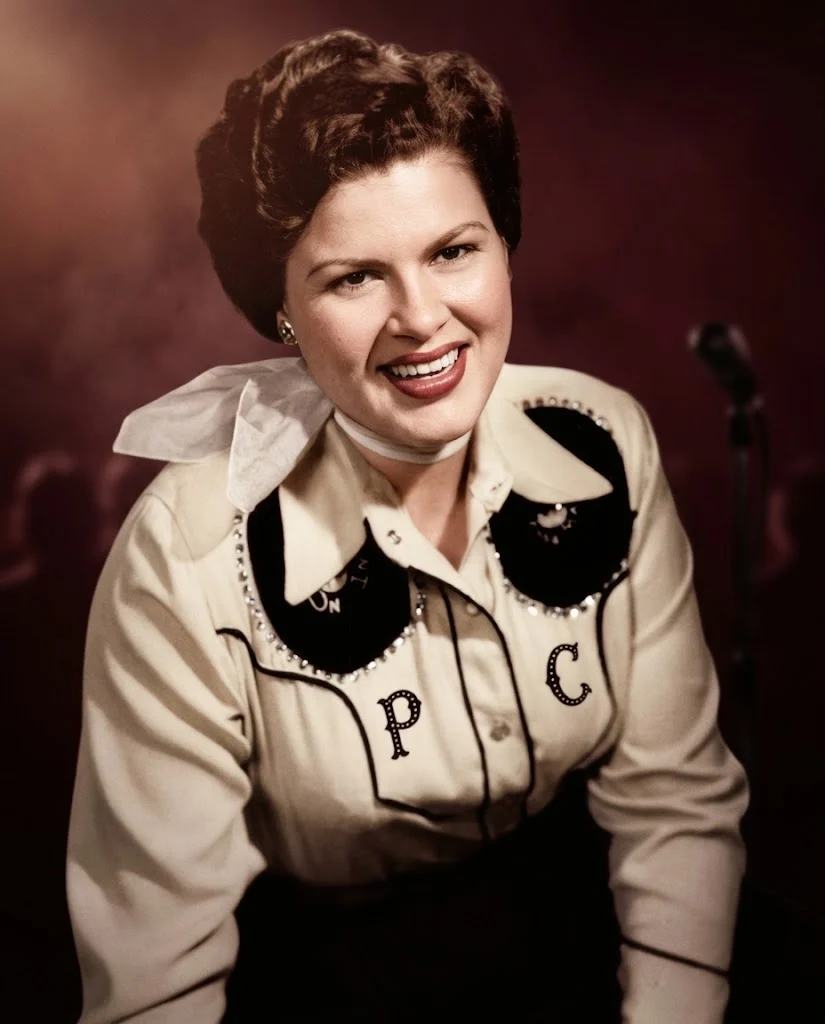
She gave her last days to a grieving widow, but the rush to reach her own children ended in a silence that would echo through country music forever.
On March 5, 1963, Patsy Cline was at the absolute peak of her fame. Yet her final choice was not that of a superstar—it was simply a mother desperate to get home.
The 30-year-old vocalist had just completed a series of charity shows in Kansas City, organized to support the family of Cactus Jack Call, a beloved local DJ who had been killed in a car wreck. Despite battling a severe cold, Cline refused to cancel her appearance. On March 3, she stepped onto the stage in a white chiffon dress, delivering a set that would unknowingly become her last public performance.
Her heart, however, was already pulling her back to Tennessee. Her husband, Charlie Dick, and her two young children, Julie and Randy, were waiting at their home in Goodlettsville. Friends had noticed she carried a quiet sense that her time was short, but she pushed that aside for the only priority that mattered: seeing her kids.
Her manager, Randy Hughes, piloted their small Piper Comanche, with fellow country stars Hawkshaw Hawkins and Cowboy Copas aboard. The group departed Kansas City, but heavy storms, fierce winds, and driving rain quickly turned the sky against them. They were forced to land in Dyersburg, Tennessee, to refuel.
The airport manager took one look at the darkening horizon and warned Hughes about the brutal conditions ahead. He even offered his personal car, advising them to drive the rest of the way—a route that would have taken hours but guaranteed their safety.
For a mother eager to embrace her children, a long, slow drive felt like an agonizing delay. Hughes was confident in his skills, and Cline was driven by a fierce need to walk through her own front door. They declined the vehicle, boarded the aircraft, and lifted off into the heavy overcast.
The plane never reached Nashville. It crashed in a rugged, wooded area near Camden, Tennessee, leaving no survivors. The sudden tragedy claimed Cline, Hughes, Hawkins, and Copas, fracturing the country music community in an instant.
The aftermath brought the entire industry to a standstill. Early the next morning, a young Roger Miller and other artists rushed into the rural woods to search through the wreckage, hoping for a miracle that never came. Nashville’s studios and offices effectively shut down as the city grappled with the loss of three major stars.
Yet, in the wake of that immense loss, the foundation Cline had built began to reshape the genre. Before her rise, female country singers were largely treated as opening acts or window dressing for male headliners. She demanded top billing, fought fiercely for equal pay, and proved that a woman could carry a national tour on her own shoulders.
Her unprecedented crossover success bridged the gap between traditional honky-tonk and mainstream pop orchestration. In 1973, she became the first female solo artist inducted into the Country Music Hall of Fame. Close friends like Loretta Lynn carried her memory forward, ensuring that Cline’s trailblazing business sense and unique vocal phrasing became the permanent gold standard for every woman who followed her to Music Row.
Among the items recovered from the crash site was a sleek wristwatch belonging to Cline. The delicate hands had stopped moving at exactly 6:20 PM. Time froze in that Tennessee forest, but the voice she left behind on vinyl refused to stay quiet.
The flight was supposed to be a simple journey back to a husband and two children. Instead, it became the moment an artist stepped out of the present and into permanence. She did not just leave behind a catalog of timeless records; she left the blueprint for what a woman in country music could achieve.