
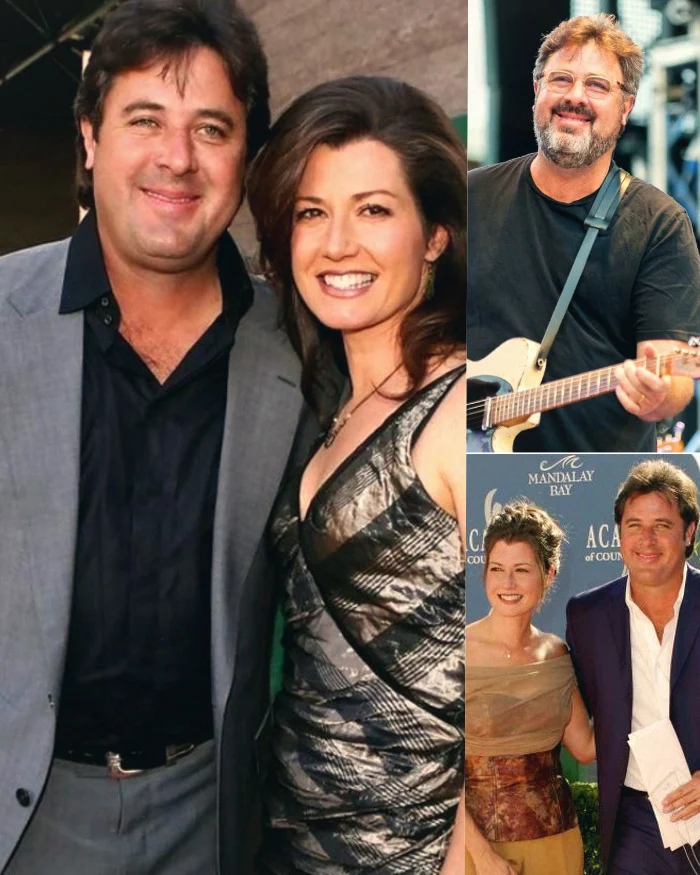
When the ‘King of Country Music’ extended his hand, Vince Gill didn’t just shake it—he broke down in tears. This wasn’t a fleeting moment of stage fright or a tearful thank-you speech. This was the culmination of a lifetime dream, the moment the Grand Ole Opry officially welcomed him into its legendary oak circle.
For a young boy growing up in Oklahoma, there was no higher summit than standing on that hallowed stage. Gill’s musical education was shaped not by Top 40 radio, but by the intricate, lightning-fast acoustic picking of bluegrass pioneers like Flatt & Scruggs, Bill Monroe, and the Stanley Brothers—the very architects of the sound that defined the Opry’s soul. For Gill, the Opry wasn’t just a venue; it was the mother church that housed the exact sounds that had taught him how to play the guitar.
By 1991, country music was undergoing a massive commercial boom. Artists were selling out arenas and achieving crossover pop success on an unprecedented scale. Gill was right at the forefront of that explosion, touring relentlessly, releasing hit singles, and becoming a staple on country radio. But amidst all that noise and pressure, the Opry invitation anchored him.
The induction ceremony itself was stripped of the usual music industry glitz. There were no pyrotechnics or elaborate set designs—just Acuff, the wooden stage, and the history of the room. When Acuff welcomed him, he wasn’t recognizing Gill’s chart numbers or album sales. He was recognizing Gill’s fundamental devotion to the traditions of the genre.
Over the next three decades, Gill would go on to win an astounding 22 Grammy Awards, cementing his place as one of the most successful and decorated artists in history. Yet, he has consistently maintained that those industry accolades pale in comparison to his Opry induction. Trophies represent the achievements of a single year, voted on by a rotating industry academy. The Opry represents a permanent home where the legacy of the pioneers is preserved.
Long after achieving global fame and financial security, Gill never treated the Opry as a mere resume bullet or a stepping stone to bigger venues. While many artists of his stature eventually outgrow the Opry’s modest stage, Gill continually returns.
He frequently shows up on Tuesday or Saturday nights, often quietly stepping into the background with his acoustic guitar to sing harmony for younger artists making their own debuts. He has become a mentor to the next generation, making sure they understand the weight and responsibility of standing in that circle.
He proved that he was not just a superstar passing through the genre, but a fiercely loyal guardian of the music that raised him.