
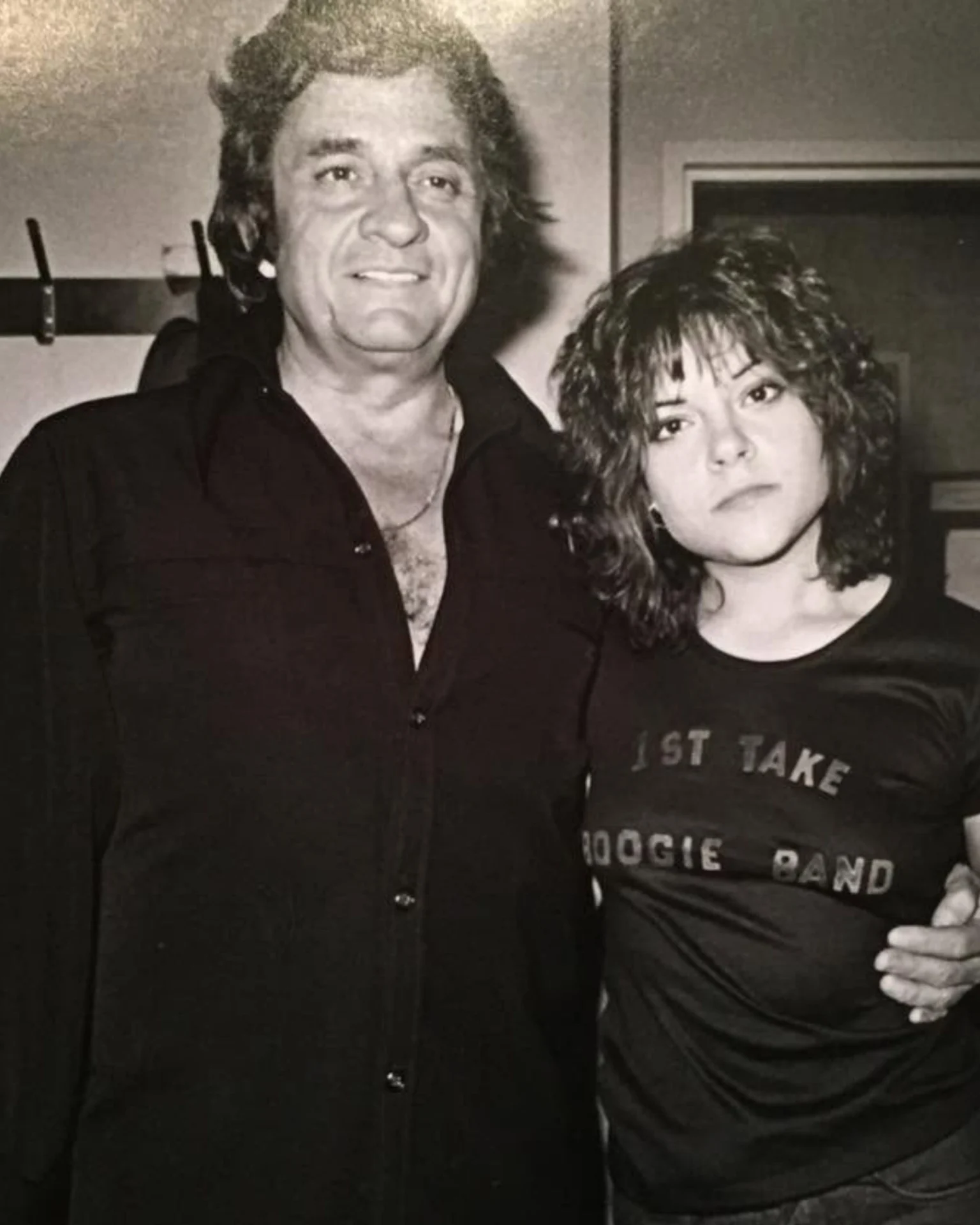
The most important object in this story is not the 2009 CD. It is the original sheet of paper made on a moving bus in 1973. Johnny Cash noticed what his daughter did not know and answered in the form most natural to him, through titles, memories, and a sequence of songs. Rosanne kept the page long enough for instruction to become inheritance.
The hand of Johnny chose one hundred songs.
The life of Rosanne chose the twelve she was finally ready to sing.
The Paper Johnny Cash Left In The Hands Of His Daughter
The tour bus was moving through the South when Johnny Cash discovered a gap in the education of his daughter.
Rosanne Cash was eighteen, recently out of high school and traveling with the road show of her father. He mentioned a song he assumed she knew. She did not. Another title produced the same answer.
Johnny began writing.
By the end of the afternoon, a sheet of paper held one hundred titles. Across the top he placed a heading that sounded less like a casual recommendation than a course of study, 100 Essential Country Songs.
The contents reached beyond country. Appalachian ballads, gospel, Delta blues, folk, and protest songs formed the streams he believed had fed American music. At the end of the day, he handed the page to her and called it her education.
The paper would remain with Rosanne for thirty six years before she was ready to make a record from it.
The Day After High School
Rosanne had grown up primarily with her mother, Vivian Liberto, in California. The Cash marriage had ended under the pressure of prolonged absence, drug use, fame, and the relationship of Johnny with June Carter.
Her father remained a commanding presence, but not an ordinary daily one. He belonged partly to arenas, television screens, recording studios, and the mythology forming around the Man in Black.
After graduating from high school, Rosanne joined his touring company. She initially worked behind the scenes, assisting with wardrobe rather than presenting herself as the next Cash singer.
The arrangement placed father and daughter inside the same moving world. There were costumes to manage, miles to cover, and long intervals when conversation could occur without the ceremony of a reunion.
One such interval produced the list.
The Songs She Had Not Inherited Automatically
The musical upbringing of Rosanne did not mirror her father. She had absorbed the sounds surrounding a Southern California teenager. She later recalled being president of a Beatles fan club.
Rosanne learned many of the songs, then placed the list among her belongings and built a career intent on carrying her own name. Recording the document too quickly would have created the very suspicion she feared, that the daughter of Johnny Cash was using the legacy of her father instead of earning an identity apart from it.
Johnny died in 2003. Vivian Liberto died in 2005. Later that year, while revisiting family material, Rosanne found the list again. By then it no longer felt like an assignment from a famous musician. It was something a father had made for his daughter during an afternoon they happened to have together.
Her husband, musician and producer John Leventhal, encouraged her to record from it. She resisted, then selected twelve songs rather than trying to turn the paper into a museum catalog.
That decision kept The List from becoming a dutiful survey. The album would be shaped by what the songs had become inside her, not by an obligation to preserve every item in the handwriting of Johnny.
Leventhal produced and arranged the sessions, often avoiding the most obvious recorded model. When Rosanne approached Girl from the North Country, for example, the famous duet by Johnny Cash and Bob Dylan stood heavily in the way. Leventhal directed her toward the original version of Dylan, allowing her to enter the song through a different door.
500 Miles became spare and desolate. She’s Got You required Rosanne to sing past the authority of the recording by Patsy Cline. Sea of Heartbreak, performed with Bruce Springsteen, retained the loneliness of the composition without turning into period reenactment.
Other guests included Elvis Costello, Jeff Tweedy, and Rufus Wainwright. Their presence widened the musical conversation in a way consistent with the original selection of Johnny, country as a meeting place rather than a sealed room.
The Father Inside The Record
Johnny Cash did not appear on The List as a ghostly duet assembled from tape. His authority sat one step farther back, inside the act of choosing.
That distance protected the album. Rosanne was not attempting to recreate his voice, and Leventhal was not dressing the sessions in predictable Cash arrangements. The father supplied the syllabus. The daughter decided how the lessons would sound after passing through her own life.
Loss deepened the songs without forcing them all to become songs about grief. Rosanne had also lived through vocal cord problems and brain surgery during the years surrounding the album. Her relationship to singing had grown physical and finite. These old compositions reached her after age and illness had removed any illusion that a voice, a parent, or an opportunity would remain indefinitely available.
The performances carry that knowledge quietly.
What The List Of Rosanne Cash Really Leaves Behind
Had she recorded it at eighteen, the album might have sounded like obedience. Had she recorded it at thirty, it might have been treated as a calculated return to the family name.
At fifty four, after building her own body of work and burying both parents, she could approach it without surrendering herself.