
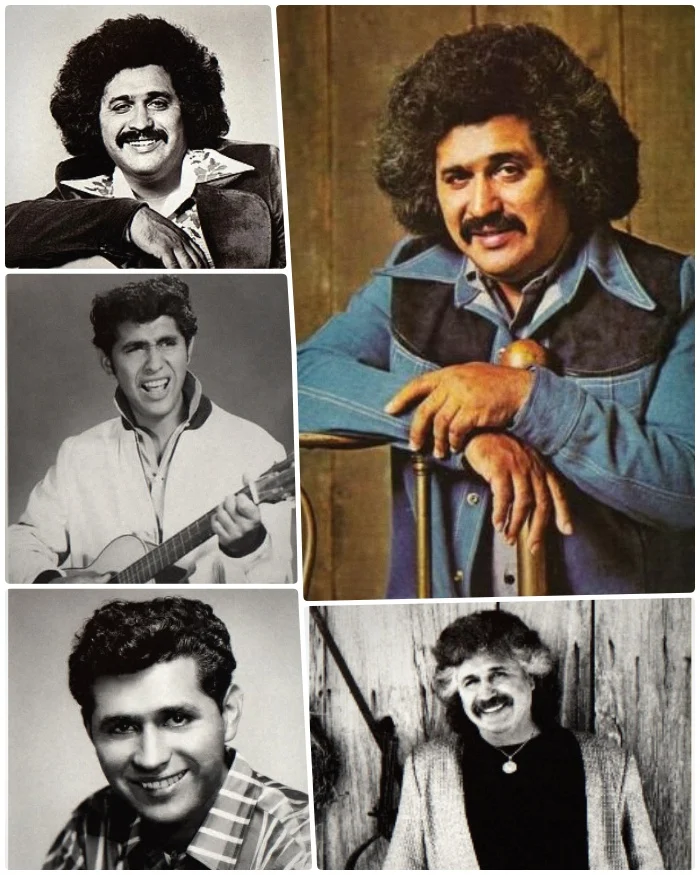
When he was buried back home in San Benito, his birth name was carved larger than his stage name. The black stone monument reads Baldemar Huerta above Freddy Fender, a final reminder that the voice which topped both the country and pop charts began in poverty, in the migrant fields, and at his mother kitchen table.
That voice first earned a prize when he was only ten. Baldemar Huerta stepped up to a radio microphone in Harlingen, Texas, sang the Mexican hit “Paloma Querida,” and carried home a tub of groceries valued at ten dollars for his mother.
A voice raised in the fields could help feed the people who believed in him first
Long before country and pop listeners knew him as Freddy Fender, the boy nicknamed “Balde” grew up in the poor El Cuhamil neighborhood of San Benito. Born on June 4, 1937, to Mexican immigrant Serapio Huerta and Texas-born Margarita Garza, he lost his father at age six. Left to support her children alone, Margarita packed the family onto the backs of flatbed trucks every spring to follow the migrant harvest north.
From the age of ten, Baldemar worked beside his mother and siblings picking sugar beets in Michigan and cucumbers in Ohio and tomatoes in Indiana and cotton in Arkansas before returning to the Rio Grande Valley for the winter citrus season. In the evenings, when food was scarce and the family did not know what the next week would bring, Margarita sang old Mexican love songs to calm her children.
Wanting to play along before he had enough field money for an instrument, the eight-year-old built his own from an empty sardine can and a scrap of wood and stretched wire. Only later could he save nine dollars to buy his first real secondhand Stella guitar. Sitting on labor camp steps after long shifts in the dirt, he practiced chords while listening to Ernest Tubb and Hank Williams on a battery-powered radio and mixed their country phrasing with Valley conjunto and the blues sung by Black farmworkers in the Southern cotton fields.
Even with money tight, his family encouraged his singing. In 1947, they entered the ten-year-old in an amateur contest broadcast over Harlingen station KGBT from the local theater, where his performance of “Paloma Querida” won the first-place prize of a tub of food valued at ten dollars.
The migrant trail still pulled him out of school early. At sixteen, seeking a way out of the fields, Huerta dropped out of high school and enlisted in the U.S. Marine Corps for a three-year hitch. When he returned to the Rio Grande Valley at nineteen, he traded the farm trucks for South Texas dance halls and beer joints and quinceañeras and played gritty rock and roll for working-class crowds.
In 1957, McAllen producer Arnaldo Ramirez signed the twenty-year-old singer to Falcon Records and recorded him cutting a Spanish-language version of Elvis Presley hit “Don’t Be Cruel” titled “No Seas Cruel” along with a Spanish translation of Harry Belafonte song “Jamaica Farewell.” The records turned him into a regional sensation across Texas and Mexico under the billing “El Bebop Kid” and another early stage name, Scotty Wayne.
By 1958, hoping to cross over to English-speaking radio audiences while moving to California, he looked at the trademark stamped across the headstock of his electric guitar and amplifier and chose the surname Fender. He paired it with the first name Freddy simply because he liked how the two Fs sounded together and joked that the name would sell better outside the Valley.
A year later, in 1959, he wrote and recorded the bluesy swamp-pop ballad “Wasted Days and Wasted Nights” for Duncan Records. The single began climbing the national charts until a 1960 marijuana arrest in Baton Rouge sent him to Louisiana Angola State Penitentiary for nearly three years and halted his momentum for more than a decade.
After Governor Jimmie Davis, himself a country songwriter, signed off on his parole, Fender worked as a mechanic in Corpus Christi and took weekend club gigs while attending Del Mar College. Producer Huey P. Meaux eventually persuaded him back into a Houston studio in 1974 to cut “Before the Next Teardrop Falls” half in English and half in Spanish.
When the record reached number one on both the Billboard country and pop charts in 1975, followed by a re-recorded version of “Wasted Days and Wasted Nights,” the thirty-eight-year-old singer brought the language of his mother kitchen straight onto national radio.
Five decades after that first ten-dollar radio prize in Harlingen, he recorded the 2002 solo album that finally won him his own individual Grammy Award with a quiet collection of classic Mexican boleros titled La Música de Baldemar Huerta. He died on October 14, 2006, at age 69 and was buried back home in San Benito beneath that black stone monument where his birth name, Baldemar Huerta, was carved in letters larger than Freddy Fender.