
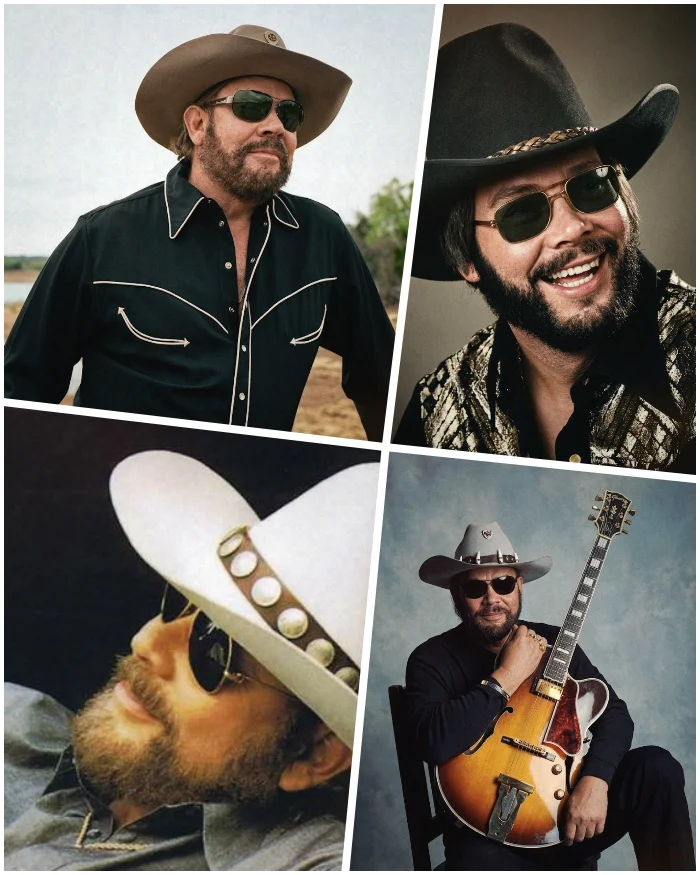
On August 8, 1975, Hank Williams Jr. stood on a snowfield near Montana’s Ajax Peak, unaware that within seconds his life would be shattered and remade. The 26-year-old, already burdened by the ghost of his legendary father, was about to experience a fall that would strip away his past and forge a new identity.
Born Randall Hank Williams, he had been pushed onto stages since age eight, singing his late father’s songs in tailored suits, a voice not truly his own. His mother, Audrey Williams, and Nashville promoters had crafted him as a tribute act, but beneath the surface, he was drowning. Earlier that year, after a suicide attempt and years of heavy drinking, he’d fled to Alabama to record with Southern rock musicians, seeking an escape from the machine that had consumed him. The trip with his friend Dick Willey to the Montana-Idaho border was meant to clear his head.
Near the nine-thousand-foot mark on the Continental Divide, the snow crust beneath his boots gave way. He plummeted nearly 500 feet down a jagged slope of snow and granite, crashing face-first into a boulder at the bottom. The impact split his face from forehead to chin: skull fractured, nose and teeth sheared away, eye sockets shattered, jaws broken into fragments.
Miraculously, Hank Jr. remained conscious in the freezing snow for over two hours while Willey hiked for help and guided a U.S. Forest Service helicopter into the narrow basin.
Air-lifted to St. Patrick Hospital in Missoula, Montana, he underwent more than seven hours of emergency surgery just to stabilize his airway and close his cranial cavity. Doctors gave him slim odds of surviving the first 48 hours due to brain swelling and meningitis risk.
During those darkest weeks in the ICU, his godfather Johnny Cash and June Carter Cash flew to his bedside. Unable to speak through his wired jaw and tracheotomy tube, he communicated by scribbling notes and blinking. When Cash leaned close and told him the trials had to make him stronger rather than bitter, Hank Jr. squeezed his hand in silent agreement.
The next two years brought seventeen separate reconstructive operations. Surgeons used bone grafts from his ribs and hip to rebuild his nasal bridge, reconstructed his cheekbones with wire and synthetic plates, and realigned his crushed palate. For months, he lived on liquid meals through a straw.
When the wires finally came out, the physical recovery transitioned into vocal rehabilitation. His altered facial structure and scar tissue had changed his resonance and tongue placement. A professional recording artist since childhood, he had to relearn basic consonants, breath control, and projecting single notes without slurring, sitting with speech therapists and practicing alone at home.
When he finally returned to the public eye, the clean-shaven young man who resembled Hank Williams Sr. was gone. His left eye sat slightly misaligned, a deep vertical scar ran down his forehead, and his jawline was asymmetrical. To avoid stares at his surgical grafts, he grew a full beard, wore dark prescription sunglasses to shield his reconstructed eye sockets, and pulled a black cowboy hat low over his brow.
That protective armor coincided with a total artistic breakthrough. Freed from his father’s physical shadow, he fully embraced the blues-heavy, rock-infused sound he had begun exploring before the fall. Between 1979 and the mid-1980s, he released a historic string of platinum albums, won five consecutive Entertainer of the Year trophies, and turned his surgical camouflage into the most recognizable silhouette in modern country music.
The mountain that nearly killed him also gave him his freedom. Hank Williams Jr. rose from the rocks not just with a new face, but with a new voice—and a legend that was entirely his own.