
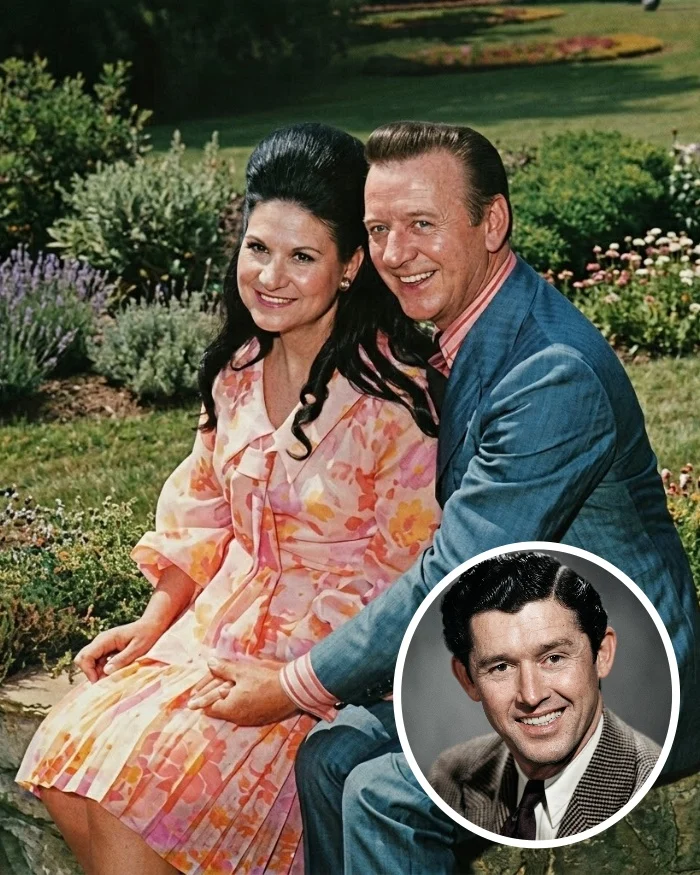
Long before the applause faded, a shy wife from Nashville became the most powerful voice country music had ever heard from a woman, and the man standing proudly in the wings was the husband who had refused to let the industry push her aside.
In the late 1940s, while touring the American South, Grand Ole Opry star Roy Acuff gave Johnnie Wright a blunt warning about his wife.
A woman could never headline a country tour or sell records on her own.
At that time Nashville ran on an unwritten rule that kept women in the background as harmony singers or brief novelty acts in a family band, and many powerful voices agreed with Acuff.
Born Ellen Muriel Deason in Nashville, she had married Wright on October 30, 1937, when he was an eighteen-year-old cabinetmaker dreaming of a life in radio. As he built a regional following with his singing partner Jack Anglin in the duo Johnnie and Jack, she often wanted to step away from the stage and devote herself to raising their three children Ruby, Bobby and Carol Sue.
Wright saw something greater in her voice. While they appeared on Knoxville station WNOX in 1943, he gave her the stage name Kitty Wells, inspired by the nineteenth-century folk ballad Sweet Kitty Wells.
Through the late 1940s, as the troupe moved between radio stations in Raleigh, North Carolina, Decatur, Georgia, and the Louisiana Hayride in Shreveport, Wright insisted that his wife receive her own featured solo spot every night. He pushed promoters to bill her as a standalone artist rather than an accessory to a male band, even after RCA Victor dropped her from its roster in 1950 and peers told him that female singers could not draw ticket buyers.
His conviction changed everything in the spring of 1952, when Decca Records producer Paul Cohen called looking for a woman to record ‘It Wasn’t God Who Made Honky Tonk Angels.’ Wright persuaded his shy wife to take the session for the union scale fee. Within weeks of its release in May 1952, the record knocked Hank Thompson out of the number-one spot on the Billboard country chart and sold more than 800,000 copies, instantly making Wells a bigger commercial draw than Johnnie and Jack and the first solo woman to reach the top of that chart.
In an era when many male performers bristled at being outshone by their wives, Wright did the opposite. He stepped in as her full-time business manager, merged Johnnie and Jack’s road schedule with hers and rebranded their traveling troupe so Wells took top billing on theater marquees across North America. Rather than signing with a corporate Nashville management firm, he handled the contracts, tour routing and nightly box-office settlements himself, and over the next five decades he managed her as the highest-paid female headliner of her era.
By 1955, only three years after her breakthrough, Wright and Anglin stood side by side with Acuff at New York’s RKO Palace Theatre on Broadway, on a bill where both Kitty Wells and their teenage daughter Ruby Wright performed as featured artists.
Tragedy struck on March 7, 1963, when Anglin died in a car crash on his way to the memorial service for Patsy Cline. Wright had lost a musical partner of more than twenty years, yet he refused to retire from the road. Instead he combined his band, the Tennessee Mountain Boys, with his wife’s backing musicians and continued touring with her for more than 250 days a year.
Wright scored a number-one hit of his own in 1965 with the Vietnam War ballad ‘Hello Vietnam,’ and the couple used that joint momentum to expand their family business. In 1968 they recorded their first duet album for Decca, ‘We’ll Stick Together,’ and launched ‘The Kitty Wells and Johnnie Wright Family Show,’ one of the earliest syndicated country television programs to feature a woman as co-host and co-headliner.
On the half-hour weekly broadcast and on stage, Wright turned the act into a multi-generational enterprise, bringing their son Bobby, known to television viewers from ‘McHale’s Navy,’ and daughters Ruby and Carol Sue onto the bill.
In 1974 Wright founded Ruboca Records, an independent label named by combining the first two letters of Ruby, Bobby and Carol, so Wells could keep recording on her own schedule after leaving Decca. Two years later, in 1976, he accompanied his wife as she was inducted into the Country Music Hall of Fame, and in 1983 the couple opened the Family Country Junction Museum and Studio near their home in Madison, Tennessee.
Between tours, Wright and Wells often greeted fans personally inside the museum, where they displayed her stage dresses, gold records and vintage touring cars while their grandson, John Sturdivant Jr., operated the adjacent recording studio.
The couple finally retired from the road after a New Year’s Eve performance on December 31, 2000, closing out more than sixty years of shared concerts. Wright remained at their Madison home alongside the singer he had pushed to the center microphone until his death on September 27, 2011, at age 97, ten months before Wells passed away on July 16, 2012, ending a nearly 74-year marriage built on belief, loyalty and a voice Nashville once tried to silence.