
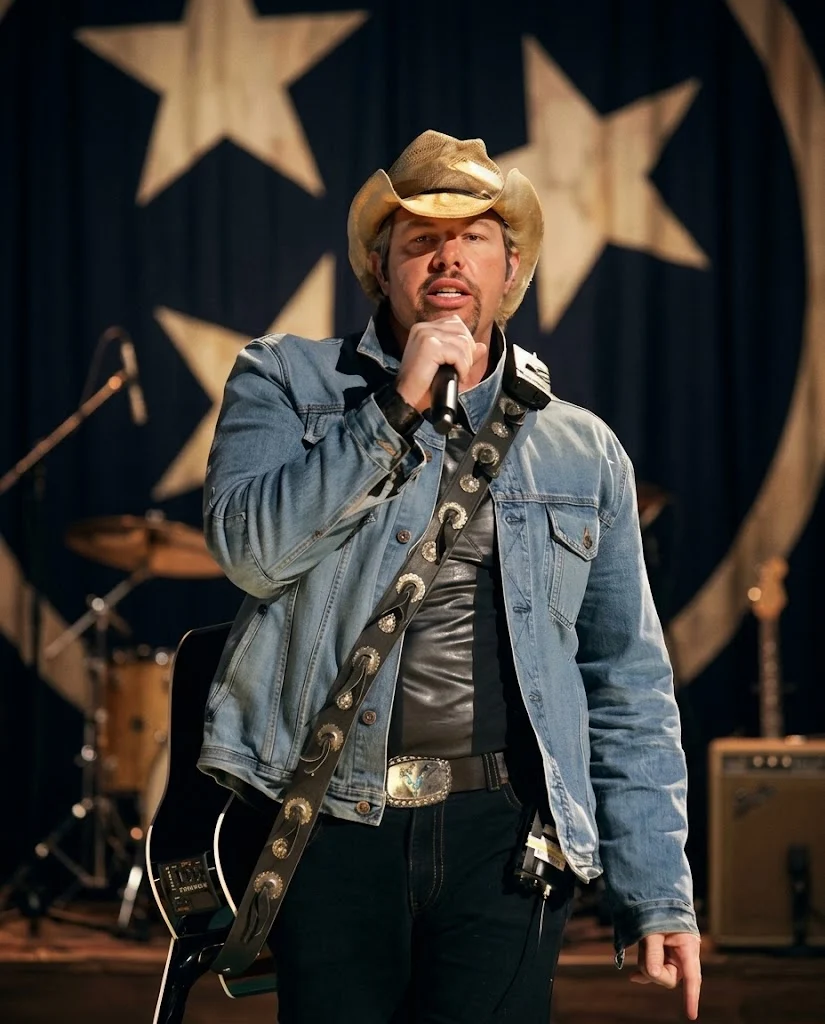
Toby Keith once stood in a smoky honky tonk and wondered whether chasing music would cost his family everything. That fear became fuel.
Before Nashville knew his name, the Oklahoma oil industry that had supported him collapsed in the 1980s. Steady paychecks disappeared. He turned to his local band Easy Money and brutal semi-pro football stints with the Oklahoma City Drillers just to keep his young family fed.
For nearly a decade he did not perform in arenas. He played beer-soaked bars across Texas and Oklahoma and sang to indifferent patrons while learning how to command a room. Nights blurred into cheap motel ceilings and the struggling engine of a beat-up van. He wrestled with the quiet dread that his dream might be stealing his wife and children their future.
He did not begin as a superstar. He began as a man who refused to quit while the world kept saying no.
He used hard-earned savings to record demo tapes and knocked on doors across Music City. Nashville answered with rejection. Executives told him his booming voice and traditional-leaning sound did not fit a polished country radio market. They told him to pack up his guitar and return to the oil fields.
Every refusal stung. Every dismissal made him harder. His songs were not polished in comfortable writing rooms. They were forged from oil stains, crumpled dollar bills, exhausted highway nights, and a blue-collar refusal to disappear.
One cassette passed across a crowded airline seat changed everything.
That grit eventually reached a commercial flight. A flight attendant who was a fan of his band handed his demo tape directly to Harold Shedd, an executive at Mercury Records. Shedd listened on the plane and heard a raw conviction the other labels had missed.
Intrigued by the commanding baritone, Shedd traveled to see Keith perform live in his home state. The undeniable energy of that show led to a 1993 recording contract. Keith knew exactly which song should introduce him to the world.
He debuted with Should’ve Been a Cowboy, a track he had written entirely by himself in a motel bathroom in Dodge City, Kansas. The song became a cultural phenomenon and went on to be the most-played country song of the entire 1990s.
From that moment he built his empire on his own terms. He wrote his own songs, controlled his own masters, and launched his own label so no executive could ever tell him no again. Even as stadiums filled around the world and he became a towering figure of American patriotism, the man onstage remained the roughneck who once played for tips in Oklahoma dive bars.
The oil fields taught him how to work. The empty bars taught him how to fight.
His voice was once rejected by Music City. Today it echoes through the American heartland and reminds every dreamer that the deepest empires are often built from the hardest beginnings.