
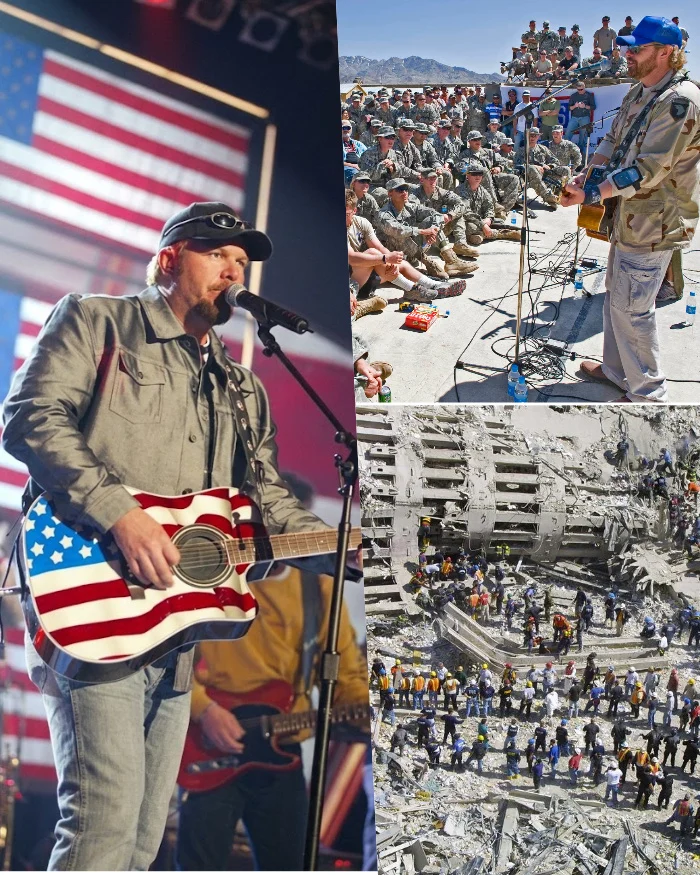
One crumpled sheet of fantasy football paper became the unlikely birthplace of a song that carried a grieving son’s private sorrow into a wounded nation.
Toby Keith lost his father six months before the September 11 attacks. His father, H.K. Covel, had served in the Army and lost his right eye while doing so. He was the kind of man who raised the American flag at their Oklahoma home with steady devotion. When that flag continued to fly after his death, the sight carried a weight that never fully lifted.
On a Tuesday morning in the fall of 2001, Keith sat alone and checked sports statistics as he normally would. The routine collapsed as the news from New York and Washington unfolded. In that stunned silence, he reached for the closest thing he could find, a discarded sheet meant for a fantasy football draft, and pressed a pen hard against it.
The words that came out were not shaped for Nashville. They came from a son’s heartbreak, a father’s military pride, and a country suddenly exposed to fear. Keith poured his unresolved grief into a fierce tribute to service, resilience, and defense. The song became a protective cry from a man watching his homeland under threat.
Because the feeling was so personal, Keith kept the music away from the industry. He believed the lyrics were too raw and too uncompromising for ordinary radio. For a long time, the song lived only in his hands and on his voice, not in studios or boardrooms.
He took it instead to the people he felt most needed to hear it. During tours run by the United Service Organizations, he stood on makeshift stages in austere military settings and sang the verses with only an acoustic guitar. There was no polished production, no commercial distance, and no hiding the emotion behind studio effects.
The soldiers responded with a force that changed everything. They approached him after performances and made clear that the song reflected their own resolve. Their reaction showed Keith that the piece had moved beyond private mourning and become a public need.
The decisive moment arrived through General James L. Jones, Commandant of the Marine Corps. He heard the song during one of those raw overseas performances and watched its effect on the troops. He then told Keith that it was his duty as an American citizen to record it and share it with the nation.
He told Keith it was his duty as an American citizen to record the song and share it with the nation.
That conversation convinced Keith to release the music. He finally brought it into a studio, keeping the fierce energy that had struck the troops. The song then spread far beyond military bases, echoing from porches to stadiums and giving voice to a country still struggling to understand its pain.
Yet the anthem never left its emotional root. It began as a son speaking for a veteran father who could no longer see the flag flying in his yard. A quiet Tuesday morning, a crumpled scrap of paper, and a heavy heart became a lasting monument.