
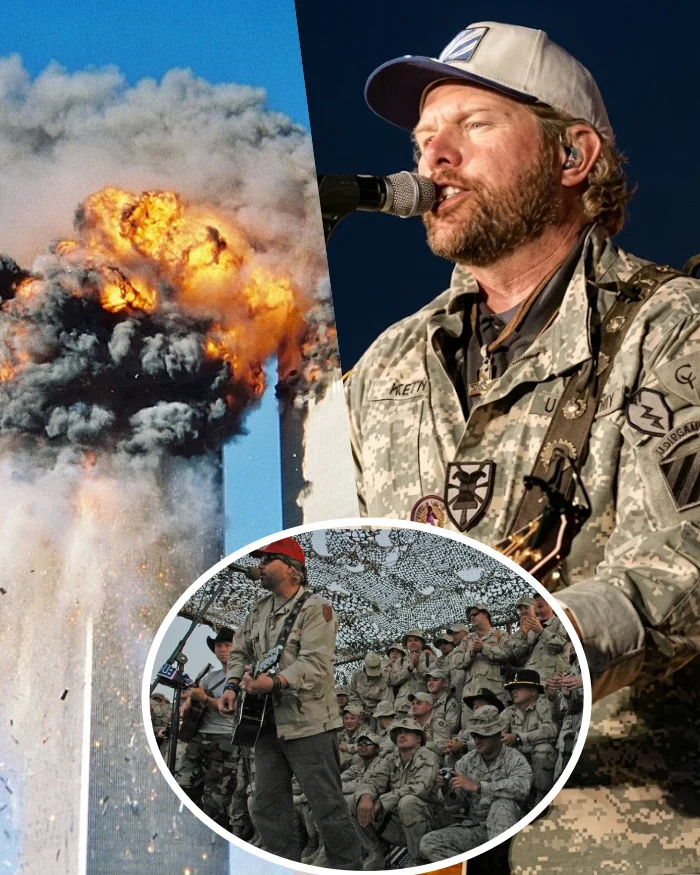
On the eve of a holiday meant for fireworks and family, a country star was pulled from a national television stage because his song felt too raw for a polished broadcast.
In the summer of 2002, Toby Keith was invited to perform on an ABC Independence Day special. The appearance looked routine until veteran news anchor Peter Jennings objected to the planned track. Network executives called the post-9/11 anthem too aggressive for a family-friendly holiday show.
They gave Keith an ultimatum. He could soften the lyrics or choose another song. He refused to change a single word.
The track was Courtesy of the Red, White and Blue. It had been written in twenty minutes on the back of a fantasy football sheet. Keith created it as a private tribute to his father, Hubert Keith Covel, a United States Army veteran. He had sung it in tears after personal loss and national grief collided after September 11. He never meant it as a political statement.
He chose honesty over exposure.
ABC wanted a holiday-friendly moment. Keith wanted to protect a message from his family and his country. He walked away from the massive platform.
The rejection turned into a cultural flashpoint. Millions of working-class Americans still processing the trauma of a shattered era rallied behind his refusal. The public backlash pushed his next album, Unleashed, to number one on the Billboard 200. It later reached multi-platinum status.
The song almost never existed as a commercial recording. Keith first wrote it for acoustic USO shows for deployed military personnel. General James L. Jones, Commandant of the Marine Corps, heard him perform it and pulled him aside.
He told Keith it was his duty as an American citizen to record the song.
That charge from a military leader changed the path of the anthem. Keith took it into the studio. His loyalty stayed with service members, not television executives.
The 2002 broadcast dispute became part of modern country music history. It showed how a private tribute could become a public anchor for a vulnerable nation.