
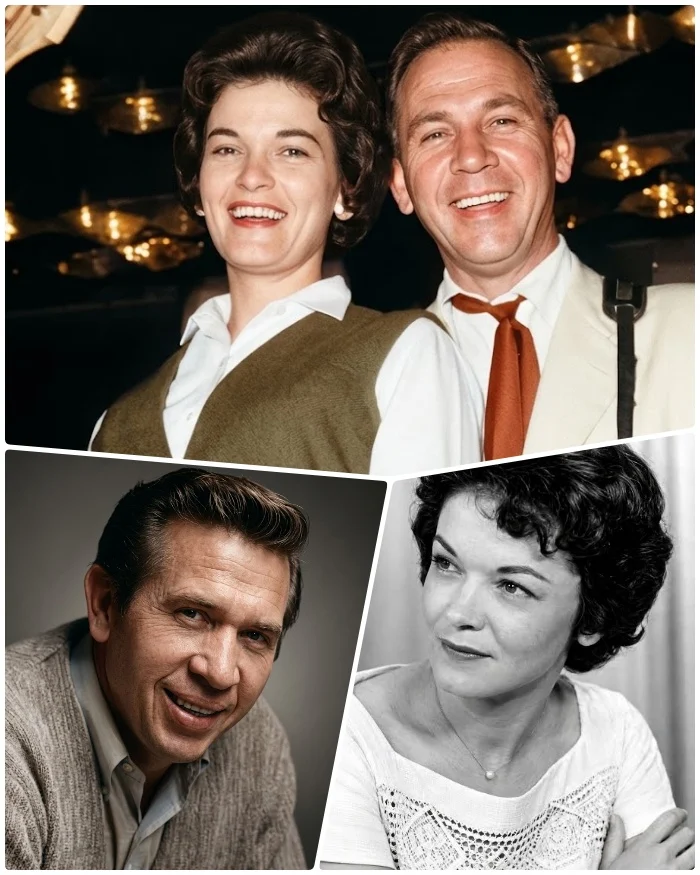
On a spring night in 2006, Buck Owens walked off the stage at his Crystal Palace in Bakersfield after one more performance, went home, and died in his sleep at seventy-six. Less than a month later, on April 17, Bonnie Owens died at seventy-six in a Bakersfield hospice, with their sons Buddy Alan and Mike standing beside her to the end. Their story did not begin with fame or fortune. It began with two teenagers who were too poor to pay for a divorce and too devoted to their children to ever truly walk away from each other.
They could not afford to end their marriage, so they built a family that never really ended.
Both had grown up in Dust Bowl families that left Texas and Oklahoma and headed west to pick cotton under the Arizona sun. They met at a local roller rink and soon performed together on KTYL radio, and on July 1, 1948, the two eighteen-year-olds married in Mesa, Arizona. Within three years they had two sons, Buddy Alan in 1948 and Mike in 1950.
By day Bonnie waited tables at roadside diners while caring for the babies. By night the young couple played noisy taverns until closing time for enough spare change to buy milk. Poverty wore them down, and Buck felt pulled toward a music career that Arizona could not give him.
In 1951 they agreed to part ways, only to discover that neither of them could scrape together the few dozen dollars needed to pay the courthouse filing fee. Buck moved alone to Bakersfield, California, that year to find steady studio and club work. For two full years they lived completely separate lives while remaining legally married on paper, until they finally saved enough money to finalize the divorce in 1953.
Bonnie held no bitterness. After raising the two boys on her own during the separation, she packed them up in Arizona in 1953 and followed Buck to Bakersfield. She took a job serving drinks and singing at the Blackboard nightclub so Buddy Alan and Mike could grow up down the road from their father.
Once settled in Bakersfield, both parents helped build the raw and electric honky-tonk style that became known as the Bakersfield Sound. Buck played lead guitar in Tommy Collins’s band and backed Capitol Records sessions in Los Angeles before forming the Buckaroos. Bonnie worked shifts at the Blackboard, jotting down song ideas on cocktail napkins and recording early regional singles such as ‘A Dear John Letter’ with Fuzzy Owen on Mar-Vel Records.
At the start of the 1960s, Fuzzy Owen and his cousin Lewis Talley launched Tally Records in Bakersfield and signed both Bonnie and a former San Quentin inmate from neighboring Oildale named Merle Haggard. After Haggard spent a brief stint playing bass in Buck’s band, where teenage Buddy Alan also sat in on drums, Bonnie and Haggard recorded their 1964 duet ‘Just Between the Two of Us’. That record stayed on the country charts for more than six months and won Vocal Group of the Year at the inaugural Academy of Country Music Awards.
On June 28, 1965, Bonnie and Haggard married. That same year Capitol Records released her solo album ‘Don’t Take Advantage of Me’ and the Academy of Country Music voted her its first Female Vocalist of the Year. During those same years, Buck Owens and His Buckaroos, driven by Don Rich’s Telecaster and high harmony, scored twenty-one number-one country hits beginning with 1963’s ‘Act Naturally’, turning Bakersfield into a national recording center alongside Haggard’s band, the Strangers. Even as Buck and Haggard competed at the top of the charts, the two men and Bonnie raised Buddy Alan and Mike without friction.
Before Buddy Alan turned twenty, he toured on the road with Haggard and Bonnie as a member of the Strangers. He then signed with Capitol Records in 1968 and joined his father’s Buckaroos. That year he charted his debut Top 10 single, ‘Let the World Keep On a Turnin’, recorded as a duet with Buck, and later won the Academy of Country Music’s Most Promising Male Vocalist award while appearing regularly alongside his father on ‘The Buck Owens Ranch Show’ and ‘Hee Haw’.
By the mid-1970s, Bonnie stepped back from her solo recording career to tour full-time as a harmony singer in the Strangers and co-wrote Haggard’s 1974 number-one hit ‘Old Man from the Mountain’. When she and Haggard divorced in 1978, she kept her microphone on his stage for another twenty years and served as maid of honor at his next wedding.
Across five decades in Kern County, the family circle that began in Arizona taverns remained intact through holiday dinners, shared concert bills, and shows at Buck’s Crystal Palace theater in Bakersfield. It was a bond forged in hardship, tested by divorce and remarriage, and held together by music and by two sons who never had to choose between their parents.