
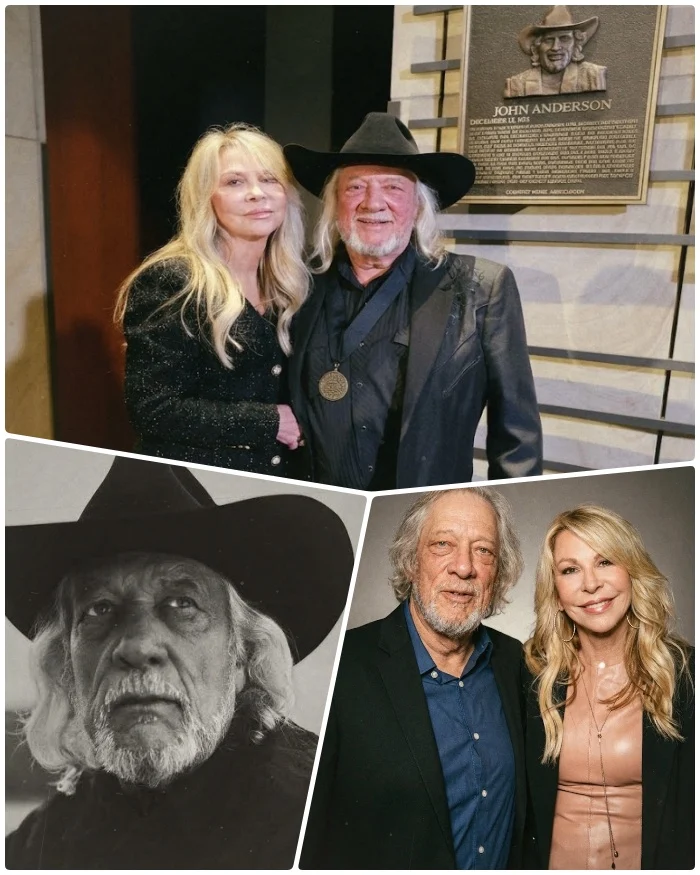
He had waited a lifetime for that medallion, but when John Anderson finally reached the microphone inside Nashville’s CMA Theater, he did not look at the bronze plaque or the cheering crowd first. He looked down at the front row, at the woman who had kept their home and his heart intact when the music business had walked away.
Only two days earlier, on October 18, 2024, John and Jamie Anderson had marked forty-one years of marriage. On October 20, 2024, that love story stepped into the spotlight as Anderson was inducted into the Country Music Hall of Fame in the Modern Era Artist category, joining the 2024 class alongside the late Toby Keith and veteran guitarist James Burton.
Before the honor was bestowed, the stage filled with the sound that had helped rescue traditional country in the early 1980s. Brothers Osborne and Carly Pearce joined songwriter Shawn Camp to sing from Anderson’s catalog, including the enduring standards “Wild and Blue” and “Swingin’”, a reminder of the unmistakable phrasing that made him a neotraditional pioneer.
Longtime friend and fellow Hall of Fame member Bobby Bare then stepped forward to present the official medallion. It was a full-circle moment for a singer who had arrived in Nashville from Apopka, Florida, in the early 1970s and once worked as a roofer on the Grand Ole Opry House while chasing a recording contract.
Just below the stage sat Jamie, whom Anderson married on October 18, 1983, along with their two daughters, Tasha and Brianna, and their grandchildren. As the sixty-nine-year-old singer began to speak, the weathered baritone behind more than forty charted singles caught in his throat, and he paused to steady himself.
Instead of lingering on platinum plaques, Anderson turned his speech toward the hardest chapter of their life together. When he and Jamie married in the autumn of 1983, “Swingin’” had just become the biggest-selling single in the history of Warner Bros. Records and had earned him the CMA Horizon Award and Single of the Year. Within months, shifting tastes and a punishing schedule of two hundred road dates a year began to take a heavy toll.
Between 1984 and 1990, radio stopped playing his singles and Warner Bros. eventually parted ways with him. While the fast living and temptations that surrounded road musicians in the 1980s closed in, Jamie held their quiet home together sixty miles east of Nashville in Smithville, Tennessee, and held their family together too.
She kept me from going over the edge.
Anderson did not abandon traditional country or surrender to the frustration of lost label deals. He leaned on the stability of his Smithville farm and kept recording on smaller labels until producer James Stroud brought him to BNA Records in 1991. That persistence roared back across 1992 and 1993, when “Straight Tequila Night”, “Seminole Wind”, and “Money in the Bank” carried him straight back to the top of the Billboard charts and proved a traditional singer could survive a decade in the wilderness.
Even after severe medical complications and inner-ear issues forced him off the road in 2017 and 2018, that same family anchor carried him back into the studio with Dan Auerbach and David Ferguson for his acclaimed 2020 album Years. By the night of his induction, his recovery and his career had come full circle in front of the family who had guarded both.
Near the edge of the stage, Jamie wiped away tears as Nashville songwriters, musicians, and executives rose for a prolonged standing ovation. The bronze plaque in the rotunda permanently secured John Anderson’s place in country music history, but the look he shared with the front row reminded everyone in the room who had kept him standing long enough to receive it.