
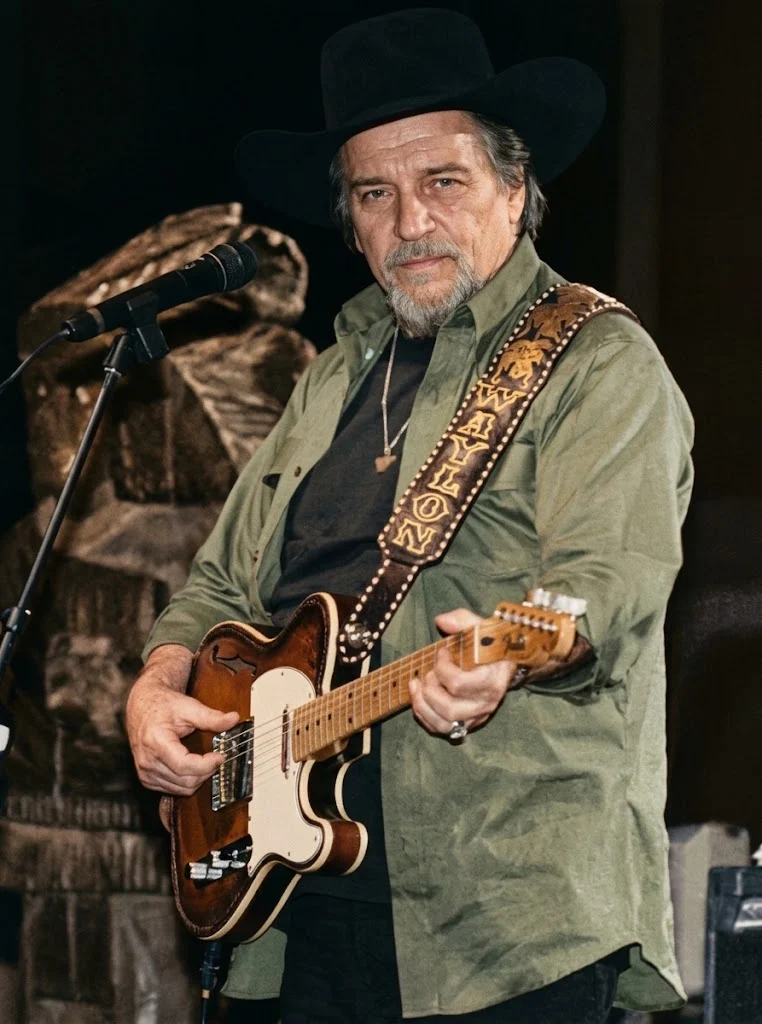
The snow-covered Iowa cornfield swallowed the plane before dawn on February 3, 1959 and left a twenty-one-year-old bass player carrying a silence heavier than grief.
Waylon Jennings had given his seat to J.P. Richardson, known as The Big Bopper, because Richardson was sick with the flu. Buddy Holly had chartered the aircraft after a brutal Winter Dance Party tour through the frozen Midwest. At the Surf Ballroom in Clear Lake, Iowa Holly teased Jennings about riding the bus. Jennings answered with a careless joke.
I hope your old plane crashes
The joke landed like a curse hours later when the plane went down and took Holly, Richardson, and Ritchie Valens. The world called it The Day The Music Died. Jennings called it a wound that refused to close.
He did not chase fame in the aftermath. He fled the stage. He returned to Texas and worked as a disc jockey in Lubbock, then moved to Kool Radio in Phoenix. The microphone became a shield. He spun records behind glass and let broadcast signals keep him away from live crowds.
He stopped playing bass. He stopped searching for a band. Survivor guilt held him down while the music industry kept moving forward. Yet the sound Holly had once heard in him kept pulling him back toward the stage.
By the early 1960s Waylon Jennings formed The Waylors and took a residency at J.D.’s, a sprawling two-story club in Phoenix. He played for cowboys and college students under club lights. He fused traditional country with the raw drive of early rock and roll and poured his lingering grief into a gritty unapologetic rhythm.
Singer Bobby Bare heard a generational voice in that voice. Bare immediately called RCA Victor executive Chet Atkins. The call set in motion a 1965 record deal that brought Jennings to Nashville.
Music City nearly broke him again. The Nashville establishment operated like a polished assembly line. Studio executives refused to let Jennings use his own road band and forced him to record with session musicians. Sweet strings and background choirs covered his raw edge. Behind closed studio doors the fight was relentless. Jennings clashed with producers who tried to dictate his phrasing. He stormed out of recording sessions when compromise threatened the song.
The defiance reached a breaking point in 1972. Exhausted by corporate control, Jennings demanded and won total creative control. He could use his own band and produce his own records. That victory shattered the Nashville mold and helped birth Outlaw Country.
The fight was never only about sound. Buddy Holly had produced his own music and fought for his own sound. Jennings felt he owed his survival to that example. He carried Holly’s memory into every studio battle, every contract dispute, and onto every stadium stage.
Waylon Jennings did not merely survive the day the music died. He made sure the industry heard exactly what he had lived to say.