
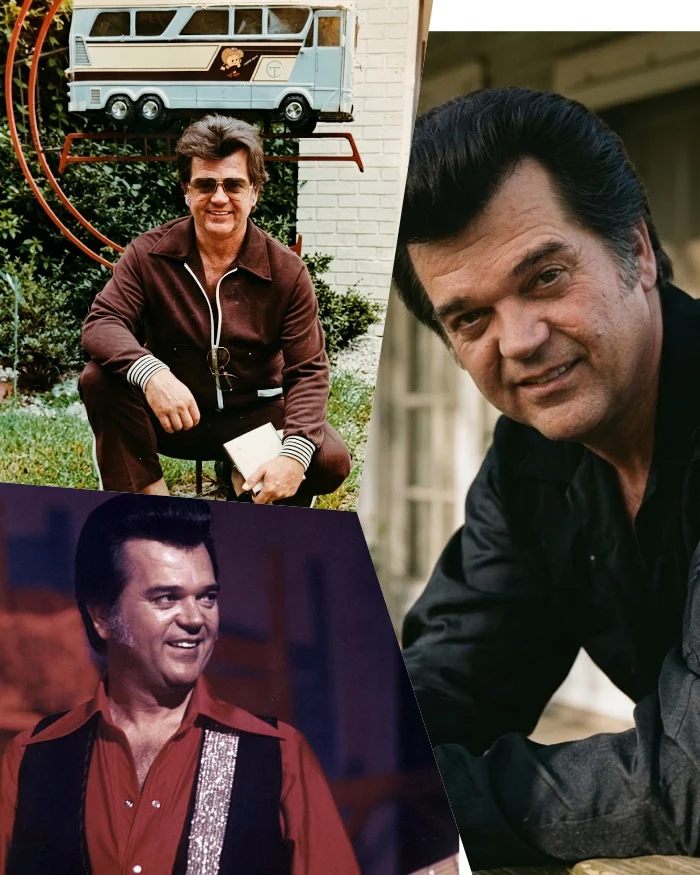
In the summer of 1965, Conway Twitty made a decision that would cost him a fortune but ultimately define his legacy. Walking off the stage at Tony Mart’s nightclub in Somers Point, New Jersey, the 32-year-old rock and roll sensation quit his lucrative career on the spot, forfeiting thousands of dollars in bookings to pursue the music his father had always believed in.
For nearly eight years after his 1958 chart-topper It’s Only Make Believe, Twitty had been living a double life. Behind the pompadour and flashy stage suits, the man born Harold Lloyd Jenkins felt like a performer playing a role that wasn’t his own. Every night, he stepped up to the microphone in front of rowdy resort crowds, but his heart was elsewhere.
“I felt like an actor every time I went out there,” Twitty later confessed, revealing the deep disconnect he felt from the music that had made him famous.
His true musical education had begun years earlier, sitting beside his father Floyd Jenkins, a Mississippi River ferryboat pilot, listening to Saturday night broadcasts of the Grand Ole Opry in their homes in Friars Point, Mississippi, and Helena, Arkansas. Throughout his pop stardom, his father had repeatedly asked him the same question: when was he going to record the real country music they both loved?
After Floyd Jenkins passed away without hearing that promise fulfilled, the noise of the New Jersey beach club became unbearable. Twitty walked off the stage, told club owner Anthony Martucci he was quitting rock music immediately, and accepted a 70 to 80 percent drop in pay while supporting his wife Mickey and their four children.
He moved his family to Oklahoma City, where he and faithful bandmates like drummer Tommy Markham and bassist Joe E. Lewis traded East Coast showrooms for concrete-floor honky-tonks across the Southwest. Booking agents who had once eagerly hired him as a pop headliner refused to guarantee country dates, forcing the band to drive hundreds of miles between low-paying clubs. Twitty reshaped his band, the Lonely Blue Boys, adding prominent pedal steel guitar and learning how to pace a three-hour set for working-class couples.
Word of his commitment reached Nashville, where veteran Decca Records producer Owen Bradley—who had guided Patsy Cline, Ernest Tubb, and Loretta Lynn—agreed to audition him. Bradley recognized that Twitty’s baritone carried natural warmth beneath the aggressive rockabilly phrasing he had used at Sun Records and MGM.
Inside Bradley’s Barn and the Decca studios, Bradley coached Twitty to abandon the loud teen-idol delivery. He instructed the singer to lower his volume, slow his phrasing, and deliver each line quietly, as if speaking across a kitchen table to a single listener.
But even with Decca Records behind him, country radio programmers treated the former pop star as an outsider. When his first Decca country singles came out in 1966, dozens of station managers refused to play them.
Twitty responded by loading boxes of vinyl 45s into his car and visiting rural radio stations across the Midwest and South. A performer who had once appeared on national television for Dick Clark sat on wooden benches in small station hallways, waiting hours for five minutes with skeptical disc jockeys so he could sing live in their offices.
Slowly, those personal visits turned into regional airplay. Working alongside steel guitarist John Hughey, who joined the band in 1968, Twitty climbed into the top five that spring with The Image of Me.
In the autumn of 1968, three full years after he walked off the stage in Somers Point, his recording of Next in Line reached number one on the Billboard country chart. The breakthrough opened a run of forty number-one country hits, fulfilled the wish Floyd Jenkins had voiced years earlier, and proved that the quiet voice Owen Bradley uncovered in Nashville had been worth every mile of those three lean years on the road.