
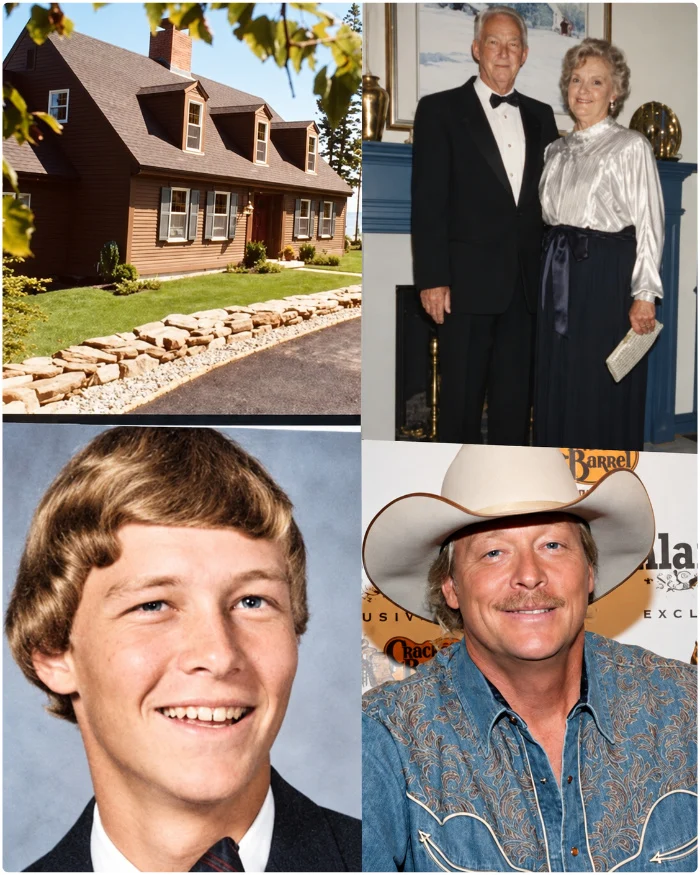
In the heart of Newnan, Georgia, a small wooden tool shed became the unlikely foundation of a country music legend’s life. Alan Jackson, born in 1958, grew up in a patchwork home that started as a 12-by-10-foot shed, rolled onto family land by his grandfather. It was a house built not with blueprints, but with love, salvaged lumber, and the unwavering determination of his parents, Joseph Eugene “Daddy Gene” and Ruth “Mama Ruth” Jackson.
Daddy Gene worked tirelessly as a mechanic, first at a paper-box plant and later at a Ford assembly line, while Mama Ruth raised their five children with warmth and resilience. As the family expanded, so did the house—room by room, wall by wall—until the humble shed cradled all seven Jacksons. Despite the cramped quarters and the elements that seeped through the wood seams, the home was filled with comfort, gospel hymns, and the aroma of Mama Ruth’s cornbread.
Young Alan slept in a hallway bed, unaware of the family’s financial struggles. His parents shielded him from hardship, surrounding him with love rather than lack. This profound sense of belonging and resilience became the soul of his music. In the 1980s, when Jackson moved to Nashville, he carried his family’s story with him, pouring it into songs like “Home” and “Chasin’ That Neon Rainbow.”
“I never realized we were poor,” Jackson later reflected. “My parents made sure we never felt short on love.”
In 1990, “Home” was released on his debut album, and though it initially served as a B-side, its heartfelt narrative of a tool shed turned home resonated deeply with listeners. Six years later, it became an official single, climbing to number three on the Billboard country charts and etching the Jackson family’s story into country music history.
Even after Daddy Gene’s passing in 2000 and Alan’s meteoric rise to multi-platinum fame, Mama Ruth remained in the house her husband built, rooted in the memories of their life together. In 2012, the family preserved the structure, moving it to the Oak Hill and The Martha Berry Museum area in Newnan—a testament to the humble beginnings that shaped a superstar.
The 12-by-10 tool shed that Daddy Gene expanded board by board for his wife and five children stands today as a monument not just to a country music icon, but to the enduring power of family, hard work, and the belief that love can build a home out of anything.